What should you look for when choosing?
First compare the nutritional information with the portion you actually eat. Then check that the ingredients and form are suitable for the people who’ll be eating them.
| What to consider |
What should you look for? |
Who might find this more important? |
| Protein per portion |
Compare protein and energy on the same basis; weigh your portion and assess any nutrition claim separately. |
If I want to tailor my portion to my protein intake, I compare the energy content too, rather than looking only at the values per 100 g. Around 36% of consumers put protein content first. |
| Safe to share |
Check the form, relevant allergies and the current label; keep the packaging if you’re handing out individual portions. |
For an Easter egg hunt, I want to know in advance whether the treat is suitable for everyone taking part. Around 29% of consumers prioritise sharing food safely. |
| Unsalted ingredients |
Read the variety name, ingredients and nutritional information; assess the exact mix rather than relying on the brand name. |
If I’m looking for a snack I can enjoy after Easter too, I focus on whether it’s unsalted and on the mix itself. Around 21% of consumers make an everyday snack their top priority. |
| Pack size |
Match the net quantity to the number of portions you’re planning and follow the storage instructions on the packaging. |
When buying for a group, I want to plan enough portions without buying more than we’ll use. Around 14% of consumers prioritise buying the right amount and reducing waste. |
Nut products at Joybuy
This selection includes unsalted peanuts, almonds and mixed nuts. Compare the nutritional information per portion and check for allergens before handing them out.
 Image unavailable
g’woon Unsalted Peanuts 250 g
An option if you’re looking for an unsalted peanut snack and want to calculate the protein per portion.
Joybuy lists 27 g of protein and 0.02 g of salt per 100 g; the description names 99% peanuts and sunflower oil. The pack contains 250 g. Contains peanuts and may contain traces of cashew nuts.
Amsterdam UMC recommends nut butter instead of whole nuts for children under 4.
View at Joybuy
 Image unavailable
g’woon Raw Unsalted Almonds 200 g
An option if you’re specifically looking for raw, unsalted almonds.
Joybuy lists 24 g of protein per 100 g and a pack size of 200 g. The product information lists almonds as an ingredient; check the allergen information on the packaging.
Amsterdam UMC recommends nut butter instead of whole nuts for children under 4.
View at Joybuy
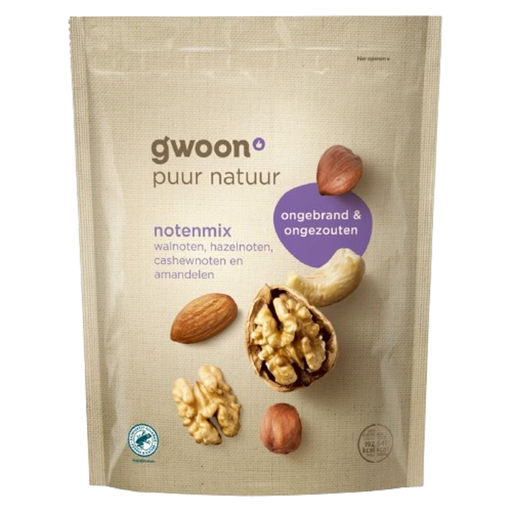 Image unavailable
g’woon Raw Unsalted Nut Mix 200 g
An option if you’d like to consider a mix of different nuts as well as peanuts.
Joybuy lists 19.1 g of protein and 0.01 g of salt per 100 g. The mix contains hazelnuts, walnuts, almonds and cashew nuts; the pack contains 200 g. May contain traces of other nuts and peanuts.
Amsterdam UMC recommends nut butter instead of whole nuts for children under 4.
View at Joybuy
 Image unavailable
g’woon Unsalted Nut Mix 200 g
An option if you’re looking for an unsalted mix and want to compare its ingredients with other varieties.
Joybuy lists 20.1 g of protein and 0 g of salt per 100 g. The description names peanuts, almonds, cashew nuts, Brazil nuts and hazelnuts; the pack contains 200 g. Contains peanuts and several tree nuts, and may contain traces of other nuts.
Amsterdam UMC recommends nut butter instead of whole nuts for children under 4.
View at Joybuy
 Image unavailable
Verse Extra Large Roasted Peanuts 210 g
An option if you’re looking for roasted, unsalted peanuts.
Joybuy lists 26 g of protein and 0.02 g of salt per 100 g. The description names 100% peanuts; the pack contains 210 g. Contains peanuts.
Amsterdam UMC recommends nut butter instead of whole nuts for children under 4.
View at Joybuy
Frequently asked questions
Do you need special protein nuts for an Easter egg hunt?
No. An Easter egg hunt isn’t automatically the same as strength training or endurance sport. If you also exercise, consider your overall diet; according to the Netherlands Nutrition Centre, most people who exercise don’t need special protein products if they eat a varied diet.
How do you calculate the nutritional value of your portion?
Multiply the declared value per 100 g by the weight of your portion, then divide by 100. For Duyvis Unsalted Peanuts, Flink lists 27 g of protein and 614 kcal per 100 g; for 25 g, that works out mathematically to 6.75 g of protein and 153.5 kcal. These are calculations based on declared values, not measured values or a recommended portion size.
Can you give whole nuts to young children during the hunt?
Amsterdam UMC recommends smooth nut butter with no added sugar or salt instead of whole nuts for children under 4 because of the risk of choking. Older children can choke on them too; make sure they eat slowly and stay with them.
Does a warning about nuts mean the same as a warning about peanuts?
No. The Netherlands Food and Consumer Product Safety Authority lists peanuts and nuts as separate allergens. Read both the ingredients and any warnings about possible cross-contamination; don’t assume a nut mix is suitable for someone with a peanut allergy without assessing their individual needs.
Can a product simply be called ‘high in protein’ or ‘high protein’?
No. A product name or protein value per 100 g alone doesn’t prove that the conditions for a nutrition claim have been met. According to the European Commission, nutrition claims are permitted only if they are included in the Annex to Regulation (EC) No 1924/2006.


