
On the go, without weighing
You want to take an individual pack with a pre-set amount. A multipack of individual portions suits this purpose, but check that the portion fits your dietary plan.


An unsalted multipack is a good choice if you want to take a pre-portioned pack with you; a larger bag lets you weigh out portions at home. Compare the total carbohydrates and energy for the amount you actually eat, and make sure your portion fits your dietary plan. Nuts are not a treatment for diabetes or a quick fix for a hypo.
You want to take an individual pack with a pre-set amount. A multipack of individual portions suits this purpose, but check that the portion fits your dietary plan.
You want to know how many total carbohydrates you’re actually eating, even when a mix is labelled unsalted. So compare the exact product and your portion, not just the sugar figure.
You want to make your own portions to take with you from a larger bag of unsalted nuts. This approach involves weighing them out and storing the rest in a tightly sealed container.
| What to consider | What to look for | Who is this important for? |
|---|---|---|
| A clearly defined portion | Check the weight of each individual pack and how many packs there are. With a larger bag, you’ll need to weigh out the portions yourself. | If I don’t want to weigh out a portion while I’m out, I look for a pack with a clearly stated weight; around 33% of consumers prioritise portion convenience. |
| Carbohydrates and energy | Compare total carbohydrates and energy per 100 g, then calculate the amount for the portion you eat. | If I want to fit my snack into my dietary plan, I check the total carbohydrates in my portion; around 27% of consumers prioritise this. |
| Ingredients and allergens | Read the ingredients and allergen information for the exact product; unsalted doesn’t mean allergen-free. | If I’m looking for an unsalted mix with ingredients I can and want to eat, I check the packaging; around 20% of consumers prioritise this. |
| Portioning and storing it yourself | Compare packs containing the same amount, and factor in the time needed to weigh out portions and store the rest. The Netherlands Nutrition Centre advises storing nuts in a well-sealed container in a cool, dark, dry place. | If I want to prepare portions at home and limit waste, I choose an amount I can store properly; around 20% of consumers prioritise this. |
The sugar figure doesn’t tell you how many total carbohydrates you’re getting. If you have diabetes, the total carbohydrates in what you eat may be important.
Calculate the total carbohydrates for your actual portion, and always compare the same amount.
A 30 g pack is a packaging size, not a recommended portion for you personally. The contents of a larger bag don’t tell you how much you should have at each eating occasion either.
Fit the amount into your dietary plan, and weigh it out in advance if you’re using a larger bag.
A larger pack doesn’t prove that the cost per portion you use will be lower. Portioning it yourself also takes preparation and a suitable way to store the rest.
Compare the same quantities, and choose a pack size you’ll actually use.
Allow time to weigh out portions, and consider the risk of waste if you don’t use the contents in time.
The term ‘unsalted’ doesn’t mean that peanuts, nuts or traces of them are absent. Duyvis lists peanuts as an allergen for its unsalted peanuts and warns that traces of nuts may be present.
If you have a known allergy, read the ingredients and allergen warning on the packaging of the exact product you want to buy.
The products mentioned are available both as a multipack and in larger bags for portioning yourself.
The AH own-brand range has a product page for Unsalted Nut Mix.
The range includes a 200 g Jumbo own-brand Unsalted Nut Mix and a product page for Duyvis Walnut 4 × 30 g.
Alesto is Lidl’s range of nuts, dried fruit and party snacks.
Trader Joe’s Unsalted Nut Mix is described as a 500 g larger pack.
PLUS Unroasted Unsalted Nut Mix is an own-brand option if you want to prepare your own portions.
These products suit the choice between individually packed portions and larger packs that you can weigh out yourself. Before choosing, check the nutritional values and allergens for the exact product.
 No image available
This larger pack is a good choice if you want to weigh out your own portions of peanuts.
Pack size: 250 g.
Total carbohydrates: 13,5 g per 100 g.
Allergens: contains peanuts and may contain cashew nuts.
 No image available
The individual packs are designed to be taken with you, so you don’t have to make portions from a larger bag yourself.
Pack size: five 23 g packs.
Ingredients information lists raisins and sweetened cranberries; check the nutritional values on the exact pack.
Contains walnuts, cashew nuts, almonds and hazelnuts. The sachet containing the desiccant is not for consumption.
 No image available
This larger pack is a good choice if you want to weigh out your own portions of almonds.
Pack size: 200 g.
Total carbohydrates: 4,8 g per 100 g.
Allergen: almonds.
 No image available
This larger pack is a good choice if you want to weigh out your own portions of cashew nuts.
Pack size: 200 g.
Total carbohydrates: 22,67 g per 100 g.
Allergen: cashew nuts.
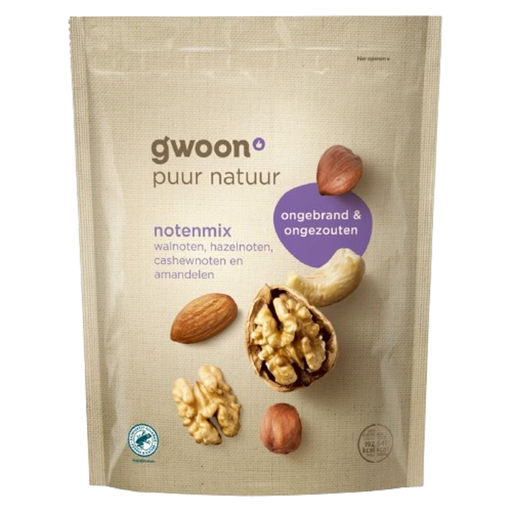 No image available
This larger pack is a good choice if you want to weigh out your own portions of unsalted nut mix.
Pack size: 200 g.
Total carbohydrates: 11,5 g per 100 g.
Contains hazelnuts, walnuts, almonds and cashew nuts; may contain traces of peanuts.
Multiply the total carbohydrates per 100 g by the weight of your portion, then divide by 100. Flink lists 11 g of carbohydrates per 100 g for Duyvis unsalted peanuts; for 30 g, that’s 11 × 30/100 = 3,3 g. This calculation applies to that product, not automatically to another nut mix.
No, 30 g is a pack size or example amount here, not personal dietary advice. Duyvis sells the multipack mentioned in 30 g packs; the Diabetes Fund’s snack list uses 30 g as an example portion for various nuts. Choose an amount that fits your own dietary plan.
No, use the fast-acting carbohydrates approach agreed with your healthcare professional. Amsterdam UMC describes foods containing fat as less suitable for treating a hypo quickly; nuts are not a substitute for your hypo treatment.
Store the rest in a well-sealed container in a cool, dark, dry place, and follow the storage advice on the packaging. The Netherlands Nutrition Centre lists rancidity, a chewy texture and mould as signs of a loss of quality or spoilage.
Check the ingredients and allergen warnings for the exact product. The NVWA requires clear allergen information, so unsalted doesn’t mean allergen-free. Duyvis also warns that traces of nuts may be present in its unsalted peanuts.