
Less fat per coffee break
You’re looking for a nut snack that lets you choose how much fat you eat during your break. To compare, check the nutritional information per 100 g against the amount you plan to have.


If you want to eat less fat with your morning coffee, you can compare the fat content per 100 g or choose a smaller portion. These are different choices. Unsalted nuts and nuts with no added oil are not automatically low in fat, so check the nutritional information and ingredients for the exact product too.
You’re looking for a nut snack that lets you choose how much fat you eat during your break. To compare, check the nutritional information per 100 g against the amount you plan to have.
You’d like plain, unsalted nuts with your coffee instead of salted party nuts or sweet coatings. The ingredients are a separate consideration from the total fat content.
You’re looking for a savoury roasted snack with no added oil, and are happy with salt or seasoning. Check the exact product: no added oil doesn’t automatically mean unsalted or low in fat.
First decide whether you’re looking for a lower fat content per 100 g or simply want to eat less. Then check the portion size, salt and ingredients of the exact product.
| What to consider | What to look for | Who is this important to? |
|---|---|---|
| Fat content | Compare the fat per 100 g for the exact product. Assess a nutrition claim separately from the preparation method. | I want to know whether a snack contains less fat for the same amount. Around 36% of consumers prioritise this comparison. |
| Portion size | Weigh the portion you plan to eat and calculate the values using the nutritional information per 100 g. | If I want to measure out how much I have during my coffee break, I focus on the values for my own portion. Around 28% of consumers prioritise portion size. |
| Unsalted ingredients | Read the ingredients and check the salt and allergen information on the exact pack. Assess the fat content separately. | I’m looking for an unsalted snack without a party-nut or sweet coating, even if it doesn’t have the lowest fat content. Around 18% of consumers prioritise this type of product. |
| Sourcing and storage | Check the pack weight, retailer and storage instructions. A product listing doesn’t guarantee it’s in stock at your local shop. | For my regular coffee breaks, I want a snack that’s easy to buy, portion and store. Around 18% of consumers say convenience is their main concern when buying. |
For solid foods, the European Commission sets a maximum of 3 g of fat per 100 g for a ‘low fat’ claim. This is a condition for using that claim; it doesn’t prove that a product carrying a different claim contains less fat than a suitable comparison product.
Unsalted nuts can still be high in fat. The ‘low fat’ claim relates to the amount of fat per 100 g.
Check salt and fat separately, and compare products on the same weight basis.
Duyvis describes Cashews Original as oven-roasted with no added oil. This preparation method doesn’t tell you how much fat the product contains compared with a suitable alternative.
Use the preparation method as information about added oil, not as a substitute for comparing nutritional values.
Nutritional values per portion are only easy to compare if the portions weigh the same. A smaller portion reduces the amount you eat, but it doesn’t make the product itself low in fat.
Compare per 100 g first, then calculate the values for the portion you plan to have.
Weighing a portion takes an extra step, but makes the amount you’re having clear.
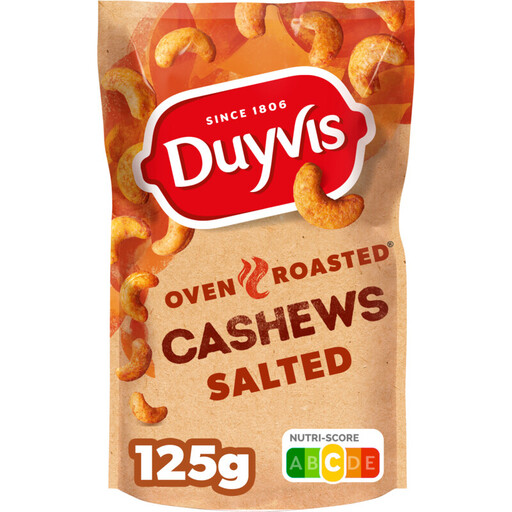
Duyvis describes Cashews Original as oven-roasted with no added oil, in a 125 g pack.
Albert Heijn lists AH Unsalted Cashew Nuts, which may be relevant if you’re looking for an unsalted option.
Jumbo lists an unsalted nut mix and unsalted cashew nuts among its relevant product types.
PLUS lists unsalted, unroasted cashew nuts in a 200 g bag.
According to the product information, ALDI offers a 250 g pack of TRADER JOE'S roasted, unsalted cashew nuts.
Lidl lists a 200 g unroasted, unsalted nut mix as a plain nut snack.
These Joybuy products range from unsalted options to cashew nuts with no added oil. These characteristics don’t prove a lower fat content; compare the nutritional information on the pack for the exact product.
 No image available
Suited to anyone looking for oven-roasted cashews with no added oil; the product description lists 4–5 portions.
Contains cashew nuts and 0.92 g of salt per 100 g.
 No image available
Suited to anyone looking for an unsalted peanut snack and wanting to measure out their own portion.
The ingredients list peanuts and sunflower oil; the product may contain cashew nuts.
 No image available
Suited to anyone looking for roasted, unsalted cashew nuts to have with their coffee.
Contains cashew nuts; the product information lists nutritional values per 100 g.
 No image available
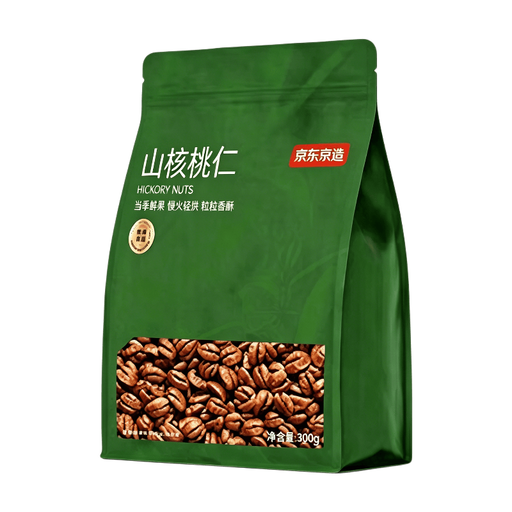
Suited to anyone who wants to take portions for several coffee breaks; the product description mentions individually wrapped portions.
The product name says it is not fried. The product information lists sugar and salt as well as hickory nuts.
 No image available
Suited to anyone looking for plain cashews and wanting to measure out their own portion.
The product information lists cashew kernels as an ingredient and gives nutritional values per 100 g.
For solid foods, the European Commission sets a maximum of 3 g of fat per 100 g for a ‘low fat’ claim. This is a condition for using the claim, not a recommendation to avoid all nuts with a higher fat content.
No. Duyvis describes Cashews Original as made with no added oil, but lists salt in the ingredients. So check the oil and salt content separately for the exact product.
Multiply the value per 100 g by the weight of your portion in grams, then divide by 100. Use the nutritional information on the exact pack; an example value for a category isn’t a product specification.
Check the ingredients and allergen information on the exact pack. The Netherlands Food and Consumer Product Safety Authority lists peanuts and nuts separately as allergens that must be identified on prepacked products.
Keep nuts tightly sealed and dry, and follow the instructions on the pack. Voedingscentrum recommends storing them at 10 to 15 °C; also check the best-before information for your product.