What should you look for when buying?
First, check whether the information on the exact pack is suitable for someone with coeliac disease. Then compare the protein per portion, followed by your everyday dietary choices and the packaging.
| What to consider |
What should you look for? |
Who is this important for? |
| Gluten information |
Check the ingredients list and any cross-contamination warning on the exact pack. A label such as ‘unsalted’ says nothing in itself about gluten. |
If I have coeliac disease, I want to know what the pack says before comparing protein content. Around 36% of shoppers put gluten information first. |
| Protein per portion |
Convert the nutritional value per 100 g to the weight you actually eat; values can vary between products. |
If I eat nuts around exercise, I want to know how much protein my own portion provides. Around 29% of shoppers focus mainly on protein per portion. |
| Everyday food choices |
As well as protein, check the salt and energy per portion. Eating more nuts for extra protein also increases your energy intake. |
If I eat nuts regularly, I want to choose an unsalted option and a portion that fits into my everyday diet. Around 21% of shoppers say their main consideration is the overall nutritional profile. |
| Packaging and storage |
Compare packs containing the same quantity and follow the storage instructions for the product you choose. |
If I’m choosing a pack for home, I want to be able to store it easily and compare quantities fairly. Around 14% of shoppers focus mainly on packaging and comparable quantities. |
Here’s a practical calculation: PLUS lists 25 g of protein per 100 g for its Unsalted Peanuts, 300 g stand-up pouch. A weighed 25 g portion therefore provides 6.25 g of protein. Based on the stated 623 kcal per 100 g, the same portion contains around 156 kcal. These values apply to this PLUS product, not to other nuts or packs.
The Dutch Coeliac Society explains that warnings about possible cross-contamination, such as ‘may contain cereals containing gluten’ and ‘not suitable for people with coeliac disease’, point to the same type of risk. A warning does not mean every individual product contains gluten, but it is relevant when making your choice. The Netherlands Nutrition Centre recommends unsalted nuts and variety; that does not automatically make a particular product suitable for someone with coeliac disease.
Nut products at Joybuy
This selection includes unsalted peanuts, almonds and nut mixes. If you have coeliac disease, always check the ingredients and warnings on the exact pack; the product listing alone does not establish whether it is suitable.
 No image available
g'woon unsalted peanuts 250 g
An option if you’re looking for unsalted peanuts; check the exact pack for gluten information before choosing them if you have coeliac disease.
The product description lists 99% peanuts, sunflower oil and 27 g of protein per 100 g.
View product
 No image available
g'woon raw, unsalted almonds 200 g
A good fit if you’re looking for raw, unsalted almonds; check the pack for gluten information before choosing them if you have coeliac disease.
The product description lists 24 g of protein per 100 g.
View product
 No image available
Anatolia Badem Natural (almonds) 500 g
A plain almond option to consider if you’re looking for a larger pack; first check the gluten information on the exact pack.
The product description lists 100% almonds, 21 g of protein per 100 g and 0.00 g of salt per 100 g.
View product
 No image available
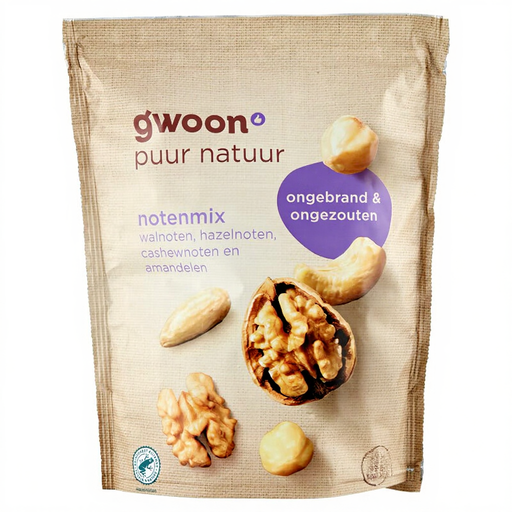
g'woon unroasted, unsalted mixed nuts 500 g
A mix to consider if you’d like to combine different types of nuts; check the gluten information for this specific mix.
The product description lists hazelnuts, walnuts, almonds and cashews, and states 16.9 g of protein per 100 g.
View product
 No image available
Verse Extra Large roasted peanuts 210 g
A good fit if you’re looking for roasted peanuts; the description says they’re unsalted. Check the pack for gluten information before choosing them if you have coeliac disease.
The product description lists 100% peanuts and 26 g of protein per 100 g.
View product
Frequently asked questions
What do cross-contamination warnings mean?
According to the Dutch Coeliac Society, warnings such as ‘may contain cereals containing gluten’ and ‘not suitable for people with coeliac disease’ point to the same type of risk. A warning like this does not mean every individual product contains gluten, but it is relevant when making your choice.
Do I always need a special protein snack for exercise?
No. According to the Netherlands Nutrition Centre, most people who exercise do not need special protein shakes or bars if they eat a healthy, varied diet. If you exercise intensely and need to recover quickly, it’s better to consider your overall diet rather than just your nut snack.
How do I calculate the protein in my portion of nuts?
Multiply the protein per 100 g by the weight of your portion, then divide by 100. For PLUS Unsalted Peanuts, 300 g stand-up pouch, which contains 25 g of protein per 100 g, a 25 g portion provides 6.25 g of protein. For another product, use the nutritional values on its own pack.
How should I store nuts and limit cross-contamination at home?
Follow the storage instructions on the pack you choose: PLUS peanuts should be stored in a cool, dry place, while Jumbo almonds should be stored in a dry, dark place. At home, keep your weighed portion separate from foods containing gluten and crumbs.
Is a nut product suitable if I also have a peanut or tree nut allergy?
Check allergen information separately from gluten information. The product information for PLUS Unsalted Peanuts lists peanuts and the possible presence of other nuts; check the pack of the product you buy.


