
People who exercise and want to calculate their protein intake
You want to know how much protein your post-workout snack actually provides, without counting a whole bag as one serving.


Choose based on the amount of protein in the portion you actually eat, rather than relying on eye-catching protein claims. According to the Netherlands Nutrition Centre, a 25 g reference handful of unsalted peanuts contains 6.3 g of protein and 157 kcal. Consider this as part of your overall diet and combine different protein sources if needed. The Netherlands Nutrition Centre includes unsalted nuts in its Wheel of Five healthy eating guidelines, but that doesn’t mean a bag of nuts is automatically a complete post-exercise meal.
You want to know how much protein your post-workout snack actually provides, without counting a whole bag as one serving.
You’re looking for a portion of nuts that fits into your diet, so you consider both protein and kcal.
You eat nuts alongside other plant-based protein sources and pay attention to ingredients, flavour and allergen information.
Start with the portion you actually plan to eat and its nutritional value. Then check the kcal, ingredients and information on the packaging.
| What to consider | What to look for when buying | Who is this important for? |
|---|---|---|
| Protein per serving | Weigh your portion and calculate the amount using the nutritional values per 100 g. For 25 g of unsalted peanuts, the Netherlands Nutrition Centre gives a protein value of 6.3 g. | When I choose a snack after training, I want to know how much protein my weighed portion provides. Around 36% of consumers prioritise being able to calculate their protein intake this way. |
| Kcal in your portion | Compare protein and kcal for the same weight. Jumbo lists 184 kcal per 30 g serving of Duyvis Unsalted Peanuts 235 g. | I want to choose a portion of nuts that fits my energy intake, without looking only at the protein per 100 g. Around 29% of consumers put this balance first. |
| Ingredients and allergens | Check the ingredients, allergens and warnings on the exact packaging. The NVWA states that allergen information must appear on the label of prepacked products. | If I’m looking for unsalted nuts or need to take an allergy into account, I want to check the ingredients of that particular pack. Around 21% of consumers prioritise the ingredients. |
| Practical use | Check the pack size and follow the storage advice for the variety you choose. | I want a pack that suits how I use and store nuts. Around 14% of consumers consider this day-to-day practicality the most important factor. |
The nutritional value per 100 g isn’t the same as the amount you eat as a snack. The Netherlands Nutrition Centre gives a protein value of 6.3 g and 157 kcal for a 25 g reference handful of unsalted peanuts.
Decide on your portion in advance and calculate the protein and kcal using the same weight.
A larger portion also increases your energy intake and empties the pack more quickly.
A product name doesn’t tell you how much protein your portion contains, nor does it prove that the product is suitable as a recovery meal.
Use the nutrition table and ingredients for the exact variety to assess your portion.
An unsalted product may still contain peanuts or other nuts. Ingredients and warnings about possible cross-contamination vary from pack to pack.
Check the allergen information on the pack you’re planning to buy.
Its range includes unsalted peanuts and oven-roasted almonds.
Its range includes AH Unsalted Peanuts, a supermarket own-brand option.
Its range includes unsalted almonds, and it also sells the Duyvis peanut variety mentioned above.
Its Dutch product listing includes unsalted almonds.
Its listings include nut mixes and a product called TRADER JOE’S Protein Nut Mix.
Lists PLUS Unsalted Peanuts, 300 g resealable pouch.
The products below include peanuts, almonds and nut mixes. Compare the product type and ingredients with how you plan to use the nuts.
 No image available
Suited to anyone who wants to enjoy unsalted peanuts as a snack and weigh out their own portion.
Contains peanuts and may contain traces of cashew nuts.
 No image available
Suited to anyone who wants to use peanuts as a snack or ingredient and shell them before use.
The peanuts are in their shells and need to be shelled first. Contains peanuts.
 No image available
Suited to anyone who wants to use almonds as a snack or topping.
Contains almonds (nuts).
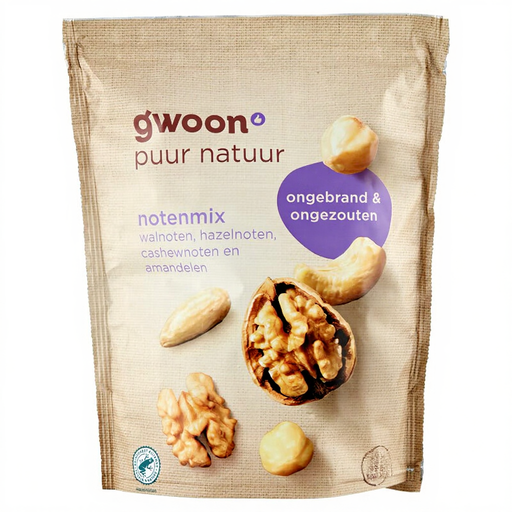 No image available
Suited to anyone who wants to use a nut mix as a snack or ingredient.
Contains hazelnuts, walnuts, almonds and cashew nuts; may contain traces of peanuts and other nuts.
 No image available
Suited to anyone looking for an unsalted nut mix to enjoy as a snack or add to dishes.
Contains peanuts, almonds, cashew nuts, Brazil nuts and hazelnuts.
No. According to the Netherlands Nutrition Centre, most people who exercise don’t need special protein shakes or bars if they eat a healthy, varied diet. First, consider what you already get from your usual food.
Use the weight of your portion and the nutritional values for the variety you’ve chosen. As a general reference, the Netherlands Nutrition Centre gives a protein value of 6.3 g and 157 kcal for 25 g of unsalted peanuts; the values for a branded product may differ.
The Dutch Association of Sports Nutrition Experts recommends 0.2–0.4 g of protein per kilogram of body weight within two hours of intense exercise, especially if you’ll be exercising again soon. This advice applies to that situation and isn’t a standard portion of nuts for everyone.
Check the ingredients and allergen information on the exact pack. According to the NVWA, allergen information must appear on the label of prepacked products; peanuts and tree nuts are listed separately.
The product information recommends storing the peanuts in a cool, dry place and putting an opened bag in an airtight, light-proof container. Also follow the best-before information on your own pack.