What should you consider when choosing?
Start with how much you’ll actually eat and the role the snack plays in your overall diet. Then compare the packaging and ingredients: a portion size on the label doesn’t mean the portions are individually wrapped.
| What to consider |
What to look for |
Especially relevant for |
| Protein per portion |
Check the nutritional information per portion and per 100 g. The labels for Duyvis Unsalted Peanuts and Jumbo Unsalted Nut Mix give portion sizes of 30 g and 25 g respectively. |
If I want to add to my protein intake after an intense training session, I look at the portion as well as the rest of my meal. Around 39% of consumers put protein content first. |
| Easy to take with you |
Check whether portions are actually individually wrapped. Jumbo lists eight 25 g portions in one 200 g bag. |
If I need to get straight on with my day after training, I want to be able to grab a measured snack without guessing on the spot. Around 38% of consumers put portioning convenience first. |
| Ingredients |
Check the ingredients and allergen information on the current packaging; ‘unsalted’ tells you nothing about allergens. |
I want to know in advance which nuts and other ingredients are in my snack. Around 23% of consumers put the ingredients first. |
Nuts and nut mixes at Joybuy
This selection includes unsalted peanuts, cashews and nut mixes for a snack on the go. Compare the ingredients and nutritional information, and check the packaging to see whether you can take an individual portion with you or need to weigh one out yourself.
 No image available
g'woon unsalted peanuts, 250 g
Suitable if you want to weigh out your own unsalted peanuts for a post-exercise snack.
Ingredients: 99% peanuts and sunflower oil. Protein: 27 g per 100 g.
Contains peanuts and may contain cashews.
View at Joybuy
 No image available
g'woon roasted unsalted cashews, 200 g
Suitable if you want to weigh out an unsalted cashew snack according to the portion you eat.
Protein: 18.67 g per 100 g.
Contains cashews.
View at Joybuy
 No image available
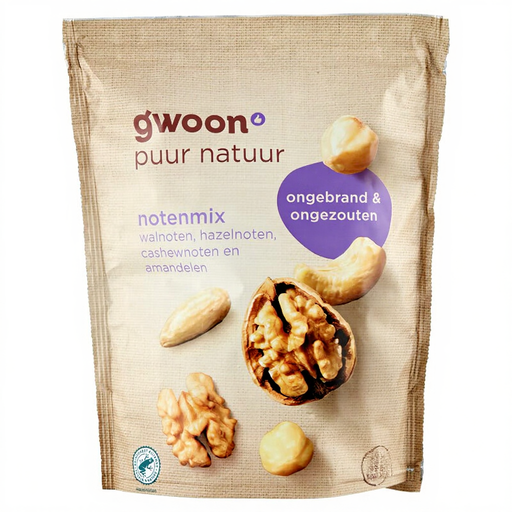
g'woon unroasted nut mix, 500 g
Suitable if you want to plan several portions in advance and weigh out your own unsalted mix.
Contains 30% hazelnuts, 30% walnuts, 20% almonds and 20% cashews; no added salt. Protein: 16.9 g per 100 g.
May contain traces of peanuts and other nuts.
View at Joybuy
 No image available
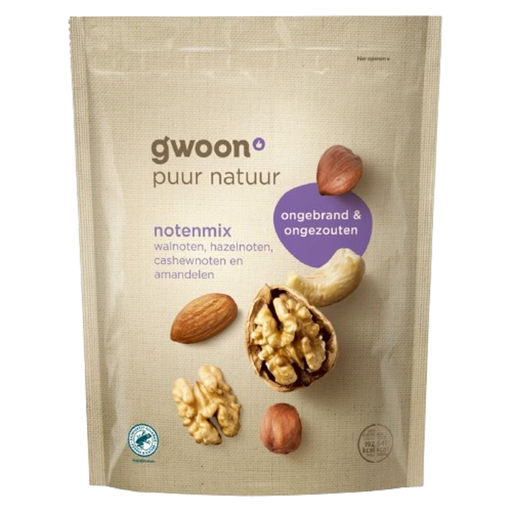
g'woon raw unsalted nut mix, 200 g
Suitable if you want to take a raw, unsalted mix with you and choose your own portion size.
Contains hazelnuts, walnuts, almonds and cashews; no added salt. Protein: 19.1 g per 100 g.
May contain peanuts.
View at Joybuy
 No image available
g'woon unsalted nut mix, 200 g
Suitable if you want to weigh out an unsalted mix with a variety of nuts.
The ingredients list includes peanuts, almonds, cashews, Brazil nuts and hazelnuts. Protein: 20.1 g per 100 g.
View at Joybuy
Frequently asked questions
Do you need to eat a special recovery product straight after every training session?
No, rapid recovery nutrition isn’t automatically needed after every activity. Vereniging Sportdiëtetiek Nederland discusses 0.2–0.4 g of protein per kg of body weight within two hours after intense or prolonged exercise when you’ll be exercising again later that day or the next day. This isn’t a fixed requirement for every recreational workout; consider your portion of nuts as part of your overall diet and training plan.
Is 25 g a required amount of nuts after exercise?
No, 25 g isn’t a personalised recovery calculation. Voedingscentrum uses 25 g as a reference for a handful of unsalted nuts; Jumbo’s label gives 25 g as a portion, while Duyvis gives 30 g. Check how much you actually eat and what that portion adds to your overall diet.
How should you store portions you’ve weighed out in advance?
Follow the storage advice for the exact product. Duyvis recommends storing an opened bag in a light- and airtight container; Jumbo advises keeping its product in a cool, dry, dark place. If you portion the nuts yourself, keep the original ingredients and allergen information handy too.
What should you check on a food label in the Netherlands if you have an allergy?
Check the ingredients and allergen information on the packaging of the exact product. The NVWA states that allergen information must appear on the label of prepacked foods; peanuts and nuts are separate allergen groups. Since 1 January 2026, the NVWA has been checking compliance with the rules on substantiated cross-contamination warnings during inspections.
Does an older allergen warning prove that a bag doesn’t comply with the rules?
Not without knowing the production and stock context. The NVWA uses the production date as its starting point and allows previously packaged stock to be sold as long as the food is safe. So if you have a relevant allergy, don’t ignore a warning just because of how it’s worded.


