
Vandaag of morgen in huis

Kwaliteit gegarandeerd

Welkomstaanbiedingen ontgrendelen: GRATIS bezorging | Tot 80% korting | Gratis 30 dagen JoyPlus-proefperiode
Download de app
A nursery night light might seem like an easy purchase, but controls, brightness and power options can vary widely. A cute-looking lamp can turn out to be too bright, awkward to position or end up serving mainly as decoration.
So don’t just go by an animal shape or a low price. Make sure you check:
Words like “soft”, “soothing” and “warm” don’t always describe measurable brightness. Colour temperature, expressed in Kelvin (K), tells you about the hue of the light. The number of lumen (lm) indicates how much light is emitted. A night light with 20 lumen is not the same as one with 40 lumen, even if both are described as warm white.
For a nursery or children’s room, gentle lighting is often practical for a quick check. If you also want to change a nappy or light a dark hallway, you may need a higher setting.
A night light with a timer can be helpful when your child falls asleep with a little light on. A night light with a sensor is useful in a hallway or beside the bed when you only want the light to switch on with movement or darkness.
A sensor light in a busy thoroughfare can switch on more often than you expect. A timer is less ideal if you need light again immediately during a night-time check. So consider both the controls and where the light will be placed.
A soft silicone night light feels pleasant to the touch, but that doesn’t automatically mean it’s suitable to play with or put in the mouth. Check the age guidance, warnings and battery safety. The Little Dutch model, for example, carries an age indication of 3+ and warns about small parts and batteries.
Always place a lamp out of a baby’s reach if the manufacturer advises it. For plug-in models, also watch out for water, heat sources and loose cables.
An LED night light typically uses little power and runs cooler in normal use than traditional light sources. Even so, LED lamps differ in brightness and colour. For night-time care, a warm, low setting can be more comfortable than cool daylight.
A dimmable night light with multiple levels offers more flexibility. The VIVREAL Unicorn model, for example, lists three brightness levels with touch control. According to the product information, the panda version also has three dimmable settings.
A rechargeable night light is easy to take from the nursery to the bedroom or on trips. Do check the charging time and stated run time. The unicorn model lists a 1200mAh battery, a 2 to 3 hour charge time and 8 to 10 hours of use.
A plug-in model doesn’t need charging, but is less flexible to move. A battery-powered option can be practical in a hallway, provided the battery compartment stays securely closed and you follow the warnings.
With sensor lights, technical details are more useful than broad marketing terms. The Aigostar LED Sensor Night Light lists 1 W, 40 lm, a light sensor, 230 V and a stated consumption of 0.5 kWh per 1000 hours. According to the product information, the model is intended for indoor use and features a day–night sensor.
Another model lists 20 lm, a colour temperature of 2800–3200 K and a power draw of 0.5 W. Always check the latest product specifications and the manual before using a lamp in a nursery.

Why it fits this profile: This plug-and-play model has simple one-button controls and is ideal if you want gentle ambient light without a timer or charging.
The product description mentions integrated LED lighting and single-button control. There are no complicated settings, but do check the 3+ age warning.
Decorative squirrel design, integrated LED module and materials described in the product information as BPA- and phthalate-free.

Why it fits this profile: Ideal if you value easy controls, portability and a fixed switch-off time. The unicorn shape also makes it a lovely gift night light.
The product information lists three brightness levels, a 30-minute timer and touch control. You don’t have to choose between just on or off.
1200mAh rechargeable battery, stated run time of 8–10 hours and a soft silicone housing, according to the product description.
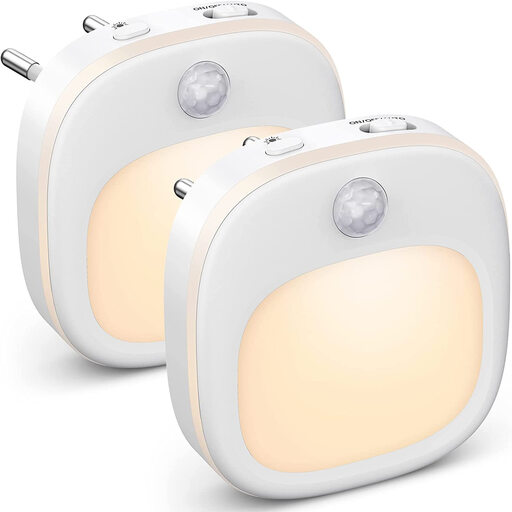
Why it fits this profile: A practical choice if you want to light multiple spots, such as the hallway and nursery, without switching a lamp on by hand each time.
According to the product listing, this model features motion detection, three colour temperatures and five dimming levels. That gives you more control than a light with a single fixed brightness.
Set of two, five dimming levels and a motion sensor, according to the product data. Check placement and the power connection before buying.
We’ve compiled a complete, up-to-date list of products that fully meet these strict selection criteria and the applicable European safety regulations.
Use a nursery night light or children’s night light only as directed in the manual. Keep these points in mind:
A warm colour, low lumen output and a timer can be enough for night-time orientation. In a hallway, a sensor or multiple lights may be more practical. If you mainly want ambience, choose an animal night light such as a squirrel, panda, unicorn or duck.
That depends on the purpose. For soft lighting in a children’s room, a low light level is often sufficient. For a hallway or quick care tasks, a brighter setting can be practical. Check the stated lumen and, if you want to cover multiple scenarios, choose a dimmable model.
A rechargeable night light avoids regularly replacing disposable batteries, but it still uses electricity to charge. The actual cost depends on charging frequency, battery capacity and your energy tariff. A plug-in model has no charging cycle, whereas a sensor light only switches on when needed.
Place the light securely and out of your baby’s reach. Don’t point it directly at the face and keep cables away from the cot. A plug-in model should be kept clear of textiles and moisture. Always check the installation and safety instructions for your chosen product.
