Who is this choice relevant to?

Parents looking for a regular lunch staple

You may want to pack something crunchy, but need to check whether it is clearly labelled wholegrain and fits the nursery’s food policy. The Netherlands Nutrition Centre lists wholemeal bread and wholegrain crackers as options for young children.

Parents of children with food allergies

You need to compare the allergens and any warnings on the packaging of the exact product with the individual arrangements for your child and the nursery.

Buyers for a nursery group

You need a product whose current packaging can be checked for the whole group and that can be used in line with the food policy. A familiar product name is no substitute for checking.

What should you look for?

Wholemeal bread or wholegrain crackers

When: Choose a product clearly labelled wholegrain if you’re looking for a regular lunch staple; the Netherlands Nutrition Centre lists these options for young children.

Keep in mind: Even with a wholegrain product, allergens, your child’s age and the nursery’s arrangements all matter.

Toast or melba toast

When: Consider this as a crunchy addition if the specific product’s packaging is in line with the food policy and allergy arrangements.

The trade-off: Being toast doesn’t automatically make a product wholegrain or equivalent to a wholegrain lunch staple.

Digestive biscuits

When: Consider a specific biscuit only if the nursery allows it and its packaging fits the food and allergy arrangements.

The trade-off: The name ‘digestive’ alone tells you nothing about whether a biscuit is wholegrain or suitable as a regular lunch staple.

What to considerWhat to check when buyingWho it matters to
Regular lunch staple Check whether the specific product’s packaging says wholegrain and whether it fits the food policy. If I regularly pack something crunchy as a lunch staple, I want to be able to confirm that it’s wholegrain. Around 42% of consumers prioritise this.
Allergens and nursery policy Read the current ingredients list, allergen information and any cross-contamination warnings, then compare them with the individual arrangements. If a child has a food allergy, the exact product must comply with the arrangements for both my child and the nursery. Around 33% of consumers put this check first.
Crunchy product format Choose a specific type of toast or melba toast and check the packaging, rather than relying on the product name alone. For lunch, I’m mainly looking for a familiar, crunchy format that’s easy to pack. Around 25% of consumers put this practical need first.

Common mistakes

  • Assuming digestive, plain or melba means wholegrain

    These names don’t confirm that a product is wholegrain. For young children’s lunches, the Netherlands Nutrition Centre specifically lists wholemeal bread and wholegrain crackers as options.

    Check that the packaging of the product you want to pack clearly says wholegrain.

  • Packing a familiar product without checking its allergens

    Allergens vary from product to product. For example, Sligro lists wheat, soya, rye, oats and egg among the allergens in Bolletje Beschuit Naturel; rusks are also a different product from toast.

    When opening a new pack, check the current allergen information and any warnings, then compare them with the child’s allergy plan and the nursery’s arrangements.

  • Assuming bread made with baker’s salt contains iodine

    Baker’s salt contains added iodine, but according to the Netherlands Nutrition Centre, bakers aren’t required to use it. So a bread-like product doesn’t prove which salt has been used.

    If this matters for your child’s diet, don’t rely on the product name; check the ingredients information for the specific product.

Brands to consider

Bolletje

Bolletje makes rusks, among other products. These are different from toast and can be considered as a crunchy alternative.

  • The range includes a rusk option for anyone who wants to look at other crunchy products as well as toast.
  • Sligro lists wheat, soya, rye, oats and egg among the allergens in Bolletje Beschuit Naturel. Check the current packaging before packing it.

Van der Meulen

Van der Meulen offers melba toast varieties with different grain descriptions.

  • Albert Heijn lists, among others, a 7-grain variety and wholegrain varieties, including wholegrain spelt.
  • Check the ingredients, allergens and wholegrain labelling on the packaging of the variety you choose.

JOS POELL

JOS POELL offers plain toast and wholegrain toast as separate varieties.

  • Jumbo lists plain toast, while Albert Heijn lists wholegrain toast, so you can look for the specific variety you want.
  • Don’t assume that one variety has the same ingredients or allergens as another; read the label on the pack you choose.

Albert Heijn

Albert Heijn offers its own melba toast varieties alongside listings for other brands.

  • The product listings help you distinguish between specific melba toast varieties.
  • Albert Heijn notes that ingredients, nutrition and allergy information may change. Always read the packaging of the product you’re using.

Melba toast for a crunchy addition

This melba toast could be a crunchy addition to nursery lunch, provided the specific product’s packaging complies with the food policy and allergy arrangements. Separately, consider whether you want a product clearly labelled wholegrain as a regular lunch staple.
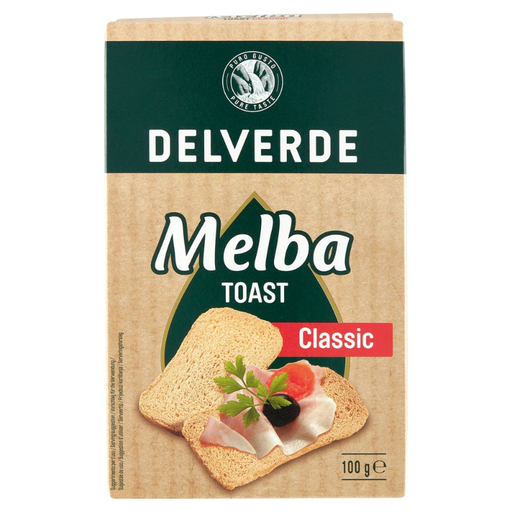
Delverde Classic Melba Toast, 100 g pack

Delverde Classic Melba Toast 100 g

An option if you’re looking for melba toast as a crunchy addition and the nursery allows this type of product.

When checking allergens, look for the listed wheat and barley, as well as possible traces of sesame, soya and mustard. Compare the current packaging with the arrangements for your child.

If you’re looking for a regular lunch staple, check the packaging to see whether the product is wholegrain. Supervise young children while they eat and make sure they chew properly.

View at Joybuy

Frequently asked questions

Are digestive biscuits a suitable regular lunch staple for nursery?

Don’t choose digestive biscuits as a regular lunch staple based on their name alone. For young children, the Netherlands Nutrition Centre lists wholemeal bread as one lunch option. Assess a specific biscuit by checking its packaging and the nursery’s food policy.

Do I need to check toast for gluten?

Yes. If your child has a gluten allergy or another relevant allergy, always check the packaging of the exact variety. The Netherlands Food and Consumer Product Safety Authority highlights the importance of allergen information on labels; you can’t assume that rusks and other types of toast have the same allergens.

Does toast automatically provide iodine from baker’s salt?

No, the product name doesn’t tell you that. According to the Netherlands Nutrition Centre, bakers aren’t required to use baker’s salt with added iodine. Check the ingredients information if this matters when choosing a product.

Can the nursery have its own rules about bringing in toast or biscuits?

Yes. Ask about the nursery’s food and allergy policy in advance. The Dutch government describes food as part of childcare policy; a product label won’t tell you whether it complies with the nursery’s arrangements.
