
Anyone putting together daily nursery lunches
You want to know whether breakfast cake fits the food policy or whether bread should remain the basis of lunch. The Netherlands Nutrition Centre recommends bread for young children’s lunch.


Wholemeal bread is the best choice for a regular lunch at nursery: the Netherlands Nutrition Centre recommends bread for young children’s lunch and does not include cake among foods that support a nutritious diet in its example childcare food policy. If the nursery’s policy allows breakfast cake as an occasional treat, compare the specific product’s fibre, sugars, sweeteners and allergens. If a child has individual dietary requirements, always check the packaging and the nursery’s arrangements.
You want to know whether breakfast cake fits the food policy or whether bread should remain the basis of lunch. The Netherlands Nutrition Centre recommends bread for young children’s lunch.
You’re considering breakfast cake for an occasional treat and comparing specific products for wholegrain ingredients, fibre, sugars and sweeteners.
You’re buying or handing out food to a group of children and checking the current allergen information and the nursery’s individual arrangements in advance.
First, find out what the nursery serves as its regular lunch. Only compare breakfast cakes if the policy allows an occasional portion.
| What to consider | What to check | Who this matters most to |
|---|---|---|
| Place in the lunch | Check the food policy: is breakfast cake allowed as an occasional extra, and what makes up the regular lunch? | If I’m arranging the daily lunch, I want to avoid a wholemeal cake quietly replacing bread. For around 42% of consumers, this is the main consideration when choosing lunch. |
| Ingredients | Compare the wholemeal content, fibre, sugars and any sweeteners per 100 g; check the portion size too. | For an occasional portion, I want to know what the chosen product contains, not just what the front of the pack says. Around 33% of consumers prioritise this comparison. |
| Allergens and arrangements | Read the ingredients and allergen information on the current packaging, and follow the arrangements for the child and the nursery. | Before I pack anything for a group, I need to know whether it meets the individual arrangements. This is the main concern for around 25% of consumers. |
Having a wholegrain base doesn’t make breakfast cake a substitute for a bread-based lunch. The Netherlands Nutrition Centre recommends bread for young children’s lunch and does not include cake among foods that support a nutritious diet in its example childcare food policy.
Start with the nursery’s food policy and consider breakfast cake only for an occasional treat, if the policy allows it.
The Peijnenburg product listed by Albert Heijn contains xylitol; Joybuy’s product information warns that excessive consumption may have a laxative effect.
Check the ingredients and nutrition information too, including fibre, sugars and sweeteners, and take the portion size into account.
The breakfast cakes discussed list rye and cereals containing gluten. For a child with individual arrangements, any ‘may contain’ statement is important too.
Check the physical packaging before handing anything out and follow the plan in place for the child and the nursery.
The Netherlands Food and Consumer Product Safety Authority explains when iodine compounds may be present in bakery products through baker’s salt. This does not tell you whether a particular pack of breakfast cake contains baker’s salt with iodine.
If iodine is relevant to an individual diet plan, check the specific product information or ask the manufacturer.
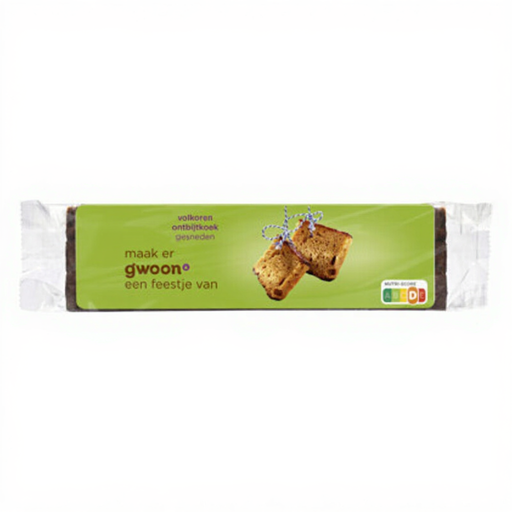
The 345 g sliced wholemeal breakfast cake is worth considering when comparing sugars, fibre and sweeteners.
AH Wholemeal Sliced Breakfast Cake is a pre-sliced 485 g product.
PLUS Wholemeal Sliced Breakfast Cake is a pre-sliced 485 g product.
ALDI lists a pre-sliced 485 g wholemeal breakfast cake from Koek & Bakker.
This pre-sliced wholemeal breakfast cake is only an option for an occasional treat if the nursery’s food and allergy policies allow it; it is not a replacement for a bread-based lunch.
 No image available
The sliced format is an option for an occasional portion if the nursery allows breakfast cake.
Before handing it out, check the allergens on the physical packaging: the ingredients list rye, but the available allergen information conflicts with this. Also check the nutrition per 100 g before comparing sugars or fibre with another product.
Not necessarily. The Netherlands Nutrition Centre recommends bread for young children’s lunch and does not include cake among foods that support a nutritious diet in its example childcare food policy. Check the nursery’s policy first; breakfast cake may be an option only if the policy allows it as an occasional treat.
No. The Peijnenburg product discussed contains xylitol and, according to Joybuy’s product information, carries a warning that excessive consumption may have a laxative effect. Compare the other ingredients, nutrition information, portion size and allergens too.
Read the ingredients and allergen information on the physical packaging of the product you intend to use. The Netherlands Food and Consumer Product Safety Authority requires allergens to be clearly identified in the ingredients list and the type of cereal to be stated for cereals containing gluten. Also follow the nursery’s individual arrangements.
No. The Netherlands Food and Consumer Product Safety Authority says iodine compounds may be present in bakery products only through added baker’s salt; this does not confirm that every breakfast cake contains it. Check the specific product information or ask the manufacturer if this matters for an individual diet plan.