
Vandaag of morgen in huis

Kwaliteit gegarandeerd

Welkomstaanbiedingen ontgrendelen: GRATIS bezorging | Tot 80% korting | Gratis 30 dagen JoyPlus-proefperiode
Download de app
A black men’s bodywarmer is useful for walking, cycling, travelling and everyday wear. However, not every warm men’s bodywarmer is suitable for active use. A thick style can restrict your movement, while a thin gilet may not keep you warm enough when the wind picks up.
If you’re looking for a black The North Face men’s bodywarmer, don’t focus solely on the brand or appearance. The fit, insulation, ventilation and protection from light rain all affect how practical it is to wear.
A bodywarmer with a DWR finish can help protect you from light moisture or a brief shower. That doesn’t automatically mean it will keep out heavy rain for long periods. Check whether the product information describes it as water-repellent or says it has a fully waterproof construction.
The product description for the The North Face NF0A8DY6 specifies a Non-PFC Durable Water-Repellent finish. This is handy in changeable weather, but you’ll still need a rain jacket in prolonged rain.
More padding doesn’t always mean more comfort. An insulated men’s bodywarmer can be warm, but may quickly feel too hot when walking or exercising if excess heat can’t escape. Look at how the insulation works with the breathable side panels.
According to the product description for the The North Face ThermoBall bodywarmer, synthetic insulation is used in the chest and back, while the side panels are breathable. This points to a hybrid design that combines warmth with ventilation.
A bodywarmer is often worn over a shirt, long-sleeved top or lightweight fleece. A style that’s too tight can pull across your shoulders and chest. One that’s too loose may let in draughts and feel less secure when you’re cycling or walking.
Check your hip measurement as well as your chest measurement. Also consider whether you want to wear a layer underneath. The product information lists sizes from XS to 3XL; check the product page to see which options are currently available.
The product description specifies 100% synthetic fibre insulation, with ThermoBall as the insulating material. Synthetic insulation is generally practical for outdoor use in changeable conditions and is easy to combine with other layers. How warm it feels will also depend on the wind, what you’re wearing underneath, your activity and your personal preference.
If you’re looking for a lightweight men’s bodywarmer, consider the balance between insulation and freedom of movement. A compact style works well as an extra layer, but may offer less protection if you’re standing still in cold weather for a long time.
According to the product information, the outer fabric of this style is made from 91% polyester and 9% elastane. Elastane can add stretch when you move your arms, for example when walking with poles, cycling or training.
Pay attention to how the bodywarmer fits. Stretch is useful, but it won’t make up for choosing the wrong size. The shoulder seams shouldn’t pull, and the zip should fasten without straining when you’re wearing a light layer underneath.
For active use, ventilation is one of the main differences between a basic black men’s outdoor bodywarmer and a more performance-focused style. The product description mentions FlashDry fabric and says it helps to wick moisture away from the skin. As this is a branded term, we’re presenting it as a product claim from the manufacturer, not as a guaranteed result for every wearer.
The combination of moisture management and breathable side panels makes this style particularly worth considering for walking, light training and everyday cycling. What you wear during intense exercise is a personal choice: a bodywarmer covers a large part of your torso, so it isn’t a full ventilation layer.
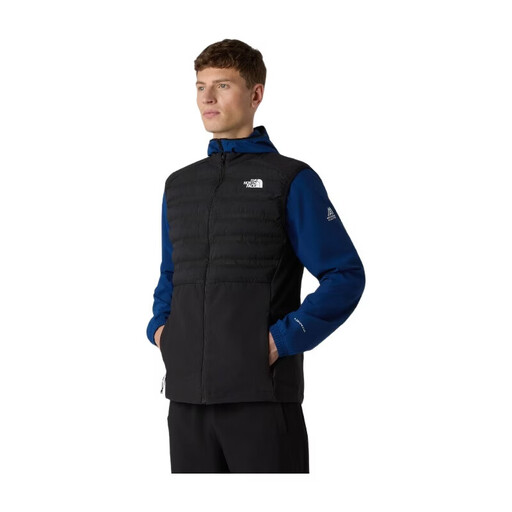
Why it suits this profile: Size S is a good choice if you want a close-fitting layer for everyday wear, walking or cycling, and prefer not to wear a bulky gilet.
The size information gives specific chest and hip measurements. You can compare these with your own clothes instead of relying on the photo alone.
91% polyester and 9% elastane; synthetic ThermoBall insulation in the chest and back; the black colour is easy to pair with other layers.
Why it suits this profile: Size L leaves room for a light mid-layer and works well for longer walks or everyday wear in cool, changeable weather.
The hybrid construction means you don’t have to focus on a thick layer of insulation alone. The side panels are described as breathable, and the fabric contains stretch.
ThermoBall synthetic insulation; Non-PFC DWR finish for light moisture; suitable for wearing over a light layer.
Why it suits this profile: Size XL is designed for anyone who needs extra room for layers or a looser fit during outdoor activities.
The stretch in the woven outer fabric helps you move your arms freely. It’s still important to compare your chest and hip measurements with the size chart.
Size XL; 9% elastane in the outer fabric; insulation in the chest and back with breathable side panels, according to the product description.
We’ve put together a full, up-to-date list of products that meet these strict selection criteria and the applicable European safety requirements.
The right care can help preserve the fit and insulating properties as much as possible. According to the product information:
A DWR finish can become less effective over time with washing and wear. Always check the care label before trying to reactivate the finish with heat.
The product description specifies a Non-PFC DWR finish that provides protection from light moisture. This makes the bodywarmer suitable for drizzle or changeable conditions, but not necessarily for prolonged heavy rain. In wet weather, wear it with a suitable waterproof layer.
Measure your chest and hips, then compare both measurements with the chart on the product page. The listed sizes range from XS to 3XL. If you want to wear a fleece or jumper underneath, allow for extra room. Also check which options are available before ordering.
According to the product information, the garment can be machine-washed at a maximum of 40 °C. Fasten all closures, use a mild detergent and follow the care label. Tumble drying on a low temperature is listed as an option if the label allows it.
