
Vandaag of morgen in huis

Kwaliteit gegarandeerd

Welkomstaanbiedingen ontgrendelen: GRATIS bezorging | Tot 80% korting | Gratis 30 dagen JoyPlus-proefperiode
Download de app
A non-stick frying pan may seem simple to choose at first glance. However, attractive phrases on the packaging can hide important differences. A pan may appear suitable for induction, but have a base that is too small. A coating may be described as scratch-resistant, while metal utensils are still discouraged. And although a pan may be dishwasher-safe, the care instructions may state that it will last longer if washed by hand.
For everyday frying, searing, stir-frying or low-fat cooking, the most important factors are the coating, dimensions, hob compatibility and care requirements. Below, we explain the key points to consider.
A frying pan suitable for all hobs should work on induction, gas, electric and ceramic hobs. Don’t just check the title: look at the product specifications as well. A magnetic base is required for induction. Also pay attention to the base diameter: a 28 cm pan may have a considerably smaller effective cooking surface.
Not every pan is universal. According to the product information, the Tefal Easy Cook & Clean 32 cm is suitable for gas, electric, ceramic and glass-ceramic cooking, but not for induction. This is an important distinction if you’re looking for an induction frying pan.
Ceramic, titanium and stone-effect coatings have different properties. Product information may include terms such as “extra scratch-resistant”, “non-stick” or “long-lasting”. According to information provided by the brands concerned, some coatings are designed to last longer, but their lifespan also depends on heat, utensils and cleaning methods.
Where possible, use wooden, silicone or nylon spatulas. Avoid metal utensils and steel wool. Don’t heat an empty pan at a high temperature for an extended period, and allow a hot pan to cool before washing it.
PFAS-free and PFOA-free are not automatically the same product claim. PFOA is one substance within the wider PFAS group. If a product only states “PFOA-free”, that is not the same as an explicit PFAS-free claim.
For some models in this selection, the product information explicitly states “PFAS-free”, including certain Brabantia, Redchef, Tefal and USELUCK products. Always check the current specifications for the product itself. A “healthy frying pan” is not a medical category either, so focus on the materials used, care instructions and specific safety information.
A ceramic frying pan generally has a ceramic-based coating. Aluminium is often used for the pan body because it is relatively light and conducts heat quickly. Stainless steel can add more weight, but it is sturdy and suitable for higher temperatures.
Pay attention to the following:
When it comes to brand claims, remember that, according to the brand’s own information, a coating may be PFAS-free or suitable for low-fat cooking. Treat this as a product specification rather than a health promise.
A 24 cm frying pan is well suited to one to three portions, depending on the dish. This size is practical for eggs, omelettes, vegetables and smaller cuts of meat. A 28 cm frying pan provides more cooking space for a family or several ingredients at once. A 20 cm pan is useful for one person or small side dishes.
A larger pan does not always make cooking more convenient. Also check the weight, handle and size of your cooking zone. A 32 cm pan may be suitable for larger quantities, but it takes up more space in a kitchen cupboard and on the hob.
A dishwasher-safe frying pan is convenient, but washing by hand with a soft sponge is often recommended to help keep the coating in good condition for longer. Also check whether the pan is oven-safe and up to what temperature. A metal handle and a plastic or Bakelite handle have different usage limits.
A frying pan with a lid or deep sauté pan is useful for stews, sauces and dishes that need to retain moisture. For stir-frying, a wok with higher sides may be more suitable than a shallow frying pan.
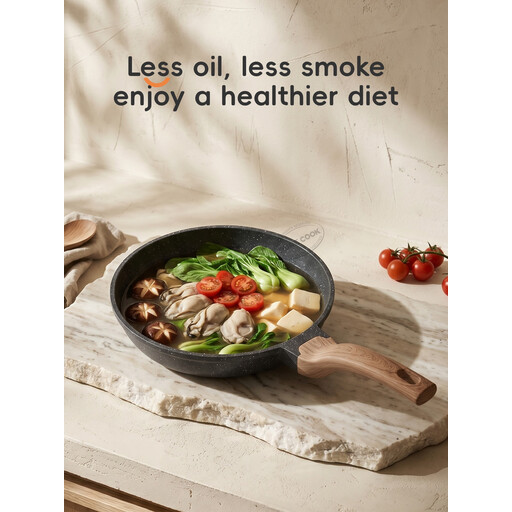
Why it suits this profile: The 24 cm size is suitable for everyday portions, while the aluminium pan body is described in the product information as lightweight and quick to heat.
The specifications explicitly mention induction, gas and ceramic hobs. The pan is not dishwasher-safe, so hand washing is part of its care requirements.
24 cm diameter, a wooden heat-insulating handle and a stone-effect non-stick coating according to the product description.

Why it suits this profile: This pan combines a 24 cm size with induction compatibility, oven use and a dishwasher option.
The product information states that it has a PFAS-free ceramic coating, is suitable for all common hobs and can be used in the oven up to 200 °C. Hand washing is still recommended to help preserve the coating.
Made from 100% recycled forged aluminium according to the product information; suitable for ovens up to 200 °C and for the dishwasher.
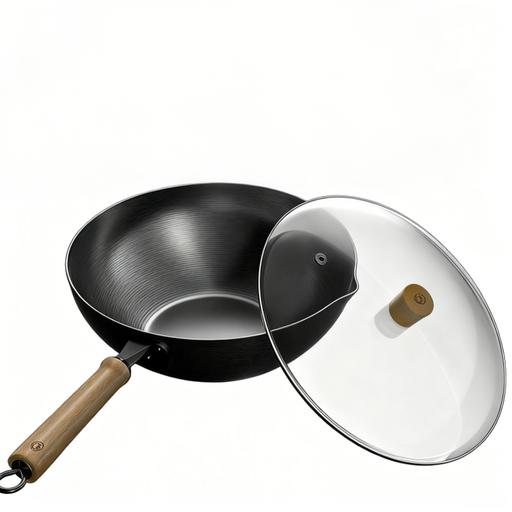
Why it suits this profile: The high sides and 32 cm size are well suited to stir-frying, larger quantities and dishes containing several ingredients.
The product title states that it is suitable for induction and gas. Before buying, however, check that the size and base are compatible with your cooking zone.
32 cm wok shape, lid and non-stick coating according to the product information; suitable for stir-fried dishes.
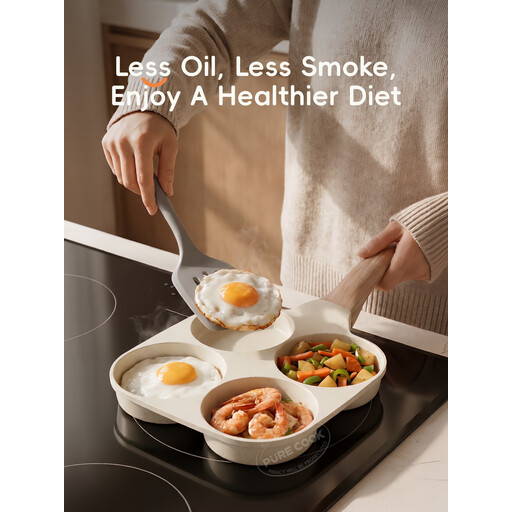
Why it suits this profile: The four compartments are practical for eggs, mini pancakes, burgers or sausages that need to be cooked at the same time.
The product specifications state the exact 19 cm size and recommend hand washing. This makes it clear in advance that it is not a general-purpose family frying pan.
Lightweight aluminium, four separate compartments and, according to the product information, suitable for induction, gas and ceramic cooking.
We’ve put together a complete, up-to-date list of products that fully meet these strict selection criteria and the applicable European safety regulations.
For one person or small portions, 20 cm is practical. A 24 cm frying pan is suitable for everyday cooking for one to three people. Choose 28 cm when cooking for several people or when your ingredients need more space. A 32 cm pan is particularly useful for larger meals, but requires more storage space and a suitably sized cooking zone.
That depends on the base, not just the coating. A ceramic frying pan can be suitable for induction if it has a magnetic induction base. Always check the specifications. Some models are suitable for all hobs; others, such as the Tefal Easy Cook & Clean mentioned above, are not suitable for induction according to the product information.
There is no fixed lifespan that applies to every pan. Frequent use at high temperatures, metal utensils and abrasive cleaning can damage the coating more quickly. A pan will generally last longer if you use the recommended temperature, gentle cleaning methods and suitable spatulas. Replace the pan if the coating is visibly peeling or the handle is no longer firmly attached.
