
Vandaag of morgen in huis

Kwaliteit gegarandeerd

Welkomstaanbiedingen ontgrendelen: GRATIS bezorging | Tot 80% korting | Gratis 30 dagen JoyPlus-proefperiode
Download de app
A non-stick pan may seem simple to choose at first glance. However, small differences in coating, base and size can determine whether your pan is a pleasure to use or ends up in the cupboard after a short time. This is especially true of induction pans and pan sets, where features are sometimes presented broadly while important details are less noticeable.
So watch out for these common pitfalls:
If you have an induction hob, look specifically for a magnetic, flat base and the wording “suitable for induction”. For pans suitable for all heat sources, the product information should clearly mention gas, electric, ceramic and induction cooking. Also check the diameter of the base. For example, a 28 cm wok may have a smaller induction base than its upper rim suggests.
A pan for gas does not automatically work on induction. The reverse is also true: an induction pan can be used on gas, but the handle and coating must be kept a sufficient distance from the flame.
A ceramic non-stick coating is often chosen by consumers looking for PFAS-free pans. For the Brabantia Dusk set and Brabantia Onyx products, the manufacturer states that they have a 100% PFAS-free ceramic coating. Do not automatically assume this applies to every ceramic pan: always check the product description for the specific model.
Other pans use a PTFE or titanium coating. According to the product information, the Tefal Easy Cook & Clean has a titanium non-stick coating without PFOA, lead or cadmium. This does not mean that the pan is suitable for induction; the manufacturer specifically states that induction is not supported.
With a coated pan, preferably use wooden, silicone or plastic utensils. Metal spatulas can damage the coating, even when it is described as scratch-resistant.
For one or two people, a 20 to 24 cm frying pan is often easy to handle. A 28 to 32 cm pan offers more space for families, but also requires a suitably sized cooking zone and enough storage space.
Aluminium pans generally heat up quickly. A stainless steel wok or a wok with a multi-layer stainless steel construction may be worth considering if you are looking for a sturdy pan with a different heat distribution. In both cases, check the exact coating and care instructions.
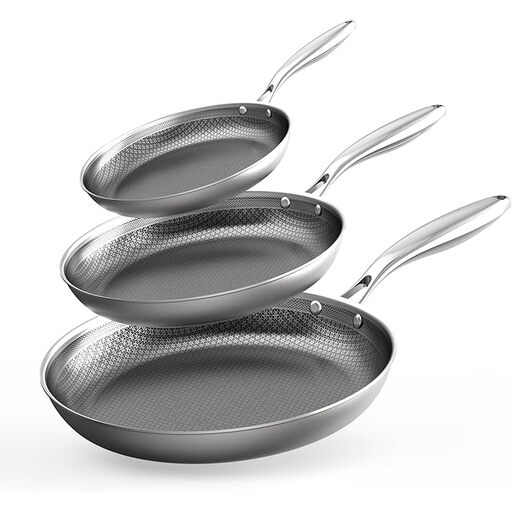
Why it suits this profile: The set contains three sizes—20, 25 and 30 cm—so you do not need to buy separate pans straight away for a variety of everyday cooking tasks.
The product name states that it is compatible with induction and all hobs. Before buying, however, check the latest technical details and instructions for use.
Three sizes, dishwasher- and oven-safe according to the product information, with handles designed to stay cool during normal use.

Why it suits this profile: The 20 and 24 cm combination is ideal for everyday meals for one to three people and for anyone who values PFAS-free pans.
According to Brabantia, the set has a PFAS-free ceramic non-stick coating. Hand-washing is still recommended to protect the coating.
Made from 100% recycled forged aluminium according to the product information, suitable for induction and oven-safe up to 200 °C.
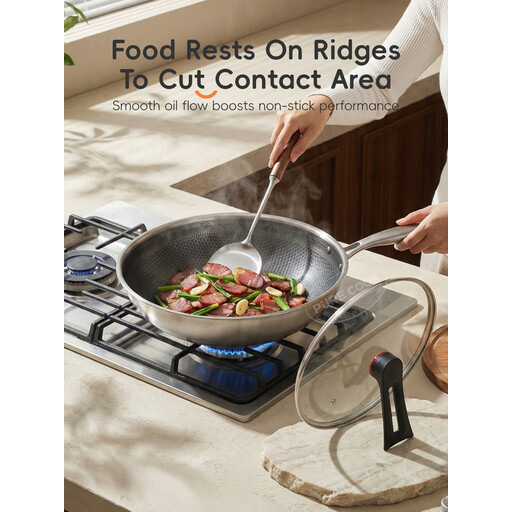
Why it suits this profile: The 32 cm wok with glass lid is designed for stir-frying, stewing and preparing larger portions for families.
The description mentions gas, induction and electric ceramic hobs. The wok is large, so check that your induction zone adequately covers the base.
Three-layer 304 stainless steel construction, honeycomb structure and glass lid according to the product information. Hand-washing is recommended.
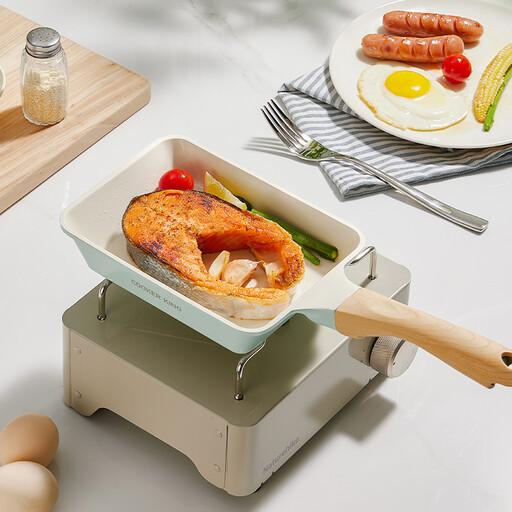
Why it suits this profile: The 18 × 13 cm dimensions and rectangular shape are designed for tamagoyaki, small omelettes and portion-focused cooking.
The product name states that it is suitable for induction and has a ceramic coating. Do not use metal utensils without first checking the latest instructions.
Compact size, rectangular shape and, according to the product information, free from PTFE and PFOA.
We have put together a complete, up-to-date list of products that fully meet these strict selection criteria and the applicable European safety regulations.
A non-stick coating will generally last longer if you:
For dishwasher-safe pans, hand-washing is often still the more cautious choice. Also check whether the handle is oven-safe. For example, one pan may be suitable for use in the oven up to 200 °C, while another model has a lower limit or is not oven-safe at all.
Only when the manufacturer explicitly states this. Check both the product title and the specifications. A pan suitable for gas and ceramic cooking is not automatically an induction pan.
Its service life depends on heat, utensils, cleaning and storage. Overheating, metal spatulas and abrasive cleaning can damage the coating more quickly. Replace the pan when the coating visibly starts to peel or when the handle is no longer firmly attached.
Not necessarily. PFAS-free pans in the range are often offered with a ceramic coating, but check the official product description for each item. Brand claims about materials and performance should be read as product information, not as a general guarantee for every pan.
