
Vandaag of morgen in huis

Kwaliteit gegarandeerd

Welkomstaanbiedingen ontgrendelen: GRATIS bezorging | Tot 80% korting | Gratis 30 dagen JoyPlus-proefperiode
Download de app
A non-stick frying pan might seem like a simple choice at first. But pans vary considerably in size, heat distribution, care requirements and suitability for induction. A low price can be tempting, but a pan that warps, doesn’t fit your hob properly or starts sticking quickly won’t offer much value in the long run.
For households in the UK, these are some of the main pitfalls to watch out for:
A ceramic frying pan has a ceramic non-stick coating. Other materials may be used in a traditional coating. Claims such as PFAS-free frying pan and PFOA-free frying pan should always appear in the product specifications, not just in general advertising copy.
Look out for the difference between:
According to the brands’ own product information, some models are also made without intentionally added PFOS, lead or cadmium. Always check the current product page before buying, and avoid metal utensils if the manufacturer recommends wooden, silicone or nylon spatulas.
An induction frying pan needs a magnetically conductive base. A pan that’s suitable for all hob types will usually have a magnetic stainless steel base or a similar construction. Also check that the base diameter suits your induction zone. A 28 cm pan may be wide at the top, while the effective heating area is smaller.
The base matters for gas, electric and ceramic hobs too. A flat base generally makes stable contact with the hob. Don’t put a hot pan straight under cold water: a sudden change in temperature can put stress on the material and coating.
“Dishwasher-safe” doesn’t mean the coating will last indefinitely through dishwasher cycles. High temperatures, strong detergents and contact with other cookware can wear down the finish more quickly. A dishwasher-safe frying pan is convenient, but washing it by hand with a soft sponge is often the gentler option.
Also check:
A healthy frying pan isn’t an official quality category. Using less oil may be useful for some dishes, but it’s best to judge a pan by its verifiable specifications, safe use and care requirements.
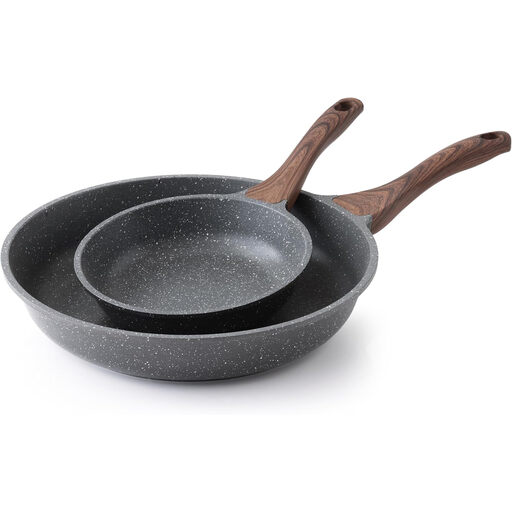
Why it suits this profile: This set pairs a small omelette pan with a spacious frying pan for everyday cooking, from breakfast to a family meal.
According to the product description, the pan is suitable for induction, gas, electric and ceramic hobs. The manufacturer says the coating is made without intentionally added PFOA or PFOS. Hand washing is recommended to protect the coating.
Two useful sizes, cast aluminium and oven-safe up to 400 °F, according to the product information.
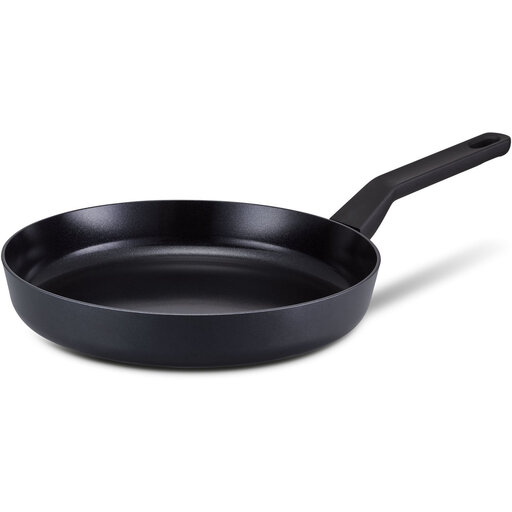
Why it suits this profile: This compact pan is designed for everyday frying and suits anyone who values recycled aluminium and clear information about materials.
The product information specifies a PFAS-free ceramic coating and compatibility with induction, gas, electric and ceramic hobs. It also recommends hand washing, despite the pan being dishwasher-safe.
24 cm diameter, 100% recycled aluminium according to the product description, and a ceramic coating.

Why it suits this profile: This non-stick wok is designed for stir-frying, braising and larger portions, with a glass lid for dishes that need longer to cook.
The specifications state that it has a flat magnetic base for induction, gas, electric and ceramic hobs. The manufacturer recommends hand washing, making it clear that dishwasher use isn’t intended.
30 cm size, three-layer stainless steel construction, honeycomb pattern and a tempered glass lid, according to the product information.
We’ve put together a complete, up-to-date list of products that meet these strict selection criteria and current European safety regulations.
A 20 to 24 cm pan is suitable for small portions, eggs and pancakes. A 26 to 28 cm pan gives you more room for meat, vegetables or a meal for several people. For stir-frying and simmering, a deep pan or sauté pan with a lid is more practical.
That depends on more than the ceramic coating. The pan needs a magnetic base, so check that the product page explicitly states that it’s suitable for induction. Many models are also suitable for gas, electric and ceramic hobs, but specifications vary from pan to pan.
Its lifespan depends on heat, use and care. Don’t use an empty pan on a high heat, avoid sharp metal spatulas and let the pan cool before washing it. Even with a dishwasher-safe frying pan, hand washing can help keep the coating in good condition for longer. Stop using the pan if the coating visibly starts to peel or is badly damaged.
