
Vandaag of morgen in huis

Kwaliteit gegarandeerd

Welkomstaanbiedingen ontgrendelen: GRATIS bezorging | Tot 80% korting | Gratis 30 dagen JoyPlus-proefperiode
Download de app
A non-stick frying pan may seem easy to choose, but product pages often use broad terms such as “healthy”, “all cooktops” and “indestructible coating”. In practice, differences in hob compatibility, care requirements and size can determine whether a pan continues to perform well.
That is why you should focus on verifiable specifications. An attractive coating means little if the pan is not suitable for your induction hob or is used with metal utensils after just a few weeks.
A frying pan for all hobs must have a magnetic base for induction. Aluminium alone will not work on an induction hob. So check whether the product description explicitly mentions induction, gas, electric and ceramic hobs.
For example, the 32 cm Tefal Easy Cook & Clean is suitable for gas, electric and ceramic cooking, but according to the product information it is not suitable for induction. This is an important difference if you have a new induction hob or are planning to switch to one soon.
A ceramic frying pan and a pan with a stone-effect coating are not the same thing. Check the stated type of coating and the care instructions. Some models use a ceramic layer, others a PTFE coating, while others use a texture that, according to the product description, limits direct contact with the cooking surface.
You should also read a claim such as “PFAS-free frying pan” carefully. “Without intentionally added PFAS” is a specific product claim and is not automatically the same as a general statement about all possible substances. If in doubt, the manufacturer’s material information and the product page should be your guide.
A dishwasher-safe frying pan may technically be suitable for the dishwasher, but repeated exposure to high temperatures and strong detergents can affect the lifespan of a non-stick coating. For many pans, hand washing with a soft sponge is recommended, even when dishwasher use is permitted.
Also, do not heat an empty pan at a high temperature, and avoid sudden temperature changes, such as placing a hot pan directly under cold water.
A frying pan with a non-stick coating is useful for eggs, pancakes, fish and vegetables with little oil. With a delicate coating, wooden, silicone or nylon utensils are preferable. Some honeycomb models state in the product description that certain metal spatulas may also be used, but sharp edges should still be avoided.
Look out for signs of wear. If the coating starts to peel, becomes badly damaged or the handle is no longer firmly attached, stop using the pan.
A large pan on a small induction zone may heat unevenly. So, as well as the diameter, check the diameter of the magnetic base.
An aluminium pan usually heats up quickly and is relatively lightweight. A multi-layer stainless-steel construction may distribute heat differently and often feels heavier. Also check whether the handle is oven-safe and up to what temperature.
A wooden handle is not automatically suitable for oven use. The same applies to plastic or Bakelite handles: the stated temperature limit is more important than the marketing name.
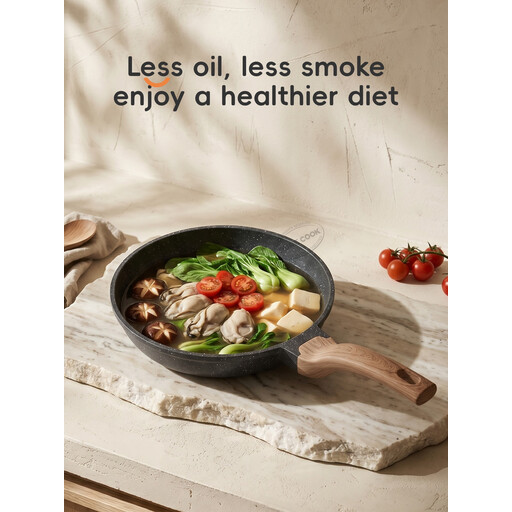
Why it suits this profile: This 24 cm aluminium pan is designed for everyday frying, sautéing and smaller portions. According to the product description, the model is suitable for induction, gas and ceramic hobs and should be hand-washed.
The product information clearly specifies the suitable heat sources. It also lists hand washing, gentle utensils and avoiding heating the pan empty as care recommendations.
Aluminium body, 24 cm diameter, easy to use and a smooth non-stick coating according to the product description.

Why it suits this profile: This pan combines a ceramic coating with a stainless-steel handle and, according to the product information, is suitable for all the listed heat sources, including induction. The pan is oven-safe up to 200 °C.
The product page explicitly states that it is PFAS-free, suitable for induction and oven-safe up to the specified limit. This means you do not have to infer these properties from general terms.
24 cm, ceramic PFAS-free coating according to the product information, suitable for all the listed hobs and dishwasher-safe.
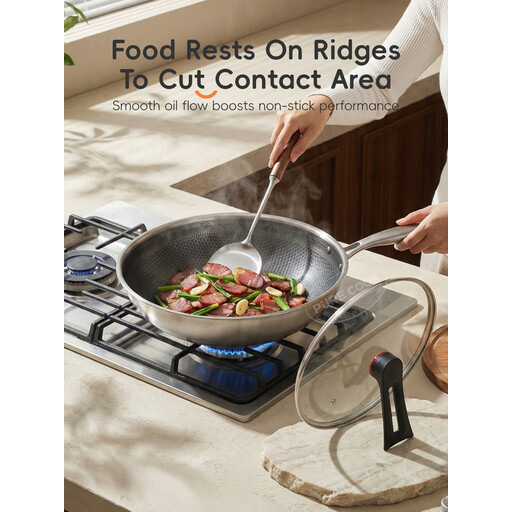
Why it suits this profile: This 32 cm wok is designed for stir-frying, sautéing, braising and preparing larger meals. According to the product description, the body is made from three-layer 304 stainless steel and the pan is suitable for gas, induction and electric ceramic hobs.
The compatible hobs and care instructions are clearly stated. According to the product information, hand washing and allowing the pan to cool gradually help to keep it in good condition.
32 cm size, glass lid, three-layer steel construction and honeycomb texture according to the product description.
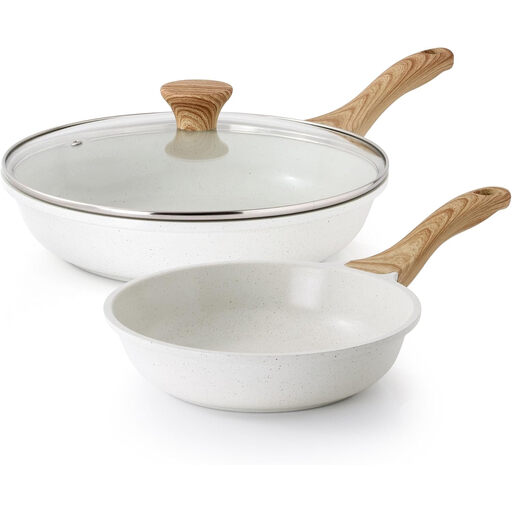
Why it suits this profile: The set includes a small omelette pan and a larger frying pan with a glass lid. According to the product description, both are suitable for induction, gas and electric hobs, and the ceramic coating is free from intentionally added PFAS, PTFE, PFOA, PFOS, APEO, lead and cadmium.
The set specifies both the coating and the suitable hobs. The care instructions recommend hand washing and non-abrasive tools; dishwasher use is not listed as suitable.
Two sizes, glass lid, aluminium body and broad hob compatibility according to the product information.
We have compiled a complete, up-to-date list of products that fully meet these strict selection criteria and the applicable European safety regulations.
The lifespan of a non-stick coating depends on more than just the material. These habits can help with everyday use:
A dishwasher-safe frying pan is convenient for busy households, but hand washing may be the wiser choice if you want to keep the coating in good condition for as long as possible.
Choose a model whose product information explicitly mentions induction. A magnetic, flat base is needed for efficient heat transfer. Do not rely solely on terms such as “universal” or “all hobs”.
This varies depending on the coating, frequency of use and care. High temperatures, scratches, stacking and dishwasher cycles can accelerate wear. Replace the pan when the coating becomes visibly damaged or the base becomes warped.
Not necessarily. Also consider the size, heat source, handle, oven use, lid and cleaning instructions. A PFAS-free ceramic frying pan may suit your preferences, while another user may benefit more from a deep frying pan with a lid or a complete frying pan set.
