
Anyone who likes to make their own warm bowl
With plain oats, you can choose which toppings to add. If you want to compare sugar levels, check the nutritional information as well as the ingredients.


Choose plain oats if you want to decide for yourself what goes into your warm breakfast and which toppings to add. Plain portion sachets are a better fit when quick preparation is your priority. Crunchy breakfast cereal is different from porridge, so compare the ingredients, nutritional information and allergens. ‘No added sugar’ doesn’t mean that a product contains no sugars at all.
With plain oats, you can choose which toppings to add. If you want to compare sugar levels, check the nutritional information as well as the ingredients.
Plain portion sachets are worth considering if you want a measured serving that can be heated quickly. Check the preparation instructions on the pack, and bear in mind that flavoured varieties may contain different ingredients.
Crunchy products have a different texture from porridge and can be enjoyed with yoghurt or quark. For these varieties, compare the ingredients, nutritional information and allergens too; they’re not the same as plain oats.
Start by deciding whether you want warm porridge or a crunchy breakfast bowl. Then compare the ingredients and the ‘of which sugars’ figures per 100 g. Preparation time and allergens may also help you make your choice.
| What to consider | What to check before buying | Who it matters to |
|---|---|---|
| Ingredients and sugars | Read the ingredients list and compare the ‘of which sugars’ figures per 100 g. ‘No added sugar’ doesn’t mean the same as ‘sugar-free’. | Anyone who wants to choose their own fruit or other toppings may prefer a simple oat base; around 36% of consumers put checking the ingredients first. |
| Preparing a warm breakfast | Check the preparation instructions, preparation time and serving size. | On a busy morning, I want a warm bowl without having to measure much out; around 29% of consumers make quick preparation their top priority. |
| Texture and protein | For crunchy varieties, compare protein, fibre, sugars and energy per 100 g, as well as the ingredients. | If I prefer a crunchy bowl with yoghurt or quark, I’m looking for a different texture from porridge; around 21% of consumers prioritise this and extra protein. |
| Allergens | Read the current allergen information. If you have coeliac disease, look for the official Crossed Grain symbol on the oat packaging, as recommended by the Voedingscentrum. | If an allergen limits my choice, the product needs to meet that need; around 14% of consumers put checking this first. |
According to the Voedingscentrum, products with no added sugar may still contain naturally occurring sugars. So the front of the pack won’t tell you how much sugar the product contains in total.
Read the ingredients and compare the ‘of which sugars’ figures per 100 g in the nutrition table.
A crunchy variety has a different composition and use from plain oats for warm porridge. The Quaker Cruesli Protein varieties listed by Jumbo contain additional ingredients alongside oats, including wheat gluten and oil.
First decide which breakfast texture you want, then compare the ingredients, allergens and nutritional information for each product.
The Voedingscentrum points out that oats can become contaminated with gluten during processing. If you have coeliac disease, an ingredients list that simply says oats won’t give you the reassurance you need.
If you have coeliac disease, check the current packaging for the official Crossed Grain symbol.
The product listings reviewed range from ordinary porridge oats and plain portion sachets to crunchy Cruesli Protein varieties.
Brinta Oatmeal is an option if you’re looking for extra-fine oats as the base for a warm bowl you can customise.
ALDI lists Golden Bridge Fine Wholegrain Oatmeal as a simple oat option.
The first four products are oats for making a warm bowl, including a quick-preparation portion option alongside plain oats. The last product is a crunchy breakfast option, not porridge oats; check the packaging if you want to avoid added sugar.
 No image available
A portion option to consider if you want to make a warm bowl quickly. Check the ingredients, preparation instructions and ‘of which sugars’ figures on the packaging.
 No image available
An oat base for anyone who wants to put together their own warm bowl and toppings. Compare the ingredients and sugars per 100 g on the packaging.
 No image available
An option if you want to prepare oats with your choice of toppings. According to Albert Heijn’s product listing, Brinta Oatmeal is made from 100% oats; check the current packaging for allergen information.
 No image available
An oatmeal option for a breakfast bowl you can make your own. Check the ingredients, allergens and nutritional information on the packaging if you want to compare it with other oats.
 No image available
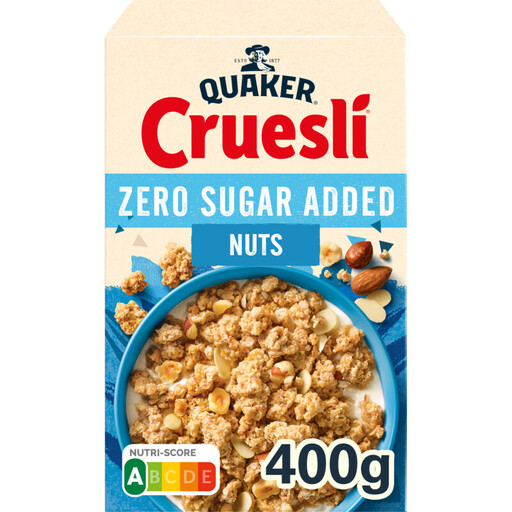
A crunchy breakfast option if you’re not looking for warm porridge. Treat Zero Sugar as part of the product name, and check the ingredients, allergens and ‘of which sugars’ figures on the packaging.
No. The product may still contain naturally occurring sugars. The Voedingscentrum recommends looking beyond the front of the pack: read the ingredients and check the ‘of which sugars’ figures per 100 g.
Plain oats give you the freedom to choose your own toppings. Prepare them according to the pack instructions, and check the ingredients of anything you add to your bowl if you want to avoid added sugar.
Ordinary porridge oats aren’t automatically suitable for people with coeliac disease, as oats can become contaminated with gluten during processing. The Voedingscentrum recommends choosing only oats with the official Crossed Grain symbol on the packaging.
Start by comparing different products per 100 g, so differences in serving size don’t skew the comparison. Then check the serving information to see how much you’d use for your own bowl.