
Vandaag of morgen in huis

Kwaliteit gegarandeerd

Welkomstaanbiedingen ontgrendelen: GRATIS bezorging | Tot 80% korting | Gratis 30 dagen JoyPlus-proefperiode
Download de app
A night light with a motion sensor can be useful in a bedroom, nursery, hallway or toilet. The light switches on automatically when movement is detected, so you don’t have to search for a switch. However, these lights vary considerably in their power source, brightness, sensor range and installation.
So the right choice depends on more than just how it looks. Pay particular attention to these common pitfalls.
Not every motion-sensor light only responds in the dark. Check whether the light has a light-sensitivity threshold, such as 20 lux. This lets you limit the automatic function to dark conditions. A light without this setting may keep responding during the day or when there is enough ambient light.
A high lumen count may sound appealing, but bright light isn’t always practical in a bedroom or nursery. A soft LED night light may be enough for a short route to the toilet. An entrance, patio or driveway, on the other hand, needs more light. So look at lumens, colour temperature and dimming options, rather than just the number of LEDs.
A mains-powered light doesn’t need charging, but it needs to be placed near a socket. A rechargeable night light is more flexible, but has a limited run time per charge. Battery-powered models are easy to position, while a solar outdoor light with a motion sensor depends on getting enough daylight.
A range of around 3 to 5 metres is often practical for a small hallway or bedroom. Also check the detection angle and whether the sensor only activates in low light. Product information may specify activation at a maximum of 20 lux and a range of 3 to 5 metres. Actual detection also depends on where the light is positioned, any obstacles and the direction someone walks past the sensor.
Brightness is measured in lumens (lm). A value of around 20 to 30 lumens works well for orientation lighting in a bedroom, wardrobe or hallway. Outdoor lighting often needs a much higher light output.
Colour temperature is measured in kelvin (K):
A dimming function with several settings makes the light useful at different times. If you’re considering a light with high colour rendering, check the stated CRI value. A CRI of over 85 is listed in the product information for some models, but this doesn’t guarantee that everyone will perceive the light in the same way.
A plug-in light is easy to position, while a wireless wall light or rechargeable light gives you more flexibility. For a built-in lithium battery, check the capacity, charging time and stated run time. The stated run time usually depends on the brightness setting and how often the sensor is activated.
For outdoor use, the IP rating is important. IP44 means protection against splashing water, but not immersion or powerful jets of water. This may be suitable for a patio, balcony or sheltered entrance. Don’t place an IP44 light somewhere it will be exposed to prolonged direct rain or jets of water.
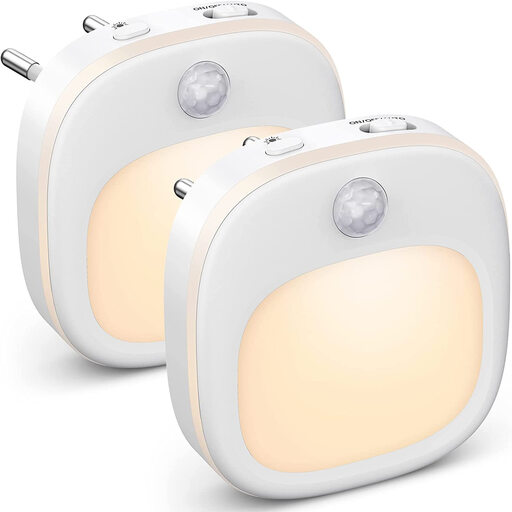
Why it suits this profile: The set includes two lights, for example for a bedroom and hallway. According to the product information, three colour temperatures and five dimming settings are available.
The five dimming settings help prevent a small room from being lit unnecessarily brightly. Just check beforehand that there’s a suitable socket near your chosen location.
Two lights, 1 W power per light and three colour temperatures, according to the product listing.

Why it suits this profile: This rechargeable night light is a good fit for households that don’t want to place a light by a socket. It has a built-in 500mAh battery and charges via USB.
The light doesn’t rely on a fixed socket. Bear in mind that it needs charging: according to the product information, run time in sensor mode is up to 10 hours.
USB charging, five brightness settings, three colour temperatures and a stated light output of 30 lumens.
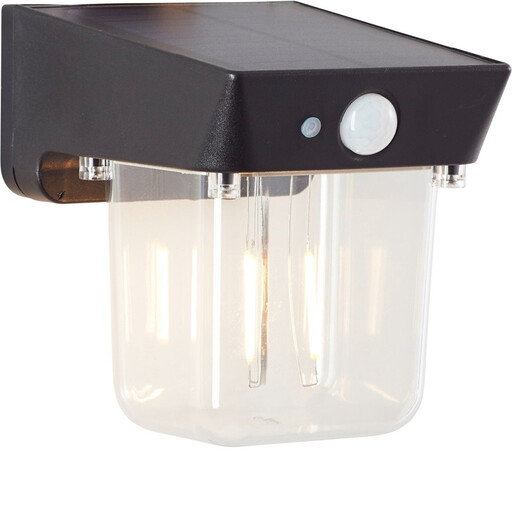
Why it suits this profile: This solar outdoor light with a motion sensor is designed for an entrance, patio or garden where you don’t want a fixed mains connection.
The built-in battery and solar panel mean there’s no need for a power cable. The specification states that IP44 provides splash protection, so position the light in a sheltered spot.
Solar power, integrated LED, 180 lumens, 2 W power and a stated IP44 rating.
We’ve put together a complete, up-to-date list of products that meet these strict selection criteria and current European safety regulations.
Position the light at a height and angle that lets the sensor detect the direction of travel. Avoid obstacles such as tall cupboards or doors that block its view. Test the light in the dark and check that it doesn’t shine directly into your eyes.
Run time depends on the type of power source. A plug-in light works for as long as it receives power. For a battery-powered or rechargeable model, run time depends on battery capacity, brightness and the number of activations. For outdoor models, the amount of sunlight also affects the available power.
Only if its position and protection rating are suitable. Check the IP rating and take the zones around water into account. According to the product information, an IP44 light is splash-resistant, but isn’t designed for immersion or direct jets of water. If it’s a fixed electrical installation, check the relevant safety regulations.
