
Vandaag of morgen in huis

Kwaliteit gegarandeerd

Welkomstaanbiedingen ontgrendelen: GRATIS bezorging | Tot 80% korting | Gratis 30 dagen JoyPlus-proefperiode
Download de app
A night light with a motion sensor can be useful in the bedroom, nursery, hallway, toilet or kitchen cupboard. The light switches on automatically when movement is detected, so you do not have to search for a switch at night. However, not every model is suitable for every situation.
The biggest buying mistakes usually result from three common pitfalls:
So do not just look at the appearance or the number of light settings. Pay particular attention to the sensor, brightness, mounting method and charging method.
A PIR motion sensor generally detects movement within a certain distance. The models in this selection, for example, state a range of 3 to 5 metres. This is useful for a hallway, cupboard or bedroom, but positioning determines how much of the room is covered.
A light sensor operates based on the brightness of the surroundings, expressed in LUX. Some lamps, for example, switch on automatically at a maximum of 20 or 40 LUX. Combining light and motion detection prevents the lamp from switching on unnecessarily during the day.
For a night light for a hallway and toilet, automatic activation is practical. For a cupboard, a PIR sensor is often the more logical choice, as the light only switches on when you approach the door or start looking for something.
Colour temperature is measured in Kelvin (K):
A night light with colour temperature adjustment offers more flexibility than a lamp with one fixed shade. A night light with dimming is particularly useful beside a bed. Do check whether all colours can be dimmed. With some models, stepless dimming only applies to warm white, while RGB colours have a fixed brightness or colour cycle.
Also check the lumen output. A lamp producing 20 to 40 lumens is often sufficient as orientation lighting. A cupboard or work surface may require more light.
A rechargeable LED night light with a built-in lithium battery can be used wirelessly and charged via USB. Check:
A USB rechargeable lamp can be charged via a laptop, power bank or suitable USB charger. Only use the specified charging voltage and keep the lamp away from water. Mains-powered models do not need charging, but their positioning is less flexible.
When choosing cupboard lighting with a sensor, check the dimensions. A profile that is 10 millimetres thick is easier to fit beneath a shelf than a round lamp several centimetres wide. Self-adhesive mounting is simple, but the surface must be clean and dry. Check regularly that the lamp is still securely attached.
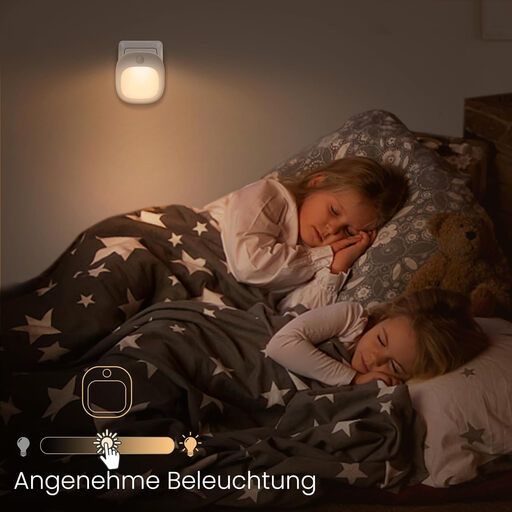
Why it suits this profile: This 2-pack combines a built-in 500mAh battery, USB charging and multiple settings. This means you can provide wireless lighting in two small spaces without needing to use a mains socket straight away.
The product information states both a motion range of 3–5 metres and activation at a maximum of 20 LUX. The five dimming levels and three colour temperatures are also clearly specified.
30 lumens, five brightness levels, three colour temperatures and USB charging via 5 V/1 A. The stated operating time in sensor mode is up to 10 hours.

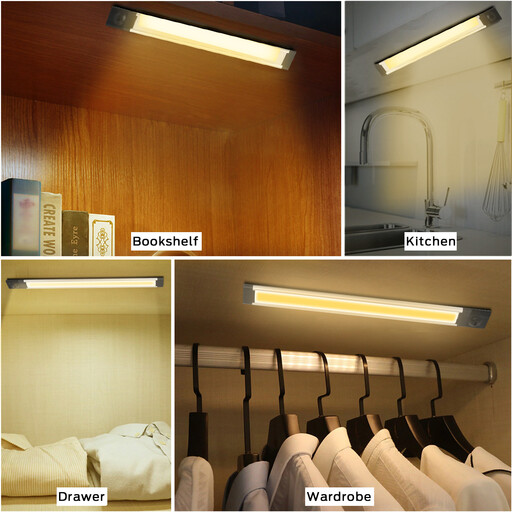
Why it suits this profile: The long, slim design is intended to provide even lighting in kitchen cupboards, wardrobes and along shelves. The 2-pack makes it possible to illuminate multiple areas.
The specifications state dimensions of 400 × 38 × 10 mm. This allows you to check in advance whether the lamp will fit into a narrow recess, rather than relying solely on lifestyle images.
61 LEDs, PIR detection at 3–5 metres, three colour temperatures and a built-in 1,100mAh battery. According to the product information, it can be mounted with self-adhesive tape without drilling.
Why it suits this profile: With a stated light output of 400 lumens, this model is designed for larger or darker areas, such as a storage room, staircase, garage, wardrobe or long hallway.
According to the product description, it can be mounted using magnetic attachment or hanging hooks. This means you do not need to drill holes, but you should check that the fixing can safely support the weight.
36 SMD LEDs, a stated light output of 400 lumens, adjustable colour temperature from 2,800–6,500 K and a compact size of 26 × 4 × 1 cm.
We have put together a complete, up-to-date list of products that fully meet these strict selection criteria and the applicable European safety regulations.
Do not position a sensor lamp behind the edge of a piece of furniture or a curtain. This can restrict the detection range. In a nursery or child’s bedroom, a child-friendly night light is not automatically a toy. Follow the safety instructions, keep cables out of reach and do not allow young children to use a rechargeable lamp unsupervised.
A lamp near a washbasin or toilet should be protected from splashing water in accordance with the manufacturer’s instructions. Most of the models mentioned are intended for indoor use and must not be immersed or exposed to excessive moisture.
LED lamps are generally energy-efficient and can help keep running costs down, but the actual cost depends on wattage, operating time and charging frequency. A 1-watt lamp that switches on briefly uses less energy than one that stays on continuously all night. For a battery-powered model, you should also take the cost and waste of replacement batteries into account.
Clean the surface, attach the lamp according to the instructions and point the sensor towards the route people take. Then test it at different distances. With a self-adhesive model, it is advisable to check first whether the tape is suitable for the wall, cupboard or shelf.
This varies depending on battery capacity, brightness and the number of activations. The product information may provide an indication, such as up to 10 hours in sensor mode for a 500mAh model. Actual operating time may vary depending on the temperature and usage pattern.
An LED sensor lamp only switches on when the set conditions are met. As a result, it usually stays on for less time than a lamp that is constantly illuminated. Check the stated wattage, the LUX threshold and whether the lamp can also operate in permanent lighting mode.
