
Vandaag of morgen in huis

Kwaliteit gegarandeerd

Welkomstaanbiedingen ontgrendelen: GRATIS bezorging | Tot 80% korting | Gratis 30 dagen JoyPlus-proefperiode
Download de app
A night light with a motion sensor can be useful in a dark hallway, bedroom, nursery, bathroom or wardrobe. The light switches on automatically when you walk past, so you do not have to search for a switch. However, sensor lights vary considerably in how they work, how they are fitted and how they are powered.
Marketing copy often focuses on high lumen output, multiple light settings or long battery life. For everyday use in a UK home, other questions are just as important: does the sensor only work in the dark, how is the light recharged and is the fitting suitable for your wall or cupboard?
Not every LED night light that switches on automatically responds to movement. Some models only have a day/night sensor and switch on as soon as the ambient light falls below a certain level. This is practical as an orientation light, but it is not the same as a light that only comes on when someone walks past.
Therefore, check that the product description explicitly mentions PIR motion detection, a detection range and a light threshold, such as ≤20 lux.
A bright light can be useful in a storage cupboard or on a balcony, but may feel harsh next to a bed. As well as lumen output, look at the colour temperature:
A bedroom night light therefore does not need to have the same brightness as an outdoor wall light with a motion sensor.
A wireless night light usually runs on batteries or a built-in rechargeable battery. With disposable batteries, you need to allow for replacements. A rechargeable night light does not need to be connected to a socket while in use, but it does need to be charged regularly via USB.
Also consider how the light is mounted. Self-adhesive strips are suitable for lightweight lights and smooth surfaces. A heavier light with magnetic mounting requires a firm, flat surface. In addition, check whether the light is intended for indoor or outdoor use. An IP44 light is splash-resistant, but is not suitable for immersion or a direct jet of water.
A sensor range of, for example, 3 to 5 metres is useful in a hallway, bedroom or bathroom. For a driveway or garden, you may need a greater range. Philips Zyren outdoor lights, for example, specify a range of 8 metres for direct approach and 16 metres for sideways movement. According to Philips’ product information, this is linked to the built-in PIR sensor; actual detection also depends on the mounting height, direction of movement and obstacles.
The automatic switch-off time is also relevant. If this setting is not clearly specified, the light may stay on for longer than expected.
When comparing a USB night light, do not only check whether it has a charging port. Also look at:
A built-in 500 mAh battery with a stated operating time of up to 10 hours in sensor mode may be suitable for occasional use at night. For intensive use, a model with a larger battery or a permanent mains connection may be more practical.
Lumens indicate the total light output. A 20 lm model is intended for orientation lighting, while 300 to 400 lm may be more suitable for a larger room or exterior wall. A night light with a dimmer gives you extra control when you want to illuminate different situations.
Also consider the dimensions. An ultra-thin cupboard light measuring 30 cm long and 1 cm thick will fit inside a narrow kitchen cupboard, while a compact plug-in light requires very little installation. For rented homes, magnetic or adhesive mounting is more appealing than drilling, but always check the load-bearing capacity and the surface.
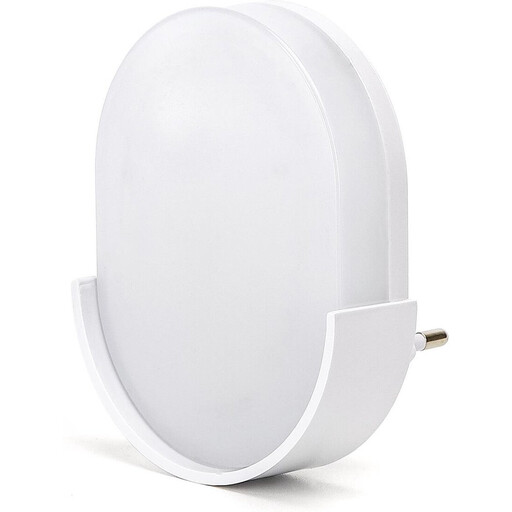
Why it suits this profile: This plug-in light is designed for indoor use and works without separate batteries or a charging cable. It is ideal for anyone looking for a straightforward solution for a hallway, toilet or bedroom.
The product information clearly states that it has a day/night sensor and is intended for indoor use. Do not expect PIR motion detection unless this is stated on the product page.
1 W power, 40 lm light output and instant plug-in installation.

Why it suits this profile: This rechargeable wall light is suitable for a balcony, patio, garden or indoor space where flexible positioning is useful. The magnetic mounting makes it easier to move and recharge.
The specifications mention USB-C charging, a motion sensor and IP44. This makes the usage limits clear: splashes are fine, but the light is not waterproof.
300 lm, 3000 K, integrated battery, USB-C and IP44 protection.

Why it suits this profile: The two long lights are designed for cupboards, kitchen units, shelves and narrow passageways. According to the product information, the PIR sensor has a range of 3 to 5 metres.
The dimensions, 1100 mAh battery capacity and three colour temperatures are stated. However, check beforehand that adhesive mounting is suitable for your surface.
30 cm long, 10 mm thick, two lights, three colour temperatures and USB rechargeable.
We have put together a complete, up-to-date list of products that fully meet these strict selection criteria and the applicable European safety regulations.
A night light with a motion sensor is most useful when the sensor, brightness and power supply suit the space. So compare the technical specifications rather than focusing solely on the marketing name. For everyday use, features such as dimming, USB charging and easy installation can make the difference between a light that stays in place and a product that ends up unused in a drawer.
Many wireless models use a magnet, adhesive strip or mounting plate. Clean and degrease the surface first, and check that it is flat enough. For heavier lights, such as an outdoor wall light, the mounting plate must be securely fixed. Do not place a sensor behind an obstruction, as this may limit its detection range.
Operating time depends on the battery capacity, brightness, colour setting and number of activations. According to the product information, a model with a built-in 500 mAh battery can operate for up to 10 hours in sensor mode. Treat such times as stated product specifications; actual performance may vary in your home.
LED lighting generally uses little power. A 0.5 or 1 W light has a low stated consumption, whereas a 24.5 W outdoor light clearly uses more energy when switched on. A motion sensor can limit how long the light stays on, but consumption depends on the brightness, activation frequency and selected operating mode.
