
Vandaag of morgen in huis

Kwaliteit gegarandeerd

Welkomstaanbiedingen ontgrendelen: GRATIS bezorging | Tot 80% korting | Gratis 30 dagen JoyPlus-proefperiode
Download de app
A night light for a child’s bedroom needs to do more than look nice. Parents want a gentle glow for nappy changes, to reassure a toddler or to find the way to the bathroom quickly at night. At the same time, attractive product pages can hide important details. So don’t just focus on colour and shape; pay particular attention to the controls, power supply, materials and placement.
A unicorn, panda or balloon shape may appeal to children, but a night light that can only be operated with a small button underneath is awkward to use at night. A touch sensor, remote control or motion sensor can make it easier to use. However, check that a child can’t activate the controls by accident.
The term ‘gentle light’ doesn’t tell you much if the brightness, colour temperature or light output isn’t specified. In a baby’s room, a warm, low light setting is often more comfortable than a bright, cool white light. A dimmable night light with several settings gives you more control. For RGB models, check that you can select a steady warm colour; colours that keep changing aren’t practical for every bedroom.
For a rechargeable night light, battery capacity, charging time and run time are important details. A light that runs out quickly could stop working at an inconvenient moment. Also check whether a USB cable is included and use a suitable charger. If you have a baby, keep the charging cable out of reach.
Look for rounded shapes, a stable base and a casing with no small parts that are easy to reach. According to the product description, the VIVREAL unicorn light is made from soft, food-grade, BPA-free silicone. This is a product specification provided by the seller, not a general guarantee for every situation. The same product information describes the light as water-resistant and drop-resistant, but recommends using it indoors and not submerging it for long periods.
For a night light for a baby’s room, also make sure you place it outside the cot and out of your baby’s reach. Keep it away from heat sources, blankets and water. Always follow the safety warnings on the product page and in the manual.
An LED night light generally uses little power and can be made in a compact design. Don’t just look at the number of LEDs; also consider:
A lamp with warm white light may be suitable beside the bed, while a brighter setting can be more useful for nappy changes. According to the product information, one of the rechargeable models has warm white light of 2600–2800 K, RGB colours and a stated light output of 40 lm. Check the product page to see which mode and light output apply to the model you choose.
A night light with a timer switches off automatically after a set period. The unicorn version has a 30-minute timer. This can be useful when a child falls asleep with the light dimmed, without leaving it on all night.
A night light with a motion sensor is particularly practical in a hallway, bathroom or beside a bed. Check the detection range and the light threshold. Some models are listed with a range of 3 to 5 metres and only switch on when the surroundings are dark enough. Don’t place the sensor behind curtains or furniture, and test its direction before fixing the light in place.

Why it suits this profile: The playful unicorn shape is ideal for children who want a decorative light for their room. It’s easy to operate by touch and doesn’t need to be installed.
The product description lists three brightness settings and a 30-minute timer, so you’re not limited to simply switching it on or off.
According to the product page: soft silicone casing, touch controls, 1200mAh battery and a stated run time of 8–10 hours.
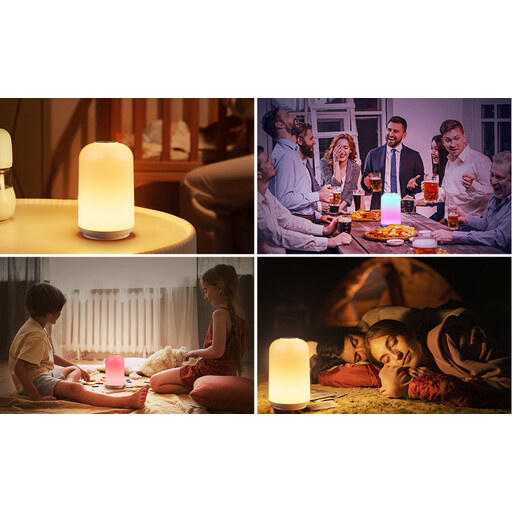
Why it suits this profile: This model is a good fit if you want one light for a child’s room or bedroom that offers both warm white light and colour settings.
The listed warm white mode is continuously dimmable, so you’re not limited to the colourful RGB settings.
According to the product information: 12 SMD LEDs, 40 lm, built-in battery, USB charging, warm white light and seven RGB colours.

Why it suits this profile: Handy for families who want a light beside the bed, in the hallway or near the bathroom, without having to search for a switch each time.
The product description lists an automatic motion-detection mode as well as a continuous-light setting. According to the stated specifications, the sensor works in low ambient light.
According to the product page: five dimming settings, three colour temperatures, a 500mAh battery and a stated sensor range of 3–5 metres. Check the package contents when your order arrives.
We’ve put together a complete, up-to-date list of products that meet these strict selection criteria and the applicable European safety requirements.
Warm white light of around 2600–3200 K is often chosen to create a calm atmosphere. The right setting depends on how you’ll use it. Choose a low dimming setting for brief use beside the bed, and enough light when you need to change your baby. Don’t place the lamp in the cot.
It varies depending on the battery, brightness setting and mode of use. Product information for some models gives a run time of 8–10 hours per charge, while sensor mode and low brightness can affect power consumption. Treat these times as stated product specifications and check the latest manual.
A low-wattage LED lamp generally uses less electricity than a comparable traditional lamp. For a mains-powered model, energy use depends on its wattage and how many hours it’s switched on. A rechargeable model uses electricity while charging; how often you need to charge it depends on the brightness setting and run time.
