
Vandaag of morgen in huis

Kwaliteit gegarandeerd

Welkomstaanbiedingen ontgrendelen: GRATIS bezorging | Tot 80% korting | Gratis 30 dagen JoyPlus-proefperiode
Download de app
A night light may seem like a simple purchase, but the differences between models can be significant. Some lights provide continuous illumination, while others respond to movement or switch off automatically. The choice between a plug-in light, a rechargeable night light and sensor-activated cabinet lighting also determines where you can use the product safely and practically.
Pay particular attention to three common pitfalls:
The right choice therefore depends on where you will use it, how you want to use it and how you want to operate the light.
For a bedroom or nursery, a soft, warm colour is often more pleasant than bright, cool white light. Look at the colour temperature in Kelvin:
A low lumen output is usually better suited to a bedside table. A wardrobe, staircase or workspace may need more light. The Light Sensor Night Light, for example, has 20 lumens, 0.5 watts and a colour temperature of 2,800–3,200 K. These specifications make it suitable for soft lighting in a bedroom, nursery or hallway.
An LED night light generally uses very little electricity. However, always check the wattage, power supply voltage and whether the light is designed for continuous use.
A night light with a motion sensor can be useful when you do not want to search for a switch during the night. Pay attention to:
A dimmable night light gives you more control in a child’s bedroom or your own bedroom. On some models, the controls work via a button or touch, while others respond to movement or a gesture. Read the product information carefully: “sensor” may refer to movement, ambient light or touch.
For a cabinet, a PIR sensor with a range of a few metres is often practical. Position the light so that the door or the person standing in front of the cabinet falls within the detection area. A sensor light behind a shelf or in a location with many obstacles may be less useful.
A rechargeable night light can be moved easily, but battery capacity and charging time are important. Check whether a USB cable is included and which charger is suitable. A mains-powered model works immediately, but requires a suitable socket and enough room for the cable.
Before installation, check:
An IP rating indicates the extent to which a product is protected against dust and water. If this information is not provided, do not use the light in a damp environment. Electrical products must not be dismantled and should be kept out of the reach of young children unless the manufacturer expressly states that the product is suitable for this purpose.
The selection below is based on the stated product specifications, dimensions, controls and power supply. Always check the current product page, included manual and connection information before buying.
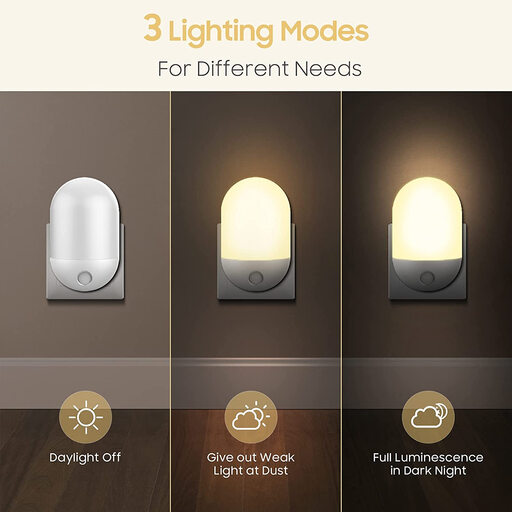
Why it suits this profile: A simple choice for anyone looking for a compact night light without complicated controls for a bedroom, nursery or hallway.
The stated 20 lumens and warm colour temperature reduce the chance of unnecessarily bright light. However, check how the light sensor responds in your room.
0.5 watts, warm white light of 2,800–3,200 K and an ABS and metal housing.
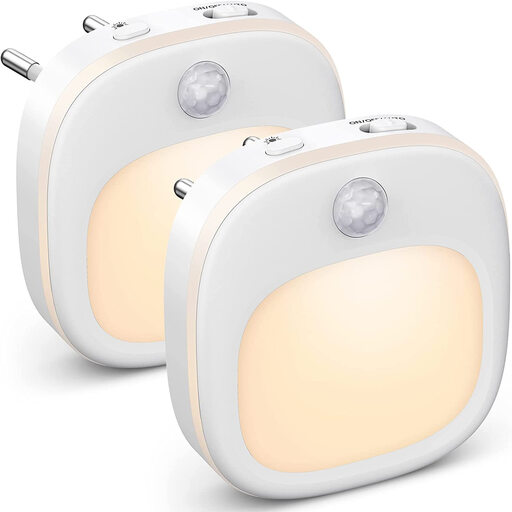
Why it suits this profile: Suitable for households that want to light two locations, such as a landing and nursery, with a choice of several light settings.
Motion detection means you do not have to keep searching for a switch. Test the positioning to minimise unwanted activation.
Set of two, three colour temperatures and five dimming levels; suitable for 100–240 V according to the product listing.

Why it suits this profile: A practical solution for kitchen cabinets, wardrobes, shelves or dark passageways where you need extra, focused light.
The slim dimensions of 300 × 38 × 10 mm take up very little space. Adhesive mounting means no drilling is required, but check beforehand that the surface is clean and suitable.
Two lights, PIR detection with a stated range of 3–5 metres, three colour temperatures and a 1,100 mAh rechargeable battery.
A children’s night light or baby night light often features a playful design. This can help support a consistent bedtime routine, but practical details should be your main consideration. Position the light out of a baby’s reach, keep cables away from the bed and check that small parts are properly enclosed.
According to the product description, the VIVREAL Unicorn Night Light has a soft silicone housing, three brightness levels, a 30-minute timer and a 1,200 mAh rechargeable battery. The stated operating time is 8–10 hours and the charging time is 2–3 hours. The claims regarding material safety and protection come from the brand’s product information; check the latest documentation and instructions before placing the product near a young child.
For a living room, decorative lighting, a table lamp or a wall light may be a better choice than a traditional night light. A table lamp on a bedside table is easy to move. The Atmosphera Tripod Lamp has an E27 fitting, a 1.53-metre cable and a maximum load of 25 watts. The bulb is not included. Check that your chosen E27 bulb is therefore suitable for the desired colour temperature and light output.
We have compiled a complete, up-to-date list of products that fully meet these strict selection criteria and the applicable European safety regulations.
An LED light generally uses little energy compared with traditional light sources. Actual consumption depends on the wattage, the number of hours it is switched on and how the sensor or timer operates. A 0.5-watt light uses less electricity when operated continuously than a model with a higher light output.
Position the light where the sensor has a clear view, for example facing the direction of travel in a hallway or underneath a kitchen cabinet. Avoid obstacles and do not point the sensor directly at a window or heat source. Test the position before completing the installation.
It can be useful if you want to move the light easily and do not want a cable next to the bed. Check the battery life, charging time and charging method. Keep the light out of the child’s reach and only charge it using a suitable cable and charger. Also follow the manufacturer’s instructions.
