
Vandaag of morgen in huis

Kwaliteit gegarandeerd

Welkomstaanbiedingen ontgrendelen: GRATIS bezorging | Tot 80% korting | Gratis 30 dagen JoyPlus-proefperiode
Download de app
A night light for a child’s room should be calming, practical and suitable for their age. Yet many parents buy a model that turns out to be less convenient after a short time. For example, a lamp can be too bright, only work from a plug socket, or have features that are hardly ever used in practice.
So don’t just focus on a cute design. Also consider the brightness, controls, power source and safety instructions. Below are the key points to look out for, along with a selection for different uses.
Bright main lighting is usually not needed during a night feed, a nappy change or a visit to the nursery. However, an LED night light with a single fixed brightness setting can still be too bright.
Look out for:
According to the product information from some brands, warm light is intended for use beside the bed. That is a product description, not a medical claim or a guarantee about sleep.
With a rechargeable night light, the usage time is often measured on the lowest brightness setting. The actual battery life depends on the brightness you choose, the colour mode and whether you use a timer.
So check:
A built-in battery is handy for travel or moving between the nursery and the living room. A plug-in lamp, on the other hand, is suitable when you don’t want to recharge.
A soft silicone figure may seem suitable for young children, but always check the safety instructions. Some decorative lamps contain small parts, batteries or are not intended for play.
Place a lamp securely and out of reach of pulling, biting and cables. Only use a lamp indoors and keep it away from water, heat and naked flames. Supervision is important with babies, even when the product description mentions child-friendly materials.
A touch night light is handy when you want to adjust a setting quickly during the night. A night light with a sensor switches on automatically when it gets dark or when movement is detected. Do note the difference:
A night light with a timer prevents the lamp from staying on unnecessarily all night. A night light with a sensor is especially practical in a hallway, by the changing table or on the way to the toilet.
Look at the materials stated and the cleaning instructions. Silicone models are often easy to wipe clean, but “waterproof” does not automatically mean a lamp can be submerged for long periods. Follow the product instructions and use a soft, slightly damp or dry cloth if possible.
With a plug-in model, the socket must remain easily accessible and the lamp must not be covered. With rechargeable models, the charging cable should be kept out of a child’s reach when unsupervised.
For a bedside table, a compact lamp with a stable base is suitable. For a hallway or cupboard, a plug-in model or magnetic LED night light may be more practical. A lamp of 400 lumens can be too bright for a bedroom, but useful as a work light in a cupboard or on a staircase. So consider the location and purpose before focusing only on the number of LEDs.
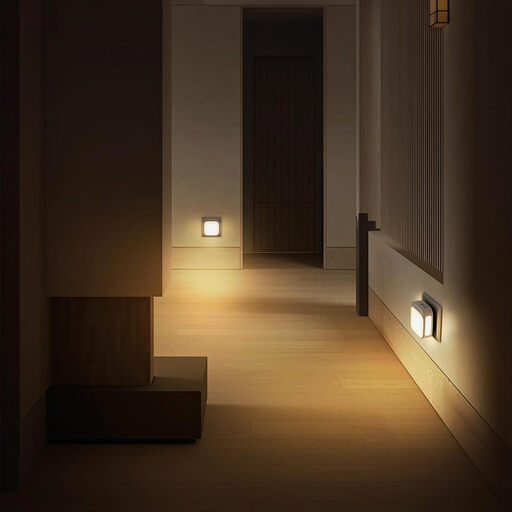
Why this fits the profile: This plug-in duo is ideal for anyone who wants a basic light in the nursery, hallway or corridor without needing to recharge.
The light sensor means you don’t have to switch the lamp on manually every evening. The adjustable brightness helps avoid a fixed, potentially too bright setting.
2 pieces, warm white light at 2800–3000 K, stepless dimming from 10–100% and a stated consumption of 0.3 W per lamp.
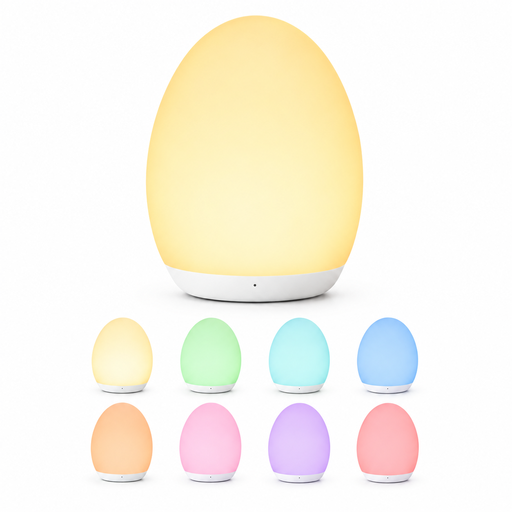
Why this fits the profile: The combination of warm white light, touch control, colour modes and a memory function offers more adjustment options for night feeds, story time and travel.
The brightness is dimmable and the lamp has a 1-hour timer. The stated maximum usage time of 100 hours only applies at the lowest brightness, according to the product information.
2000 mAh battery, warm white light, 8 colour modes, touch control and a compact size of 9.2 × 9.2 × 11 cm.

Why this fits the profile: This portable design is aimed at children who like having a tactile figure beside the bed or during a sleepover.
The three brightness levels and the 30-minute timer limit the use of a fixed bright setting or unnecessarily long running time. Follow the warning about supervision for babies.
According to the product information: BPA-free silicone, touch control, 1200 mAh battery, 8–10 hours of use and 2–3 hours charging time.
We have put together a full, up-to-date list of products that fully meet these strict selection criteria and comply with current European safety regulations.
It can be, especially when you don’t want to fumble for a switch during a night-time task. A light sensor switches on when ambient light is low; a motion sensor reacts to movement. Check the sensitivity and position the lamp so that the light does not shine directly into the eyes.
That varies by model and brightness setting. A battery of 1200 mAh or 2000 mAh does not give a fixed usage time. According to product information, a VAVA model can last up to 100 hours on the lowest setting, while the stated maximum brightness works for around 7 hours. Always check which setting the stated time refers to.
A plug-in lamp with a low wattage, such as 0.3 or 0.5 W, uses relatively little power. A rechargeable model uses electricity while charging. The actual cost depends on the wattage, how often you charge it and the current electricity rate. A timer or sensor can help prevent unnecessary running time.
