
Vandaag of morgen in huis

Kwaliteit gegarandeerd

Welkomstaanbiedingen ontgrendelen: GRATIS bezorging | Tot 80% korting | Gratis 30 dagen JoyPlus-proefperiode
Download de app
A night light might seem like a simple purchase, but small differences can make or break how pleasant it is to use every day. For instance, a lamp could be too bright for the nursery, run out of power after a short time, or switch on unexpectedly in a dark hallway. What’s more, features like “long battery life” aren’t always measured under the same conditions.
As a Joybuy Product Recommendation Officer, I therefore focus on verifiable specifications: light output, controls, power source, dimensions and safety information. This way, you avoid letting a pretty design outweigh practical use.
A cute children’s night light might match the décor, but you should also check the age recommendation and the material. According to the product information, the Little Dutch Forest Friends Night Light Squirrel is intended for children aged 3 years and over. It also warns about small parts and batteries. So a decorative model isn’t automatically suitable to be within a baby’s reach in the nursery.
A rechargeable night light may claim a long usage time, but this often applies at the lowest brightness setting. The VAVA VA-CL009, for example, states up to 100 hours at the lowest brightness; at maximum brightness, the stated usage time is around 7 hours. So pay attention to the combination of brightness level, usage mode and battery capacity.
For night-time care, an adjustable, warm light colour is often more practical than bright, cool white. For a hallway or bathroom, a more neutral or cooler light can be useful. A lamp with a motion sensor can also switch on unnecessarily often if the detection range doesn’t suit the room.
Lumens indicate how much light a lamp emits according to the product specification. A model with 20 to 40 lm is generally intended as soft orientation lighting, whereas a lamp with 400 lm provides much more light for, say, a cupboard, stairs or workspace.
Also look out for:
A product claim about a calming atmosphere or suitability for sleep comes from the brand’s product description. Do not regard this as a medical effect.
A plug-in lamp is suitable for a fixed spot and doesn’t need recharging. A rechargeable night light is more flexible for use by the bed, changing table or when travelling. Check:
For children’s models, it’s wise to keep the charging point and cable out of reach. Always follow the included safety instructions.
A night light with a motion sensor is practical in the hallway, bathroom or kids’ room when you don’t want to fumble for a switch. Look at the detection range, the light threshold in lux, and whether the sensor only works in the dark.
Extra care is needed for damp rooms. An IP rating gives information about protection against dust and water. If that rating is missing, don’t place the lamp near splashing water. Many models in this selection are intended for indoor use and must be kept dry.
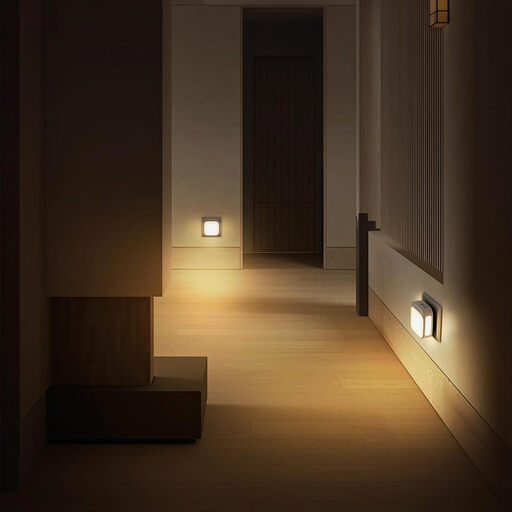
Why this fits the profile: Two compact lights offer a simple solution for, say, the bedroom and hallway, without needing to recharge or deal with complicated controls.
The product specification states 20 lm, warm white light at 2800–3000 K and a light sensor that activates in darkness. This means you don’t have to rely solely on appearance.
2 units, 0.3 W power consumption and stepless dimming from 10% to 100%. Works with a standard plug socket.
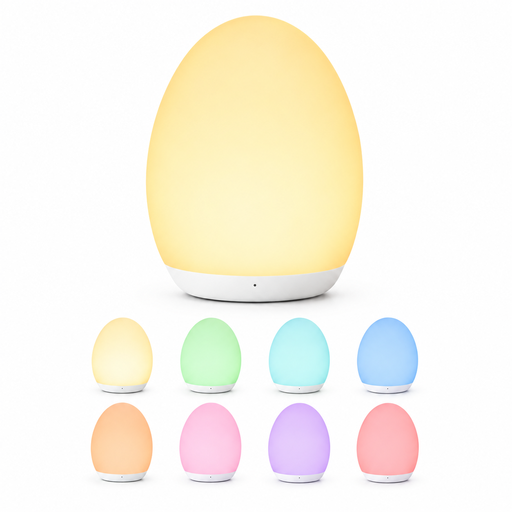
Why this fits the profile: This model is aimed at parents who want one portable lamp for night feeds, nappy changes, story time and travel.
The usage time is broken down by brightness: around 7 hours at maximum brightness and up to 100 hours at the lowest setting. This makes comparison much clearer.
2000 mAh battery, dimmable warm light, 8 colour modes, touch control, memory function and a 1-hour timer.

Why this fits the profile: Suitable for anyone looking for a night light for children, hallway, bathroom or bedroom without a fixed power point.
According to the product specification, the sensor works in darkness up to 20 lux, with a range of 3–5 metres. The lamp also has a normal mode for constant light.
500 mAh rechargeable battery, up to 10 hours of use in sensor mode, 3 colour temperatures and 5 brightness levels.
We’ve put together a full, up-to-date list of products that fully meet these strict selection criteria and comply with current European safety regulations.
That depends on the model, where you place it and the age information. Choose a lamp with soft, dimmable lighting and place it out of the baby’s reach. Check warnings about small parts, batteries, heat and moisture. A product sold as decoration for children is not automatically suitable as a toy.
This varies by model. A fixed model in this selection, for example, states 0.3 W, whereas a rechargeable lamp uses a battery and is charged via USB. The actual consumption depends on the brightness level and usage time. With a lamp that has a light sensor, the light may only switch on when the room is dark.
A timer can prevent the lamp from staying on all night. This is especially practical with a children’s night light during the settling-down period. Check whether the timer offers 30 minutes, 1 hour or another fixed period. For night-time care, a lamp without a short timer can actually be more convenient, because you can use it again straight away.
