
Vandaag of morgen in huis

Kwaliteit gegarandeerd

Welkomstaanbiedingen ontgrendelen: GRATIS bezorging | Tot 80% korting | Gratis 30 dagen JoyPlus-proefperiode
Download de app
A night light may seem simple to choose, but small differences determine whether it is pleasant to use every day. A lamp may look soft and atmospheric in the product photo, yet be too bright in practice, need charging frequently or switch on unexpectedly. For a nursery, children's bedroom, bedroom, hallway or staircase, it is therefore more useful to look at the specifications rather than just the colour and design.
Warm white light of around 2600 to 3200 K generally creates a softer appearance than cool white light. However, colour temperature does not tell you everything. The number of lumens, dimming function and positioning also determine how bright the light feels.
A night light with RGB lighting can be fun in a child's bedroom, but changing colours are not always practical during a night-time feed or a trip to the toilet. So check whether warm white light is available separately and whether the brightness can be adjusted.
A rechargeable night light means you do not have to replace batteries regularly. However, you do need to charge the device in good time. Check the battery capacity, stated usage time and type of connection. A USB night light is convenient if you already use a suitable USB charger, laptop or power bank.
The actual usage time depends on the selected brightness and function. A lamp that only switches on when it detects movement generally uses power differently from one that stays on continuously throughout the night. So look at the usage mode that best suits your situation.
A night light with a motion sensor is useful in a hallway, cupboard, on the stairs or in the bathroom. However, a sensor may switch on too often if it faces a busy passageway. In a nursery, this can be disruptive if the light comes on with every small movement.
Check the stated detection distance and the conditions under which the sensor operates, such as only in low ambient light. Position the lamp so that it lights the route, but does not shine directly into anyone's eyes.
For a night light for a nursery or bedroom, warm white light and several brightness settings are often practical. A low setting can be suitable as orientation lighting, while a higher setting works better when changing a nappy or looking for something on a shelf.
Pay attention to these points:
An LED night light generally uses little power. That does not automatically mean that every lamp lasts equally long or is equally energy-efficient. Compare the stated wattage and battery life instead of focusing solely on the term “LED”.
A lamp with a built-in battery can be positioned wirelessly, but check whether the USB cable is included and what charging voltage is specified. Use a compatible USB power supply and keep the charging port away from moisture.
For a night light beside the bed, a rechargeable battery and touch control are useful. For a cupboard or hallway, a battery-powered or sensor lamp may be more suitable, as you will not want to connect a cable repeatedly.
A compact lamp takes up little space on a bedside table or shelf. For children, a soft silicone casing is pleasant to hold, but always place the lamp securely and out of reach if the product is not intended for children to use independently.
Also pay attention to the safety information:
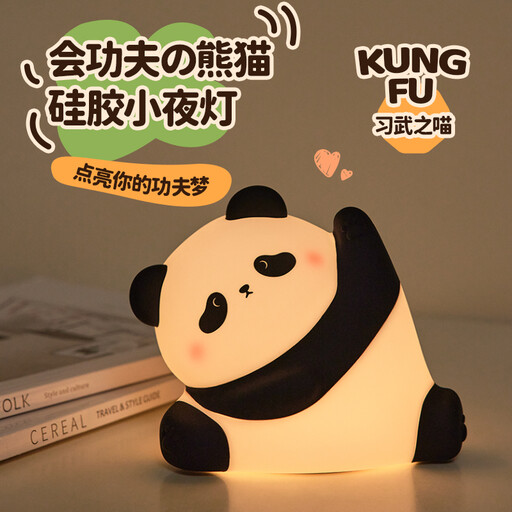
Why it suits this profile: This compact panda has a soft silicone casing, touch control and three brightness settings. That makes it straightforward to use as a first night light in the nursery or child's bedroom.
The three dimming settings prevent you from being limited to a single, potentially overly bright setting. The 1200mAh battery and USB charging function reduce the need for disposable batteries.
1200mAh rechargeable battery, three dimming settings, touch control and food-grade silicone according to the product specification.
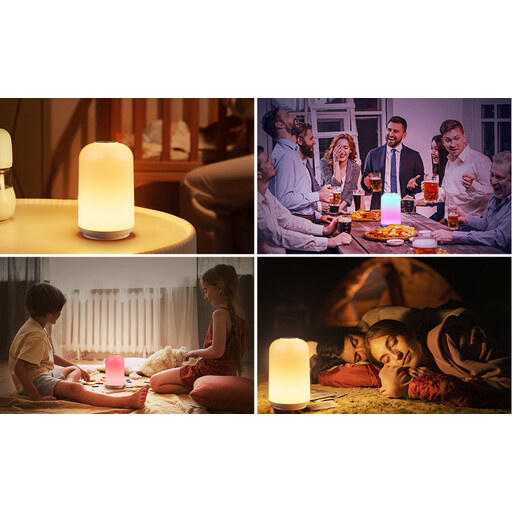
Why it suits this profile: This model combines warm white light with seven RGB colours and stepless dimming. It is ideal if you want one lamp for both a relaxing ambience and practical lighting.
The warm white mode can be selected separately, so RGB colours are not the only option. The built-in sensor is specified for ambient light of up to 40 lux.
12 SMD LEDs, 40 lumens, warm white at 2600–2800 K, seven RGB colours and stepless dimming in warm white mode.
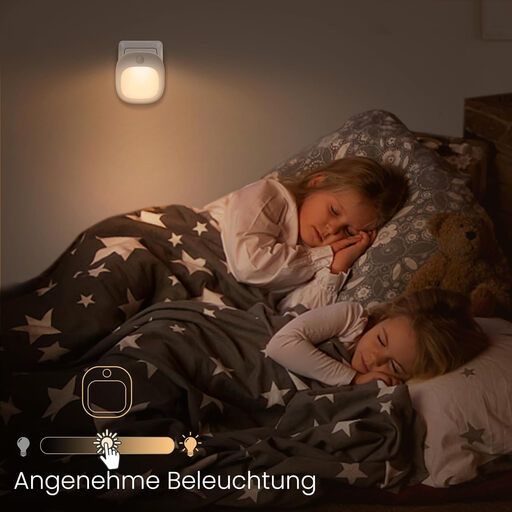
Why it suits this profile: The set is practical for two locations, such as the nursery and landing, or the hallway and bathroom. According to the product specification, the sensor switches the lamp on when it detects movement and low ambient light.
You do not have to search for a switch in the dark. Five brightness levels and three colour temperatures give you more control than a lamp with a single fixed setting.
500mAh USB-rechargeable battery, sensor range of 3–5 metres, five dimming settings and three colour temperatures.
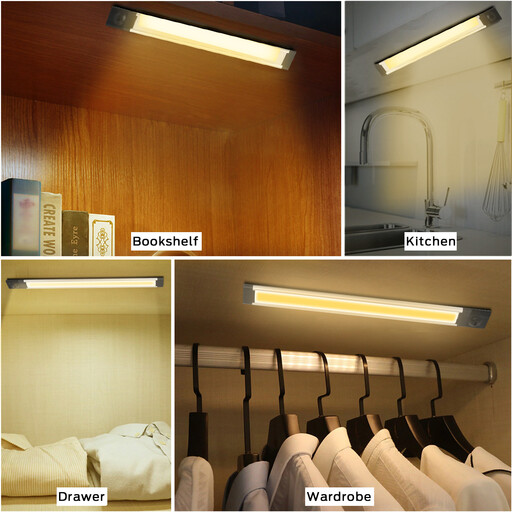
Why it suits this profile: The long, flat lamp is designed for hallways, cupboards, stairs and larger areas. Magnetic attachment and hanging hooks allow it to be installed without drilling.
The sensor and gesture controls mean you do not have to look for a small button each time. The mounting options offer more flexibility than a lamp that can only be placed on a bedside table.
36 SMD LEDs, stated luminous flux of 400 lumens, colour temperature of 2800–6500 K and attachment with a magnet or hook.
We have put together a complete, up-to-date list of products that fully meet these strict selection criteria and the applicable European safety regulations.
Warm white light of around 2700 to 3200 K is often chosen for a calm, gentle light effect. Also select a low dimming setting and do not point the lamp directly at the cot. Always check the safety instructions for the specific product and keep an electrical device out of reach of young children if supervision is required.
This varies depending on the battery capacity, brightness setting and usage mode. A sensor lamp may last longer when it only switches on when movement is detected. Charge the lamp using the specified USB power supply and bear in mind that usage time will be shorter at maximum brightness.
An LED night light often has a low stated wattage. Consumption depends on the power rating and the number of hours the lamp is switched on. A 1-watt lamp that runs for 10 hours theoretically uses around 0.01 kWh. Calculate the actual cost by multiplying this consumption by your energy tariff.
