
Vandaag of morgen in huis

Kwaliteit gegarandeerd

Welkomstaanbiedingen ontgrendelen: GRATIS bezorging | Tot 80% korting | Gratis 30 dagen JoyPlus-proefperiode
Download de app
A night light may seem like a simple purchase, but the differences between models can be significant. Some lights are mainly decorative, while others are designed as permanent lighting for a hallway, cupboard or children’s room. So don’t only consider appearance or a low price. Pay particular attention to the controls, brightness, battery and placement.
A night light with a motion sensor can be useful in a dark hallway or near a wardrobe. In a bedroom, however, a sensor may switch on unnecessarily when someone turns over or walks past the bed. A night light with a light sensor responds to the amount of ambient light instead. This is more practical when the light needs to switch on automatically as soon as the room gets dark.
Also check what the product information actually states. The sensor range, activation threshold or switch-on conditions are more important than general wording such as “smart automatic light”.
A high light output is not always comfortable next to a bed. For a bedside table or nursery, a warm white colour temperature of around 2600-3200 K may feel more restful than cool white light of 6500 K or more. A lamp with a high lumen output may be suitable for a cupboard or stairway, but impractical as a baby night light.
A dimmable night light gives you more control. Do check whether all light modes can be dimmed. With some products, only the warm white light can be adjusted continuously, while RGB colours have fixed settings.
A rechargeable night light eliminates the need for loose batteries, but battery life depends on brightness, colour mode and sensor settings. Check the battery capacity, charging voltage and included cable. An integrated lithium battery must also be charged with a compatible USB charger, as stated in the product’s safety information.
For a night light for a bedroom or children’s room, the following points are useful:
A touch night light is easy to operate, especially when you don’t want to search for a small button in the dark. A soft silicone casing can feel pleasant for children, but place the light out of reach of young children when the manufacturer recommends adult supervision.
A night light with a timer switches off after a pre-set period. A 30-minute timer can be useful at bedtime. Also check whether the light can be used while charging; this is not stated for every model.
ABS, metal, aluminium, PP and silicone are commonly used in this product category. For a children’s night light, check whether the material is suitable for its intended use according to the product description. A statement such as “food-grade silicone” or “BPA-free” is a product specification provided by the seller; do not automatically treat it as proof that every use is suitable without supervision.
For sensor cupboard lighting, dimensions and mounting are at least as important as the number of LEDs. A slim 10 mm model is easier to fit beneath a shelf. Magnetic or adhesive mounting avoids drilling, but check that the surface is clean, dry and sufficiently sturdy.
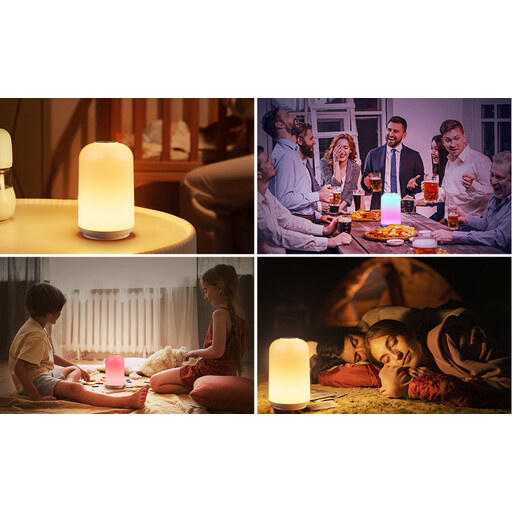
Why it suits this profile: This compact model combines warm white light, seven RGB colours and USB charging for use on a bedside table, shelf or in a children’s room.
The product specification states 40 lm, a warm white setting with continuously adjustable dimming and an ambient light sensor with a threshold of up to 40 lux.
Built-in battery, 5V-1A USB charging, 12 SMD LEDs and dimensions of 13 x 8 x 8 cm.
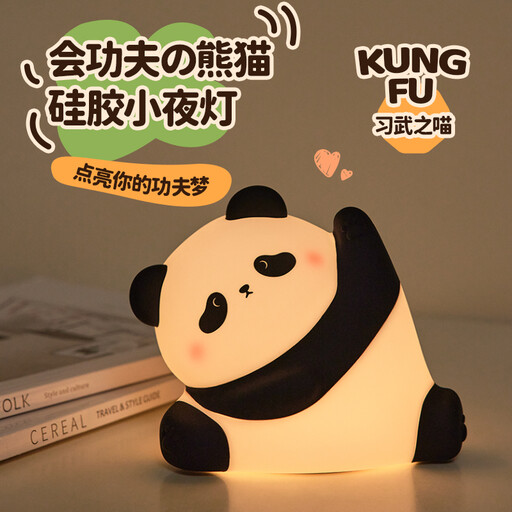
Why it suits this profile: The soft panda shape is designed for use as a decorative children’s night light beside the bed or in the nursery.
The light uses touch control with three brightness levels. The seller also states that young children should be supervised by an adult.
Food-grade silicone according to the product description, 1200mAh battery, three dimming levels and USB charging.

Why it suits this profile: This set is intended for cupboards, shelves, kitchen units and other places where a permanent lamp would be too large or cumbersome.
The listed PIR sensor detects movement at 3-5 metres and switches the lamp on and off automatically. It can be mounted without drilling.
41 LEDs, three colour temperatures, a 1100mAh battery and two lamps per set. Dimensions per lamp: 300 x 38 x 10 mm.

Why it suits this profile: The unicorn shape is ideal for a children’s room where a portable lamp with simple controls is preferred.
The product specification states three brightness levels and automatic shut-off after 30 minutes. This prevents the light from staying on indefinitely.
Touch controls, 1200mAh rechargeable battery and, according to the product information, 8-10 hours of use per charge.
We’ve put together a complete, up-to-date list of products that fully meet these strict selection criteria and the applicable European safety requirements.
Place a night light on a stable surface and keep it away from water, heat sources and loose cables. In a nursery or children’s room, supervision is important when this is stated in the product’s safety warnings. A light with an adhesive strip or magnet must be securely attached so that it cannot fall onto a bed or floor.
For a hallway or cupboard, a sensor light usually works better when it is not positioned directly opposite a window or strong ceiling light. Test the detection direction in the area where you walk. For a bedside table, manual touch controls are often simpler than a motion sensor.
LED lighting generally uses little power. According to the product information, the model with 12 SMD LEDs has a consumption of 1 W. Actual energy use depends on how long the light is on, the brightness setting and, for rechargeable models, charging the battery.
This varies depending on the battery, brightness and operating mode. The VIVREAL unicorn states that it provides 8-10 hours of use after charging, while other models do not specify a fixed operating time. Always check the product specification and allow for a shorter running time at higher brightness.
A sensor light is suitable for a hallway, stairs, cupboard or bedroom door where you need temporary lighting. Point the sensor towards the route you walk along and mount the light securely. For constant soft light beside a bed, a dimmable model with manual controls is usually easier to manage.
