
Vandaag of morgen in huis

Kwaliteit gegarandeerd

Welkomstaanbiedingen ontgrendelen: GRATIS bezorging | Tot 80% korting | Gratis 30 dagen JoyPlus-proefperiode
Download de app
A night light might seem like a simple purchase, but small differences can make a big difference to how practical it is day to day. A light may look soft and atmospheric in the product photo, yet be too bright in practice, run out of battery quickly or switch on at the wrong time.
Parents also have different needs from someone walking to the bathroom in the middle of the night. So don’t just focus on the design: pay particular attention to the controls, brightness, power supply and placement.
A night light for a child’s room doesn’t need to light up the whole room. A light with a high output can be unnecessarily bright during a night feed or when a child needs to settle back to sleep. Check the stated value in lumens and see whether the light can be dimmed.
A dimmable night light with several settings gives you more control than one that only switches on and off. Also check the colour temperature. Warm white night lights around 2600 to 3200 K generally give off a softer glow than cool white lights.
A rechargeable night light is handy on a bedside table, changing table or shelf where there isn’t a socket nearby. However, battery capacity and run time vary considerably. Check:
The stated maximum run time usually applies to the lowest light setting. For example, the VAVA VA-CL009 is listed as running for up to 100 hours at its lowest brightness; according to the product information, this doesn’t apply to night light mode. This is worth bearing in mind if you plan to use the light every night.
A motion-sensor night light is handy in a dark hallway, bedroom or bathroom. However, the sensor won’t necessarily activate every time. Check its detection range, the minimum ambient light level and how the sensor is positioned.
Some models only activate once it’s dark enough, for example when the ambient light is at a maximum of 20 lux. Furniture, doors or poor positioning can also limit the range. If you want to operate a light beside your bed without getting up, a touch-control night light may be a better choice.
Warm white is often a sensible choice for night-time use in a nursery or child’s room. A lamp with RGB or coloured light can also work well as part of a calming bedtime routine or as decorative lighting. Check whether you can select a fixed colour or whether the colours change automatically.
Look out for the difference between:
A touch button is easy to use, but check that it isn’t too sensitive. A soft silicone design may be comfortable for children to hold, but the product should be used indoors according to the instructions and kept away from heat, fire and immersion in water.
A plug-in model is suitable for a hallway or bathroom near a wall socket. A portable model is more convenient for a nursery if you want to move the light between the bed, changing table and chair. Check the dimensions too: a compact bedside light takes up less space on a narrow bedside table.
Check the materials listed, the cable supplied and the charging instructions. Products in this selection use materials including ABS, metal, PP and silicone. With rechargeable models, it’s important to use a compatible USB power supply and not to leave the cable unattended within reach of young children.
Before buying, also check:
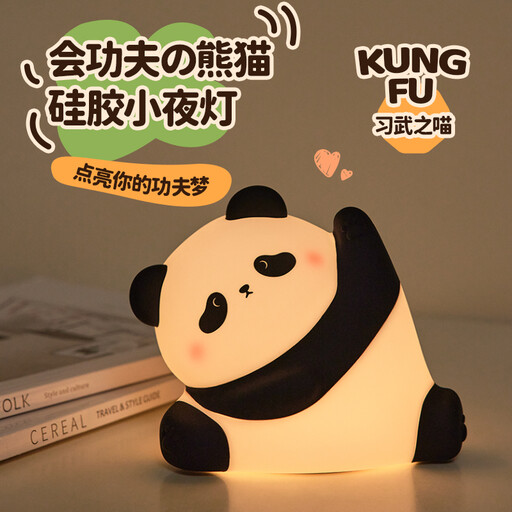
Why it suits this need: This rechargeable panda light has a soft silicone exterior, three dimming settings and touch controls. It’s straightforward to use beside a bed or changing table.
The three brightness levels mean you’re not limited to a single bright on/off setting. The 1200mAh battery also reduces the need for disposable batteries.
1200mAh rechargeable battery, three dimming settings, touch controls and silicone casing, according to the product description.
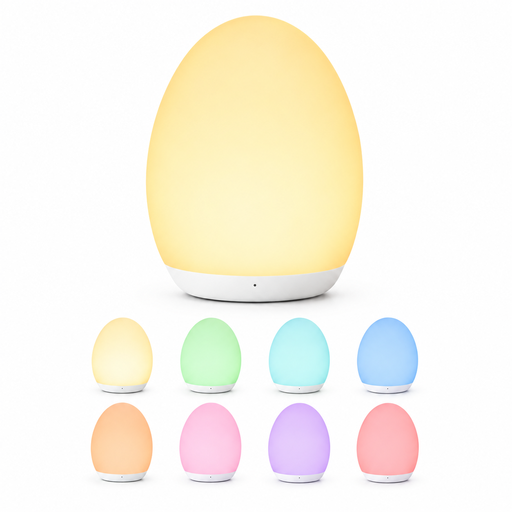
Why it suits this need: This baby night light is designed for night feeds, changing, bedtime and travel. It features warm white light, eight colour settings, touch controls and a timer.
The product information lists the maximum run time for each light setting separately. This makes it clear that “up to 100 hours” doesn’t apply to every setting.
2000mAh battery, 1-hour timer, memory function, eight colours and stated dimensions of 9,2 × 9,2 × 11 cm.

Why it suits this need: The two compact lights can be used in different places, such as the bedroom, nursery and hallway. In sensor mode, they switch on when movement is detected in the dark.
The product description specifies a sensor range of 3–5 metres, a threshold of up to 20 lux and five brightness levels. This makes it easier to understand how it works than a vague “automatic light” description.
Two lights, a 500mAh battery per light, three colour temperatures, five dimming settings and USB charging, according to the product details.
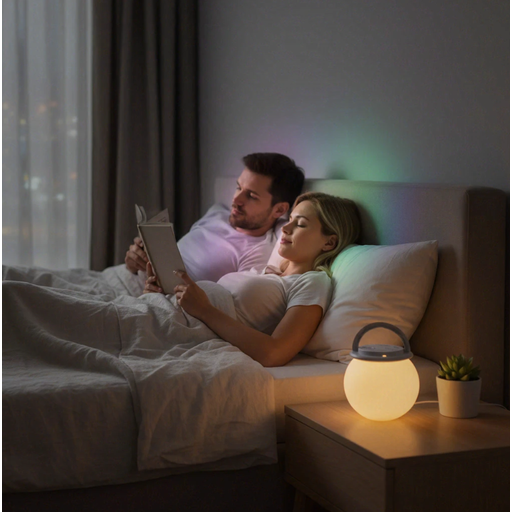
Why it suits this need: This model combines warm white light with seven RGB colours and stepless dimming. It’s a good fit if you want one light for sleeping, reading or creating a relaxing atmosphere.
The functions are separate: warm white can be dimmed steplessly, while RGB lets you choose fixed colours or an automatic colour cycle. This makes it clear which settings are available in each mode.
Warm white light at 2600–2800 K, seven RGB colours, built-in battery, USB charging and an ambient light sensor, according to the product description.
We’ve put together a full, up-to-date list of products that meet these strict selection criteria and the applicable European safety requirements.
Warm white light between around 2600 and 3200 K is often chosen to create a soft glow beside the bed. Always check whether the light is dimmable, as even warm light can be too bright at its highest setting for night-time use.
That depends on the battery capacity, brightness, colour mode and sensor use. A lower light setting generally uses less power. So don’t just look at the maximum run time: check the conditions under which it was measured too.
Position the light where the sensor can detect the route you’ll walk, for example along the side of the bed or in a hallway. Avoid obstacles and check that the sensor only activates when it’s dark enough. In a nursery, a model without automatic activation may be more practical if unexpected light could be disruptive.
