
Vandaag of morgen in huis

Kwaliteit gegarandeerd

Welkomstaanbiedingen ontgrendelen: GRATIS bezorging | Tot 80% korting | Gratis 30 dagen JoyPlus-proefperiode
Download de app
A night light might seem like a simple purchase, but the differences in ease of use are significant. One lamp can be too bright for a nursery, another might switch on unexpectedly because of a pet, and some run out of power after a short time. Even a beautiful design doesn't guarantee it will work well in practice.
So, watch out for three common pitfalls:
The right choice starts with the room, when you'll use it, and how you want to control it.
For a nursery or bedroom, soft, warm light is often more practical than a harsh white source. Look at the colour temperature in kelvin:
A dimmable night light gives you more flexibility. Check whether the lamp has fixed settings or is continuously dimmable. According to the product description, the 2-pack energy-saving sensor lights in warm white have a dimming range of 10% to 100%, a brightness of 20 lumens and an automatic light sensor that activates at a maximum of 20 lux.
Bear in mind: lumens indicate the amount of light, but not exactly how bright a lamp will feel in your room. Placement, wall colour and distance from the bed all make a difference.
A motion sensor night light is handy in a hallway, by the bed or inside a wardrobe. A PIR sensor reacts to movement within a certain range. The 2-pack LED night lights with motion detection mention three colour temperatures and five dimming levels. The ultra-thin cabinet light (30 cm) has, according to the product information, a PIR range of 3 to 5 metres.
A light sensor works differently: it responds to ambient light and switches on when it gets dark. That can be useful for a plug-in night light that needs to be available all night. For a baby night light next to the bed, manual control or touch operation might actually be clearer.
Also check:
A plug-in model doesn't need charging, but it does need a fixed spot. A rechargeable night light is portable and can be taken along during a night feed or when moving to another room.
According to the product description, the VIVREAL Unicorn Night Light features a 1200mAh battery, with a charging time of 2 to 3 hours and a stated usage time of 8 to 10 hours. The VIVREAL Panda Night Light also mentions a rechargeable 1200mAh battery and three light settings. Treat this information as the supplier's product data; the actual usage time depends on factors such as the brightness level you choose.
For use in a child's room, always check:
Don't confuse a manufacturer's claim about materials or safety with an independent guarantee. So, always review the warnings, instruction manual, manufacturer details and information about the EU responsible person. For the products mentioned, JINGDONG RETAIL (NETHERLANDS) B.V. is listed as the EU responsible party.
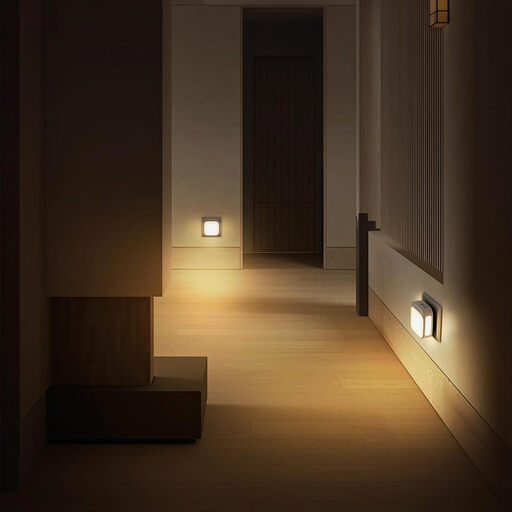
Why this fits the profile: A practical pair for the hallway, bedroom or nursery, with no separate installation or complicated controls.
The automatic light sensor means you don't have to switch the lamp on manually every time. The dimming range helps you avoid a light source that's too bright.
Two lamps, 0.3 W power, warm white light at 2,800–3,000 K and stepless dimming from 10% to 100% according to the product data.

Why this fits the profile: Aimed at parents who want a portable children's night light with gentle controls and a decorative design.
The three brightness levels and 30-minute timer make the controls more specific than just a colour choice. According to the product description, the lamp is rechargeable.
Touch control, three light settings, 1200mAh battery and a stated usage time of 8–10 hours per charge. The manufacturer mentions food-grade silicone without BPA; check the full safety information before purchase.

Why this fits the profile: Ideal for kitchen cupboards, wardrobes, shelves and walkways where you want automatic light in several places.
The PIR detection and three colour temperatures offer more control than a fixed lamp without a sensor. Measure the available space beforehand and check the mounting method.
Two lamps of 30 cm, 41 LEDs per lamp, PIR range of 3–5 metres, three colour temperatures and a built-in 1100mAh battery according to the product information.
We've put together a full, up-to-date list of products that fully meet these strict selection criteria and current European safety regulations.
It can be, especially if you don't want to fumble for a switch during the night. Choose a low brightness level and check that the sensor doesn't keep switching on unnecessarily. For babies and young children, small parts, cables and batteries must be kept out of reach. Always follow the manufacturer's age and safety warnings.
The usage time varies by model and brightness setting. Product descriptions sometimes mention a range, such as 8–10 hours with a 1200mAh battery. With heavy use, more frequent charging may be needed. Also check the charging time, the charging port and whether a cable is included.
An LED night light generally uses very little power. For plug-in models, the stated wattage is important. A 0.3 W model uses less energy when running continuously than a lamp with a higher wattage. With a battery-powered model, the focus shifts to charging frequency and battery life. Also check whether the lamp is suitable for a UK plug socket and use it according to the included instructions.
