
Vandaag of morgen in huis

Kwaliteit gegarandeerd

Welkomstaanbiedingen ontgrendelen: GRATIS bezorging | Tot 80% korting | Gratis 30 dagen JoyPlus-proefperiode
Download de app
A night light may seem like a simple purchase, but small differences can make a big difference to how practical it is. A light that’s too bright, runs out of charge quickly or switches on unexpectedly can be inconvenient in a nursery or child’s bedroom. Whether you’re choosing a night light for a bedroom, landing or hallway, it’s worth looking beyond its colour and appearance.
Common pitfalls include:
Warm white light is often a sensible choice for a nursery, child’s bedroom or bedroom. According to the product specifications, a colour temperature of around 2800 to 3200 K gives a warm white glow. Also check whether the light is dimmable and how many settings it has.
A dimmable night light is useful when you need different light levels: softer light while you’re sleeping and a little brighter when changing a nappy, reading or looking for a dropped dummy. An LED night light with several settings gives you more control than one with a single fixed brightness.
Check the difference between a genuine dimming function and simply having different colour modes. An RGB light with seven colours may be decorative, but that doesn’t necessarily mean it has a very soft setting.
A night light with a timer switches off automatically after a set period, preventing it from staying on unnecessarily all night. A 30-minute timer is common on children’s lights. Check whether you need to activate the timer again each time you switch the light on.
A night light with a motion sensor is practical in a landing, hallway or beside the bed. Check the detection range and position the light so that pets, moving curtains or people passing by don’t trigger it constantly.
A night light with a light sensor responds to the amount of ambient light. This can be useful in a dark hallway or nursery, as the light is less likely to come on during the day. Simpler models often have a fixed brightness, so check whether dimming is specified.
A rechargeable night light means you don’t need a socket every time you want to use it. The VIVREAL models in this selection are listed with a 1200 mAh battery. Stated run time and charging time vary by model and setting, so read the product information carefully.
For a children’s night light, the construction is just as important. Check for:
“BPA-free”, “food-grade silicone” and “water-resistant” are product claims. Treat them as information from the brand’s product description and always check the official specifications and safety warnings. No night light should be placed within a baby’s reach in their cot.
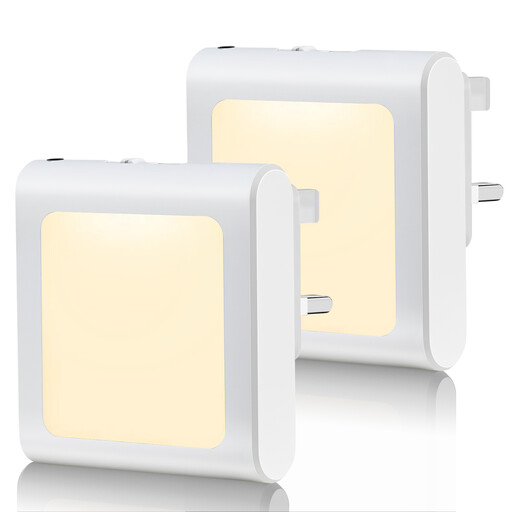
Why it suits this profile: Two compact lights are handy if you want to light a bedroom and a landing, hallway or nursery at the same time. They plug directly into a socket.
The pack contains two lights, so you don’t need to order several separately straight away. Just check that your wall sockets are suitably positioned beforehand.
ABS+PC casing, compact size, low energy consumption according to the product description, and two lights per pack.

Why it suits this profile: This design is ideal for children who want a tactile, decorative night light. The touch controls are easy to understand.
The stated three brightness levels and 30-minute timer mean you can look beyond appearance when choosing a light.
1200mAh rechargeable battery, three light settings, touch controls and a stated run time of 8–10 hours.
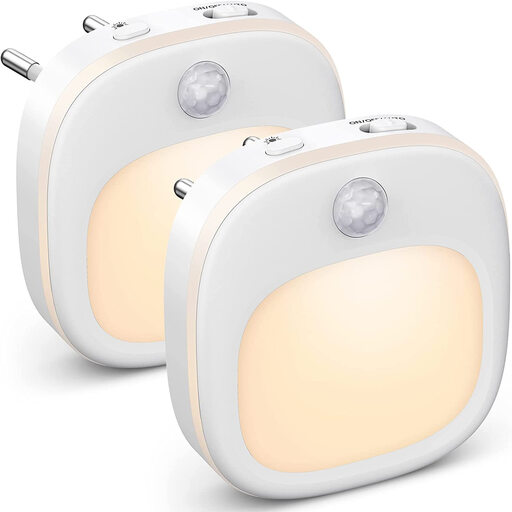
Why it suits this profile: This motion-sensor set is designed for night-time trips through the hallway, landing or nursery, or beside the bed.
The combination of a sensor, five dimming levels and three colour temperatures gives you more ways to adjust the light than a model with fixed brightness.
Two lights, 1 W SMD LED, motion detection, and adjustable light colour and brightness according to the product information.
LED lighting usually uses little electricity, but actual consumption depends on the wattage, how long the light is on and the brightness setting. A 0,5 W light uses less energy when left on continuously than a more powerful model, while a motion sensor or timer can reduce the time it stays on further.
Place a night light on a stable, dry surface or use a suitable socket. For rechargeable models, keep the cable out of reach of young children and don’t leave the product soaking for long periods, even if the description says it’s water-resistant.
We’ve put together a complete, up-to-date list of products that meet these strict selection criteria and the applicable European safety requirements.
That depends on where it’s placed and its specifications. Ideally, choose a soft, dimmable setting and place the light outside the cot and out of the baby’s reach. Always follow the manufacturer’s safety warnings and keep the product away from heat sources, water and loose cables.
Run time varies depending on the battery, brightness setting and controls. The listed VIVREAL unicorn specifications state a 1200 mAh battery, a charging time of 2–3 hours and a run time of 8–10 hours. Treat these as the stated product specifications; actual results may vary.
That depends on the wattage and the number of hours it’s on. A low wattage, LED technology and a timer or sensor can help reduce energy use. To calculate it accurately, multiply the power in kW by the number of hours of use and your own electricity tariff.
