
Vandaag of morgen in huis

Kwaliteit gegarandeerd

Welkomstaanbiedingen ontgrendelen: GRATIS bezorging | Tot 80% korting | Gratis 30 dagen JoyPlus-proefperiode
Download de app
A night-light for a child’s room can be useful during a nighttime feed, a nappy change or a trip to the bathroom. However, not every model is suited to the same situation. A light that looks appealing in a product photo may be too bright in practice, run out of power quickly or be awkward to operate when you only have one hand free.
As a Joybuy Product Recommendation Officer, I focus primarily on verifiable features: brightness, controls, power supply, sensor functions, material information and safety warnings. This allows you to compare a baby-room night-light, an LED night-light and a decorative model based on more than design alone.
Warm white light around 2600 to 3200 K generally feels calmer than cool daylight. However, colour temperature does not indicate how much light the lamp produces. It is therefore important to check the luminous flux in lumens (lm), as well as whether the light can be dimmed.
For example, a 400-lumen lamp is considerably brighter than a 20- or 30-lumen model. That may be useful in a hallway, but unnecessarily bright on a bedside table next to a sleeping child.
A night-light with a light sensor can switch on automatically when it gets dark. A model with a motion sensor responds to movement instead, usually only when it is already dark. These functions are not interchangeable.
A light sensor is practical for a socket in a nursery or hallway. A night-light with a motion sensor is better suited to nighttime routes, such as the walk from the bed to the bathroom. Check the specified light threshold and detection range. Otherwise, the lamp may switch on too often—or fail to respond when needed.
For a rechargeable night-light, the longest battery life is often measured at the lowest brightness setting. Actual runtime with warm white light, coloured light or maximum brightness can be considerably shorter.
Also check the charging time, connector type and included cable. For USB models, use only a suitable power source in accordance with the product information.
For a nursery, an adjustable low setting is often more useful than a single fixed, bright setting. A dimmable night-light can be adjusted for different situations:
Keep in mind that “dimmable” can mean different things. Some models offer three brightness levels, others five, while some provide stepless dimming. A higher lumen rating is not automatically an advantage; the ideal setting depends on the distance from the bed and the size of the room.
Touch controls are convenient when you do not want to search for a small button in the middle of the night. A night-light with a timer prevents the lamp from staying on unnecessarily. Check the available duration: 30 minutes and 1 hour are common options, but not every model has an adjustable timer.
A simple one-button control can be particularly suitable for grandparents or young children. With a remote-controlled lamp, you should also consider the need for batteries and the possibility of misplacing the remote.
Always read the safety warnings and recommended age. According to the product information, the Little Dutch Forest Friends Night Light Squirrel is intended for children aged 3 years and over and contains small parts and batteries. It is therefore not suitable within reach of a baby or younger child.
Soft silicone models sometimes state in their product information that the material is BPA-free or food-grade. This is a product specification provided by the seller and is not a reason to use the lamp as a toy or teether. Keep the lamp away from heat, water and loose charging cables. Clean electrical models with a soft cloth and never immerse them in water.

Why This Fits Their Persona: A straightforward decorative choice for a child’s room from the stated minimum age of 3, with no complicated installation required.
The product information specifies soft integrated LED lighting and one-button operation. The age restriction and small parts make it clear that this is not a lamp to be placed within a baby’s reach.
Integrated LED module; ready to use; decorative squirrel design.
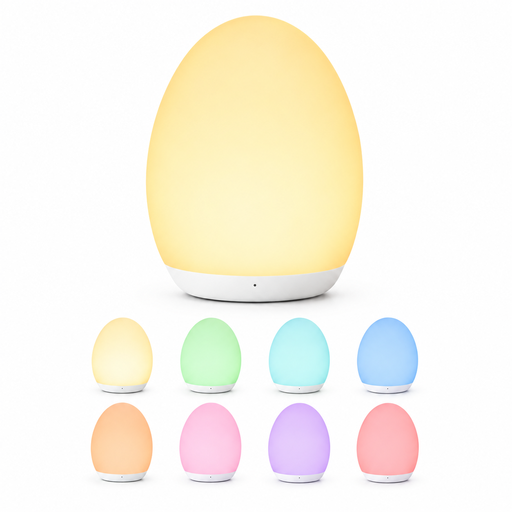
Why This Fits Their Persona: Ideal for parents who want one portable lamp for feeding, changing, bedtime and travel.
According to the product information, the stated runtime of up to 100 hours applies at the lowest brightness setting and not in every night-light mode. This makes comparisons more realistic.
Dimmable warm white light; 8 colour modes; touch controls; 1-hour timer; rechargeable 2000 mAh battery.
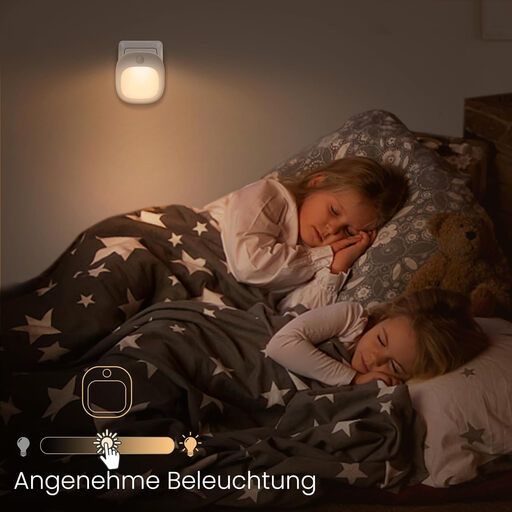
Why This Fits Their Persona: A practical choice for parents who want to illuminate two nighttime routes, such as the nursery and hallway.
The product specification states that the motion sensor works only in the dark, with a range of 3–5 metres. The lamp therefore will not switch on with every movement during the day.
Two lamps; USB rechargeable; 3 colour temperatures; 5 brightness levels; sensor mode with a stated runtime of up to 10 hours.

Why This Fits Their Persona: A gift-ready option for children who enjoy having a tangible, decorative figure beside the bed.
The three brightness levels and 30-minute timer are clearly specified. The lamp is rechargeable, but the safety warning states that it must be kept away from fire, heat and prolonged contact with water.
Soft silicone material according to the product description; touch controls; 30-minute timer; 1200mAh battery; stated runtime of 8–10 hours.
Browse a current selection of night-lights and compare features such as dimming, sensors, timers, colour temperature and rechargeability.
That depends on its placement, age recommendation, material information and controls. Keep the lamp out of the baby’s reach and check whether it contains loose batteries, small parts or a charging cable. A low dimming setting and warm white light are practical features, but they are not medical advice or a guarantee of better sleep.
Consumption depends on the wattage and the number of hours the lamp is switched on. A 0.3 W lamp uses less electricity per hour than a 1 W model. With a rechargeable lamp, you will also use energy to recharge the battery. Compare the stated power consumption with how frequently and for how long you plan to use the lamp.
A timer is suitable when the lamp should switch off after a fixed period, such as after reading a bedtime story. A sensor is more convenient for brief nighttime movement. For a constant, gentle glow beside the bed, manual controls are often easier to manage. Above all, choose the function that best suits the child’s bedtime routine and the lamp’s location.
