
Vandaag of morgen in huis

Kwaliteit gegarandeerd

Welkomstaanbiedingen ontgrendelen: GRATIS bezorging | Tot 80% korting | Gratis 30 dagen JoyPlus-proefperiode
Download de app
A night light for the bedroom might seem simple to choose – until you have to decide between warm white light, colour modes, a timer, a motion sensor and a rechargeable battery. What’s more, a nursery has different practical requirements to an adult bedroom or living room.
Many shoppers come up against the same pitfalls:
Don’t just look at the number of colours. For a baby night light or nursery night light, a low, adjustable brightness is particularly useful. Warm white light around 2600–3200K generally provides a softer glow than cool white light of around 5000K or higher.
A LED night light with multiple modes is flexible: low light for sleeping, a little more light for changing nappies, and perhaps a colour mode for decoration. Bear in mind that RGB colours aren’t always dimmable. On some models, only the warm white setting can be adjusted smoothly.
A night light with a timer stops the lamp from staying on all night. Do check the available time settings. A 30-minute timer suits falling asleep, while a 1-hour setting may work better for a longer bedtime routine.
A night light with a motion sensor is handy in a hallway, next to the bed or by a changing table. Check the detection range and light threshold. A sensor that only activates in the dark prevents the lamp from switching on unnecessarily during the day. For a children’s room, a simple tap control can be more convenient than a sensor.
A rechargeable night light is easy to move around and doesn’t need to be permanently plugged into a socket. Look out for:
For soft models, the product information sometimes describes the material as food-grade silicone, BPA-free or water-resistant. Treat this as a manufacturer’s product specification and always check the safety warnings. Water-resistant does not automatically mean it’s suitable for submersion. Use the lamp indoors and keep charging cables out of reach of babies.
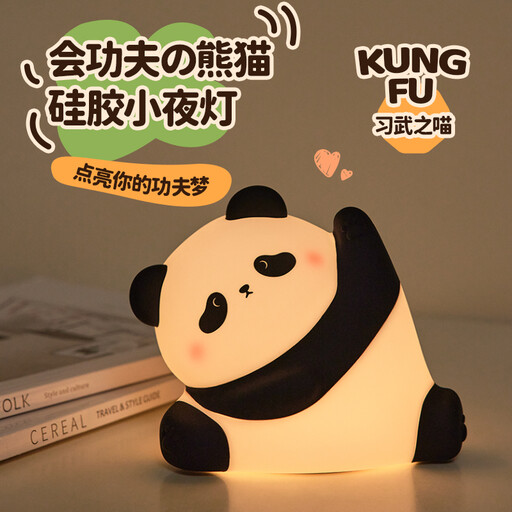
Why this fits the profile: This compact model offers a simple combination of tap control, three brightness levels and a built-in battery for the nursery or children’s room.
The three dimming levels mean you don’t need a bright main light for every use. According to the product description, the model is rechargeable via USB, so you don’t have to keep replacing disposable batteries.
1200mAh rechargeable battery, three brightness levels and a soft silicone panda shape according to the product specifications.
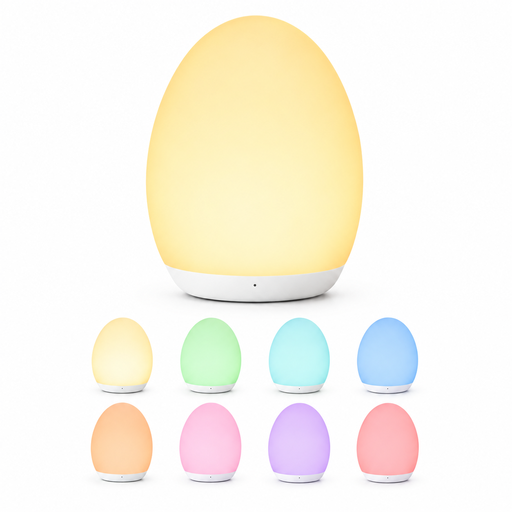
Why this fits the profile: The combination of warm white light, eight colour modes, a memory function and a timer suits parents who want one lamp for feeding, changing and bedtime.
The touch control means you don’t have to fumble for a switch in the dark. According to the product information, the stated run time ranges from around 7 hours at maximum brightness up to 100 hours on the lowest setting.
2000mAh battery, 1-hour timer, memory function and eight colour modes; the maximum run time does not apply to every light setting.

Why this fits the profile: This duo is practical for two locations, such as the nursery and the hallway, where you don’t want to have to switch a lamp on manually every time.
According to the product information, the motion sensor activates in darkness and within approximately 3–5 metres. This means you rarely have to search for the controls manually.
Two lamps, five dimming levels, three colour temperatures and a stated run time of up to 10 hours in sensor mode.

Why this fits the profile: The soft unicorn shape works as a children’s night light and decorative table lamp for a little girl’s room, without needing a separate plug during use.
The tap control and three brightness levels make operation straightforward. According to the manufacturer, the casing is made from soft, BPA-free silicone; always supervise babies and follow the warnings.
1200mAh battery, 30-minute timer, three dimming levels and a stated run time of 8–10 hours.
We’ve put together a full, up-to-date list of products that fully meet these strict selection criteria and comply with current European safety regulations.
It can be practical for falling asleep or a short bedtime routine. Choose a timer that suits the use, for example 30 minutes or 1 hour. A timer does not replace supervision. Place the lamp on a stable surface and keep cords and charging cables out of reach.
That depends on the brightness, colour mode and sensor setting. A low brightness uses less energy than bright light or a continuously active colour cycle. So look at the run time per mode, not just the highest battery life quoted.
Put it on a stable bedside table, a shelf or another flat surface. Don’t place it against bedding, curtains, radiators or other heat sources. For a motion sensor, a spot along the walking route, such as by the door or changing table, usually makes more sense than behind a piece of furniture.
