
People scanning loose clippings
You mainly scan individual newspaper clippings and want to decide whether an overhead scanner will do, or whether a flatbed is better suited to your originals.


For flat, loose newspaper clippings, an overhead scanner is a sensible choice if you want to put the device away after use. If the clippings can lie flat on glass and detail is your priority, compare a flatbed scanner too. For fragile or bound originals, contactless scanning matters more, while a document feeder is best suited to loose sheets that can pass safely through the feed path. For any model, check the scan area, software and where scans are stored on the shared computer.
You mainly scan individual newspaper clippings and want to decide whether an overhead scanner will do, or whether a flatbed is better suited to your originals.
You want to share the device and files with others without permanently taking up too much workspace.
You also scan material that is still bound or cannot safely be pressed flat, so contactless capture matters more.
Start with the original: measure your largest clippings and check whether they can lie flat on glass. Then consider workspace, text recognition and how scans will be stored on the shared computer.
| Purchase concern | What to look for | Who is this important to? |
|---|---|---|
| Size and detail | Measure your largest clipping and test small print at the intended output size. | If I want to capture clippings in different sizes and keep small print readable, size and detail come first. Around 33% of consumers make this their top priority. |
| Finding articles again | Check whether the exact model can export searchable PDFs, and assess its OCR using one of your own clippings. | If I want to search for words or topics later, searchable text matters as much as the scanned image. Around 25% of consumers prioritise being able to find their scans. |
| Desk space and sharing files | Check the device’s dimensions, connection, software and storage location; restrict access to files appropriately. | If several people use the desk and the scans, I want a practical setup and clearly managed access. Around 25% of consumers prioritise shared use. |
| Fragile or bound originals | Check whether the original can safely lie flat and whether its full size fits in a single capture. | If I don’t want to press down on a fragile clipping or page, protecting the original comes first. Around 17% of consumers say this is their top concern. |
These figures do not measure the same thing. IRIS lists a native resolution of 13 MP and a higher software-interpolated figure for the Desk 6 Pro; Plustek lists the OpticSlim 1180’s optical resolution in dpi.
Make a test scan of your smallest newspaper text and check both the image and the OCR.
An unreadable scan can take extra time to redo or to correct by hand.
For the Epson DS-C490, Epson describes A3 scans as being created by stitching scans together; the device has an A4 feeder.
Check whether the exact model captures A3 in one go or assembles the image afterwards.
Stitching separate scans together takes extra time.
CZUR positions the Shine 800 A3 Pro for flat, loose pages and describes curvature correction specifically for the ET series.
Check features for bound originals against the exact model, rather than relying on the term ‘book scanner’ alone.
If scans contain personal data, unauthorised access can pose a privacy risk. The Dutch Data Protection Authority highlights the importance of appropriate access controls for organisations.
Agree in advance where scans will be stored, who can access them and how files will be cleared away.
CZUR positions the Shine 800 A3 Pro for flat, loose sheets; the ET series is also designed for bound material.
Plustek describes the OpticSlim 1180 as an A3 flatbed scanner for material that can lie on the glass, including newspapers.
The IRIScan Desk 6 Pro is an overhead scanner for documents and books up to A3, with searchable PDF output.
ScanSnap presents the SV600 as a contactless overhead option for books and fragile documents, among other things.
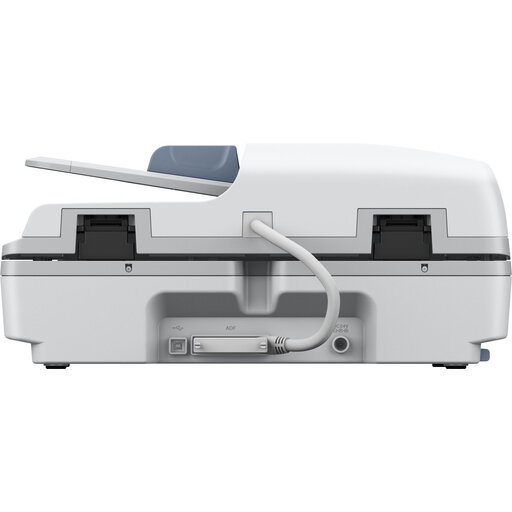
Epson describes the DS-C490 as a compact scanner with a document feeder for suitable loose sheets.
These products are suited to loose newspaper clippings: a foldable overhead scanner and a flatbed option for material that fits within the scan area.
 No image available
Suitable for flat, loose clippings when you want to clear the shared desk after use.
CZUR lists 8 MP, 205 dpi at A3 and export to searchable PDF for this model. Test it with your own small newspaper text to see whether the scan and text recognition meet your needs.
 No image available
A flatbed option for loose clippings that fit within the paper sizes supported by the model.
Before buying, check that your largest clipping fits on the scan area and that the software and storage location work for shared use.
No. For flat, loose clippings, you can also compare flatbed scanners. A contactless overhead scanner is particularly useful if you don’t want to press down on the material or also scan bound pages. Measure the original before choosing a scan size.
Check which software and connection the exact model uses, and decide where scans will be stored. If the files contain personal data, an organisation must restrict access appropriately; the measures needed depend on the purpose and context.
According to the Dutch government, there is no fixed statutory warranty period in the Netherlands; the right to a product that works as it should still applies. Many online purchases from a business usually come with a 14-day cooling-off period. Check the terms that apply to your specific purchase.
Not automatically: scanning something yourself does not necessarily mean you can share or publish protected material. The Dutch government distinguishes between making a copy for personal use and distributing it; check which rights and permissions apply before sharing. If scans contain personal data, also make sure you follow the appropriate rules for handling and access.