
One computer and an existing connection
If you already have a working network connection and just want to connect your computer, you’ll want to consider whether a switch would add anything.


If you have one computer and the network connection in your garden office is already working, a switch usually won’t add anything. For several wired devices, a compact, fanless gigabit switch may be enough. Count the cable to your home as a port, and choose PoE outputs or 2.5G only if your connected devices need those features. A switch on your desk won’t solve a missing connection between buildings or install one that isn’t there yet.
If you already have a working network connection and just want to connect your computer, you’ll want to consider whether a switch would add anything.
You need extra wired connections for a computer and other devices, for example, without a large or noisy switch next to your workspace.
As well as your computer, you may want to connect an access point, camera or faster local devices. You’ll need to assess port speeds and any PoE features separately.
First, check that the connection between your home and garden office is working. Then count the connections you need and decide whether a compact size, PoE or 2.5G is relevant to your devices.
| What to consider | What should you check? | Who is this important for? |
|---|---|---|
| Number of ports | Count your computer, other wired devices and the incoming cable from your home. That cable also uses a port. | If I want to connect several devices to one incoming cable, I count that cable too. Around 33% of consumers mainly need extra wired connections. |
| Connection to the garden office | Check that the connection from your home reaches the office and works. Assess a new cable route separately; before digging with machinery, you must submit a digging notification to the Land Registry, according to the Dutch government. | A switch is only useful to me if the connection between my home and garden office works. Around 25% of consumers prioritise that connection. |
| Size and noise | Compare the dimensions of the exact model version, check where the cables and power supply protrude, and see whether the model has a fan. | If my desk has limited space, I also need to allow for the cables and power supply next to the switch. Around 17% of consumers mainly look for a compact, quiet setup. |
| PoE | Check whether the switch itself receives PoE or has PoE outputs, as well as the required standard and available power. | If I want to power network equipment over Ethernet, I first check which PoE feature my devices need. Around 17% of consumers mainly consider PoE. |
| Port speed | Check the network speeds of your computer and any other relevant devices. A 2.5G switch won’t make a gigabit port or slower connection faster by itself. | If I want to use 2.5G for devices on my local network, those devices’ connections must also support that speed. Around 8% of consumers prioritise compatible 2.5G equipment. |
A switch adds ports, but it doesn’t replace the connection to your home. If you’re connecting one computer to a working connection, you may not need any extra ports.
Test the existing connection with your computer first, and only buy extra ports if you need them.
An unnecessary device also needs a power adapter and takes up desk space.
With the Ubiquiti USW-Flex-Mini, PoE can power the switch itself. The TP-Link TL-SG105PE has PoE+ outputs to power compatible connected devices. These are different features.
Check the exact model to see which port receives power, which one supplies it and how much power is available.
A device with PoE input still needs a suitable PoE source or the appropriate USB-C power supply.
A switch distributes an existing connection, but it won’t create one between your home and garden office. Any new cable route needs to be assessed separately.
First decide how the connection between the buildings will run, then choose a switch for the connections inside the office. Digging with machinery in the Netherlands requires a digging notification.
You may need separate connection equipment and installation work; digging with machinery also requires a digging notification.
The models mentioned illustrate different features; a specific model’s features don’t automatically apply to the entire brand.
TP-Link offers compact gigabit models, a model with PoE+ outputs and a model with 2.5G ports, among other options.
NETGEAR describes the GS305v3 as a compact, unmanaged gigabit switch with five ports for expanding a wired network.
The manufacturer lists five gigabit ports and two power options for the USW-Flex-Mini.
D-Link describes the DGS-105 as a compact, unmanaged switch with five gigabit ports, suitable for small office setups, among other uses.
These wired switches offer a range of options for adding connections, including gigabit models with PoE and a model with 2.5G ports. Check which features and port speeds suit your devices.
 Image unavailable
An option if you want to connect several devices on your desk through one incoming connection.
Five RJ45 ports with 10/100/1000 Mbps; the incoming cable uses one of the ports. Plug-and-play functionality is listed.
 Image unavailable
An option if you want to power compatible PoE devices over the network cable as well as connect your computer.
Five gigabit ports, four of which support PoE; the product information lists a total PoE budget of 56 W.
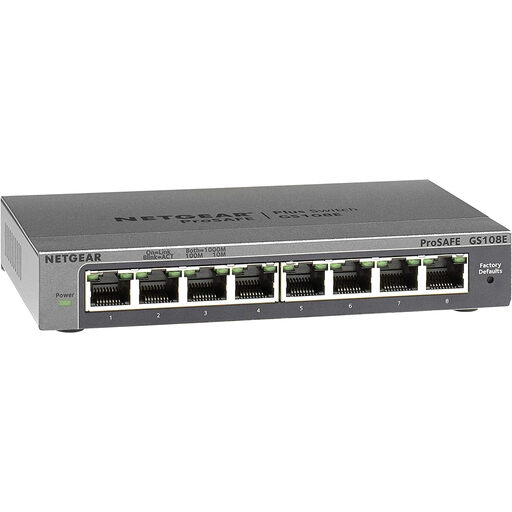 Image unavailable
An option if you want to connect more wired devices than will fit on a five-port model.
Eight ports with 10/100/1000 Mbps. The product information lists features including VLAN, QoS and IGMP snooping.
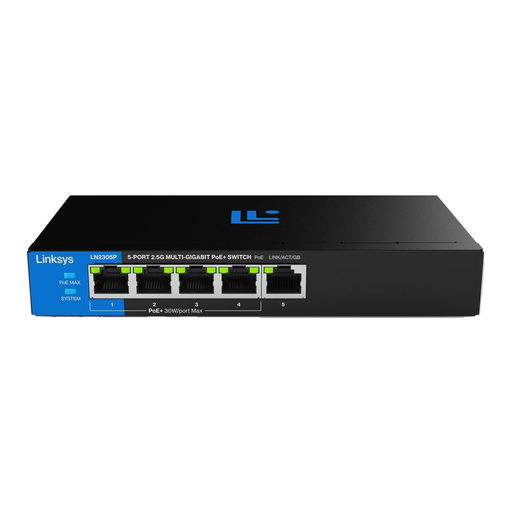 Image unavailable
An option if your connected equipment supports 2.5G and you also want to power compatible PoE devices.
Five 2.5G ports, four of which support PoE+. The product information lists up to 30 W per PoE+ port and 60 W in total.
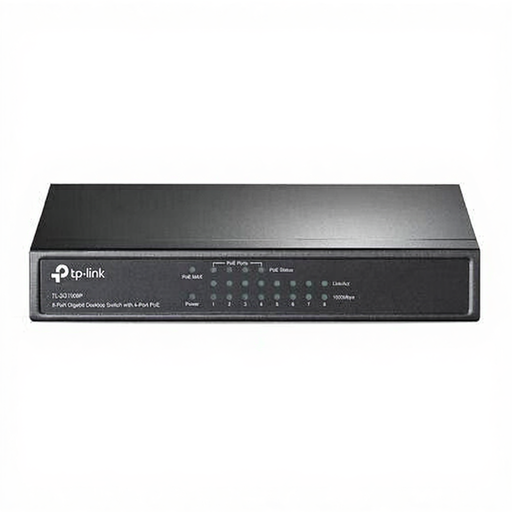 Image unavailable
An option if you need more connections and want to connect compatible PoE devices to the same switch.
Eight gigabit ports, four of which support PoE; the product information lists a total PoE budget of 64 W.
Connect the incoming network cable to one port and your computer to another. Power the switch according to the model’s instructions. Remember to include the incoming cable in the number of ports you need. According to TP-Link, the TL-SG105 doesn’t require configuration.
Check that the switch is receiving power, the cable plugs are firmly connected and the connected device is switched on. The TP-Link installation guide specifies a cable length of less than 100 metres for the connection in question; that alone doesn’t tell you whether an outdoor route is suitable.
No. Assess the switch location and cable route separately. The TP-Link TL-SG105 specifications list 0–40 °C and 10–90% relative humidity, non-condensing. Check the conditions in your garden office and the limits of the exact model.
According to ACM ConsuWijzer, you have a legal guarantee in addition to any manufacturer’s or seller’s warranty. If a product breaks sooner than you could reasonably expect under normal use, the seller must resolve the issue at no cost under those rules. A two-year manufacturer’s warranty doesn’t automatically limit your legal rights.
Before digging with machinery, the law requires you to submit a digging notification to the Land Registry. The Dutch government says you must do this at least three working days before digging. According to the Land Registry, no notification is legally required for manual digging, but you could still damage a cable. Simply connecting a switch doesn’t require a digging notification.