
Studio user short on LAN ports
You want to connect a desktop PC and a few shared devices to one existing socket, without having to configure the switch. Remember to count the connection to the existing network too.


For a desktop PC and a few shared devices connected to a single existing LAN socket, an unmanaged gigabit switch with enough ports is usually sufficient; remember to count the uplink too. Choose 2.5 gigabit only if your PC, storage and the relevant network path support that speed. Discuss VLAN segmentation with the network administrator: a VLAN switch does not automatically secure access across the whole network.
You want to connect a desktop PC and a few shared devices to one existing socket, without having to configure the switch. Remember to count the connection to the existing network too.
You need to decide which users and devices can access each network segment, and you’re able to manage the setup. The Dutch Data Protection Authority stresses that appropriate security measures depend on the data and the risks involved.
You transfer large files between a desktop PC and, for example, a NAS. TP-Link says the TL-SG105-M2 has five 2.5-Gbps ports; the connected devices and links must support that speed too.
First, count the connections you need, including the uplink. Then consider whether your studio’s devices and setup call for network management, higher speeds or PoE.
| Factor to consider | What to look for | Who is this important for? |
|---|---|---|
| Enough ports | Count your desktop PC and other wired devices, plus one port for the uplink. Choose the number of connections based on what you actually want to connect. | If I want to connect my PC and shared devices through one socket, I need enough spare ports after connecting the uplink. Around 31% of consumers say having enough LAN ports is their top priority. |
| Network separation | Ask who manages the switch, which devices should be able to communicate, and whether the router and other equipment support the segmentation you want. | If workspaces or devices shouldn’t be able to access each other’s networks freely, I want to agree the setup with the administrator. Around 25% of consumers say network separation is their top priority. |
| Local speeds | Check the port speeds of your PC and NAS, and the network path between them. A faster switch port alone doesn’t determine the speed of the entire connection. | For large files between my PC and storage, I check whether both endpoints and the relevant connections support 2.5 gigabit. Around 19% of consumers say local file transfers are their top priority. |
| Power over Ethernet | Check whether the additional device supports PoE, which standard it requires, and whether the total PoE budget is sufficient. | If I want to power a compatible access point or camera through the network cable, the switch needs to support this. Around 13% of consumers say powering additional devices is their top priority. |
| Noise and placement | Check whether your chosen model is fanless and where the power supply, switch and cables can go. Also make sure it’s suitable for desktop or wall mounting. | If the switch is close to workspaces, I want to know whether its fan will make any noise and where the cables will go. Around 12% of consumers say quiet operation and placement are their top priority. |
The connection to the existing network also uses a switch port, leaving fewer connections for your PC and other devices.
Before you buy, count all your devices and add one port for the uplink. A five-port model leaves four ports for devices after the uplink; an eight-port model leaves seven.
If you don’t have enough connections, you may need an additional switch or changes to your cabling.
The switch’s port speed doesn’t automatically determine the speed of your PC, storage, uplink or internet connection.
Check the connections at both ends and decide whether you mainly want to speed up local traffic between your PC and storage.
A switch with VLAN features gives you configuration options, but security depends on how the whole network is set up and the risks involved. The Dutch Data Protection Authority lists network segmentation as a possible security measure.
Agree with the network administrator which devices should be able to communicate and how the switch and other network equipment need to be configured.
Configuration and management may require additional time.
The range includes models for straightforward expansion, network management and faster port speeds.
The GS305E and GS305EP are five-port gigabit models with different management and power features.
The DGS-105 is a straightforward five-port gigabit switch for expanding a small wired network.
This selection from Joybuy focuses on adding wired connections for a desktop PC, with additional models offering PoE or 2.5-Gbps ports.
 No image available
A good fit for a desktop PC and a few wired devices when five gigabit ports are enough.
TP-Link lists five RJ45 ports with 10/100/1000 Mbps. The product name specifies a metal casing, while the description says it’s plug and play, with no switch configuration required.
 No image available
A good fit if you want to power compatible network devices over Ethernet as well as connect your desktop PC.
TP-Link’s product details list five gigabit ports and four PoE ports compliant with 802.3af. The description mentions quiet operation and desktop or wall mounting; check that the PoE standard is suitable for your devices.
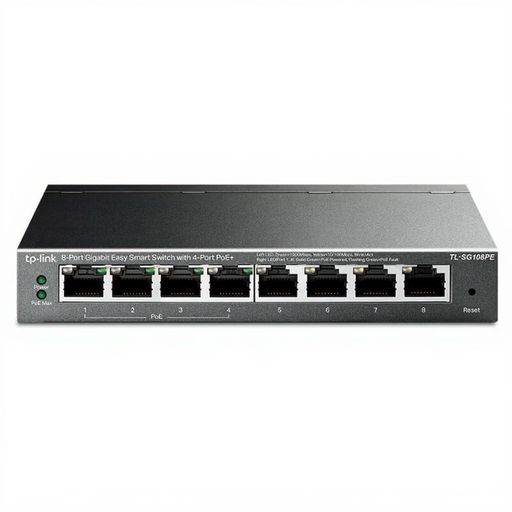 No image available
A good fit if you want to connect more wired devices and power compatible devices over Ethernet too.
TP-Link lists eight gigabit ports and four PoE ports. The product description mentions setup through a web interface for advanced management.
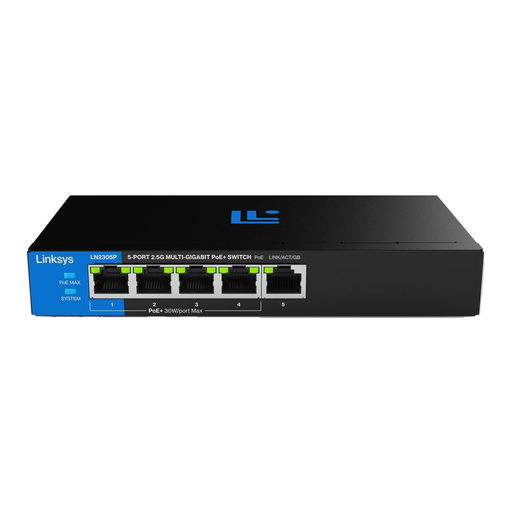 No image available
A good fit for a setup where compatible devices share local files and additional devices need PoE+.
Linksys lists five 2.5-Gbps ports, four PoE+ ports supporting up to 30 W per port, and a total budget of 60 W. The description mentions a fanless casing; your PC, storage and the relevant network path must support 2.5 gigabit.
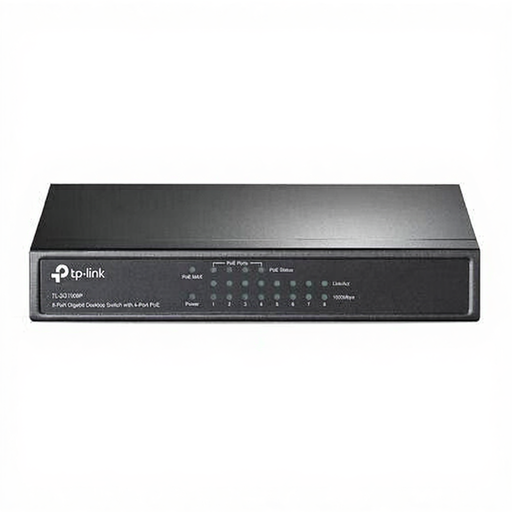 No image available
A good fit if you want to connect several wired devices and power compatible devices over Ethernet.
TP-Link lists eight 10/100/1000-Mbps ports, four PoE ports and a 64 W PoE budget compliant with 802.3af. Check that this standard is suitable for the connected devices.
Connect the switch to its power supply and an existing network socket, then connect your PC to a spare port. An unmanaged model doesn’t need to be configured; in a shared studio, make sure you know which socket and devices you’re allowed to use.
First, discuss the access separation you need with the network administrator. The smart switches mentioned offer VLAN features, but the Dutch Data Protection Authority says appropriate security measures depend on the data processing and the risks involved. Simply buying a VLAN switch doesn’t mean the whole network is set up securely.
According to the Dutch government, you’re entitled to a product that works properly in the Netherlands, and you can contact the seller to resolve a fault. There’s no fixed statutory guarantee period; what you can reasonably expect from a product depends, among other things, on the product itself and how it’s used.
According to Your Europe, specific EU CE marking rules may apply to certain categories of electrical and electronic products. Check which requirements apply to the particular model and power adapter; general information doesn’t confirm that an individual item for sale complies.