
Listener with an existing stereo system
If you want to play string quartets through your current amplifier or active speakers, first check that the connections are compatible. WiiM lists analogue and digital outputs for the Pro.


Start with your existing speakers and amplifier: a standalone streamer can feed active speakers or an amplifier, but it won’t amplify passive speakers itself. Next, check that your chosen recordings and playback route support gapless playback. Only look at room settings once you know where you want to listen. Some correction features require additional measuring equipment or a licence.
If you want to play string quartets through your current amplifier or active speakers, first check that the connections are compatible. WiiM lists analogue and digital outputs for the Pro.
If you listen to recordings from start to finish, check that gapless playback is supported for your file format and playback route. Bluesound lists gapless playback for supported audio formats.
If you mainly listen from one spot in your open-plan space, compare the available settings and what you need to use them there. WiiM lists RoomFit for the Pro, while Bluesound describes the NODE as Dirac Live Ready.
Start with the connections and amplification you need. Then check access to your recordings and gapless playback, and compare room settings last.
| What to consider | What to look for when buying | Who is this important for? |
|---|---|---|
| Connections and amplification | Find out whether your speakers are active or passive, then compare the player’s outputs with the inputs on your system. If you have passive speakers, check whether you need an amplifier. | If you want to keep using your current system, you’ll need to know whether the player connects to it and whether you need an amplifier. Around 33% of consumers prioritise connections and the amplification required. |
| Recordings and album playback | Look for your preferred recording in your music service or personal library, then check the supported format and gapless playback for your chosen playback route. | If you want to listen to an album with connected movements without the player inserting a pause, check both the recording and playback route. Around 25% of consumers give access to recordings and uninterrupted album playback top priority. |
| Listening-position settings | Compare the features of the exact model, and check where you want to take measurements and whether you need a microphone, calibration kit or licence. | If you mainly listen from one fixed spot, check that the settings suit that position and find out what the measurement requires. For around 25% of consumers, adjusting the system to their listening position is a priority. |
| Control and expansion | Check that the player works with your preferred app and service. If you want to listen in several places, find out which devices work together within the same system. | If you want to control the player with a particular app or add listening zones later, check which devices and controls are compatible. Around 17% of consumers prioritise control or expansion. |
WiiM describes the Pro as a streamer, not an amplifier. You therefore can’t connect passive speakers directly to this model.
Before choosing, find out whether your speakers are active or already connected to an amplifier. If you have passive speakers without an amplifier, compare streaming amplifiers.
Bluesound says you need a separate licence and calibration kit to use Dirac Live, so the label doesn’t mean everything is ready to use straight away.
Check which components you already have and compare what you’ll need in total with the settings you actually want to use.
Support for music services or local media doesn’t guarantee that your specific string quartet recording is available.
Look for the recording in your intended service or library beforehand, and check that the playback route is suitable.
The WiiM Pro is a standalone streamer for a system that already has amplification; the WiiM Amp is a streaming amplifier for a different kind of purchase.
The NODE combines a standalone streamer with BluOS, a range of connection options and room-correction capability.
The CXN100 is worth comparing if you use both streaming services and your own digital music library.
HEOS may be relevant if you already have compatible Denon or Marantz equipment, or want to group listening zones.
This Joybuy pick is a Wi-Fi MP3 player which, according to the product description, can stream music to Bluetooth speakers. Check that this output route suits your existing stereo system.
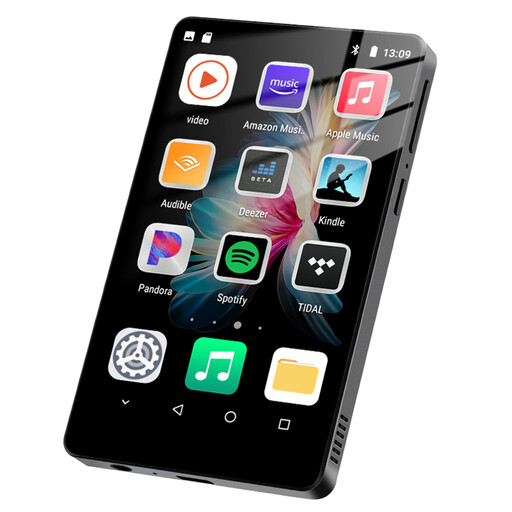 Image unavailable
The product description lists Wi-Fi, streaming apps and Bluetooth output to speakers. Check that this connection suits your system.
Android 11, 4-inch touchscreen, 2 GB RAM and 16 GB storage; storage can be expanded to 256 GB. The product name also mentions an FM radio.
Check that the specific device carries the correct CE marking. The Dutch Authority for Digital Infrastructure describes CE marking as mandatory for the relevant equipment.
Not to a player without a built-in amplifier, such as the WiiM Pro. Use a suitable amplifier or compare streaming amplifiers, and check your speakers’ connections and requirements.
Check that gapless playback is supported for the file format and playback route you actually use. Bluesound lists gapless playback for supported audio formats, but that doesn’t mean every service or recording will work properly.
No, not without the required equipment. Bluesound describes the NODE as Dirac Live Ready and says that a separate Dirac Live licence and calibration kit are needed. Check what you already own before buying.
Check that the specific device carries the correct CE marking. The Dutch Authority for Digital Infrastructure says CE marking is mandatory for the relevant equipment; a brand mentioned in this guide doesn’t mean that an individual product has been checked.
Look for the specific recording in advance in the music service or personal library you plan to use. Also check that the format and playback route support gapless playback if you want to listen to the movements without interruption.