
Evening listener
You want to play orchestral music quietly and adjust the tonal balance, without assuming that a setting will make every quiet passage audible.


Choose a network player that connects to your existing amplifier or active speakers and supports the music source you use. Then compare the available tone controls and album settings. These may suit your listening preferences, but they won’t guarantee that every quiet passage will be audible.
You want to play orchestral music quietly and adjust the tonal balance, without assuming that a setting will make every quiet passage audible.
You listen to complete symphonies or concert albums and want to choose between adjusting levels for an album as a whole and matching individual tracks. Bluesound describes these two ReplayGain modes as different ways of handling levels.
You want to keep using your current amplifier and speakers. The connections you need and the way you play your music determine whether a separate player will suit your setup.
A good fit if: you want to keep your amplifier or active speakers and can connect the player to them.
Bear in mind: a standalone streamer won’t power passive speakers. Also check where the volume and EQ are controlled.
A good fit if: you play your own files and want to manage levels at album level.
Bear in mind: Album gain and Track gain handle levels differently. Album-level adjustment won’t automatically make every quiet passage louder.
A good fit if: you want to fine-tune playback for your listening position and your chosen player has suitable features.
Bear in mind: room calibration isn’t the same as automatically adjusting for low-volume listening. Some systems require additional equipment or a licence.
| What to consider | What should you check? | Who is this important for? |
|---|---|---|
| Tonal balance and controls | Check whether the player offers EQ or tone controls, and where you adjust the volume. WiiM lists EQ for the Pro Plus; Bluesound documents bass and treble controls for its players. | If I listen quietly in the evening, I want to be able to adjust the tonal balance without expecting this to make every quiet orchestral passage audible. Around 36% of consumers prioritise tonal balance and controls for low-volume listening. |
| Relative levels between album tracks | Check whether your playback method and files support the ReplayGain feature you want. Bluesound distinguishes between Album gain and Track gain. | If I’m listening to a complete symphony album, I don’t want all the movements automatically set to the same level. Around 29% of consumers give album playback top priority. |
| Connection and music source | Compare the inputs on your setup with the player’s outputs, and check that it supports your preferred app or music library. WiiM lists RCA, optical and coaxial outputs for the Pro Plus; according to WiiM, the Ultra doesn’t support AirPlay. | If I want to keep my current stereo, I look for compatible connections and access to my own music source. Around 21% of consumers prioritise connectivity and access to music. |
| Listening-room calibration | Check what measurement method, equipment and any licence are required for the room-calibration feature you’ve chosen. WiiM describes RoomFit settings; for Dirac on the NODE (N132), Bluesound specifies a separate licence and measurement kit. | If I want to fine-tune playback for my listening position, I want to know in advance what the process involves. Around 14% of consumers give room calibration top priority. |
A standalone network player connects to an amplifier or suitable active speakers; it won’t drive passive speakers on its own.
Make a note of the speakers and inputs you use beforehand, and check that your amplifier can remain part of the setup.
Passive speakers still need a suitable amplifier.
Bluesound describes Album gain as adjusting levels for an album as a whole, while Track gain matches the levels of individual tracks. These are different ways of handling an album’s levels.
Choose the setting deliberately when playing a work as a complete album, and check that your files and playback method support ReplayGain.
For Dirac on the Bluesound NODE (N132), Bluesound specifies a licence and measurement kit that must be purchased separately.
Before buying, check which components you’ll need and whether they’ll suit your setup.
You’ll need to arrange the licence and measurement kit separately to use this calibration.
WiiM lists AirPlay support for the Pro Plus, but not for the Ultra.
Check the exact model and your preferred playback method before making a choice.
The Pro Plus is an option for connecting to an existing amplifier or active speakers; the Ultra adds RoomFit settings.
The NODE (N132) is an option to consider if you’re looking into BluOS control, tone adjustment and, potentially, a separate Dirac setup.
The CXN100 is an alternative if its StreamMagic sources and digital outputs suit your existing setup.
The DMP-A6 Gen 2 is an option if you want to combine your own music files, the listed streaming sources and a range of digital outputs.
The C 658 is a streaming DAC/pre-amplifier for a setup where room calibration and other sources also play a part.
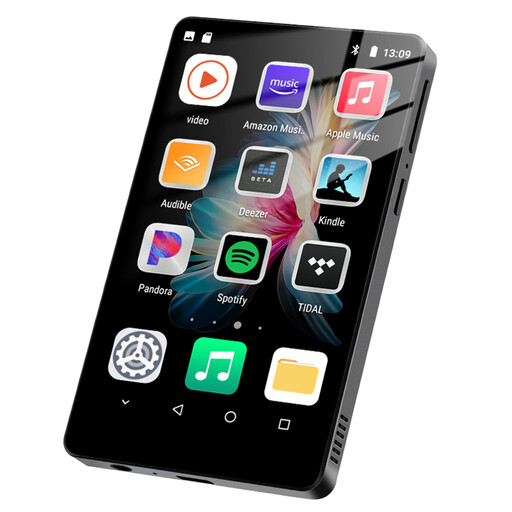
A Joybuy product that suits one aspect of this listening need: a Wi-Fi and Bluetooth MP3 player for listening through headphones, Bluetooth or the built-in speaker.
 No image available
The product description mentions listening through headphones, a Bluetooth device or the built-in speaker. Check beforehand that the connections suit your stereo system.
The title lists Wi-Fi, Bluetooth 5.0, a 4-inch touchscreen and Android 11.
The title lists 2 GB RAM and 16 GB storage, expandable up to 256 GB, as well as FM radio and a speaker.
The product description mentions apps and streaming services via Google Play when connected to Wi-Fi.
For this wireless model, check that the required EU conformity information and CE marking are present.
No, that isn’t implied by the features listed for network players. Yamaha describes loudness compensation for its own R-N1000A; it isn’t a general feature of network players. Try a modest tone adjustment with your own setup to see whether you like the result.
First check which inputs your amplifier or active speakers have. WiiM lists RCA, optical and coaxial outputs for the Pro Plus. Passive speakers still need a suitable amplifier.
According to Bluesound, Album gain adjusts levels for an album as a whole and preserves the relative level differences between tracks; Track gain matches the levels of individual tracks. Check that your files and playback method support this feature.
Not in full: Bluesound describes the NODE (N132) as Dirac Live Ready, but says that a separate licence and measurement kit are required to use it.
Radio equipment placed on the EU market must comply with the applicable EU product rules and related conformity requirements. For the specific model, check that the required information and CE marking are present.