
Owner of an existing stereo system
You want to stream music online without replacing your amplifier or active speakers. The available inputs and outputs determine which standalone player will connect to your system.


Start by checking which music services are supported and how the player connects to your system. A standalone network player is designed for use with an existing amplifier or active speakers; it cannot power passive speakers on its own. You can then compare features such as a subwoofer output, room calibration and control options. Some features, such as Dirac Live on the Bluesound NODE N132, require additional equipment.
You want to stream music online without replacing your amplifier or active speakers. The available inputs and outputs determine which standalone player will connect to your system.
You want to check whether room settings or a subwoofer output suit your setup, without assuming they will produce the same result in every listening position.
You want to control music from an app and might want to play it in more rooms later. Compare the services supported and the controls available on each model.
Suitable if: you already have an amplifier or active speakers and a compatible input is available.
Bear in mind: a standalone player cannot power passive speakers on its own.
Suitable if: you want to use passive speakers without a separate, compatible amplifier.
Bear in mind: check that the connections and amplifier specifications are suitable for your speakers.
First check that your music service and existing system are compatible. Then compare room, control and any additional equipment requirements.
| What to consider | What to look for | Who is this important for? |
|---|---|---|
| Support for your music service | Check that the exact model supports your service and preferred control method. | If I want to keep using my regular music service and online library, I want to know in advance whether they work together. Around 28% of consumers rank access to their music service as their top purchasing priority. |
| Connection to your system | Make a note of whether your speakers are active or passive, and which inputs are available on your amplifier. | If you want to keep your existing amplifier or speakers, finding a suitable connection to your system is a priority. Around 22% of consumers put this first. |
| Room calibration and bass | Compare the subwoofer output and room settings. Dirac Live on the Bluesound NODE N132 requires a licence and a compatible measurement microphone. | In a large living room, I may want to consider whether room settings or a subwoofer suit my listening position. Around 22% of consumers prioritise room and bass adjustment. |
| Control and expansion | Check which app and control method you want to use, and whether they will work with any other rooms you may add. | If I want to control music easily through an app or play it in more rooms later, I look at the controls and system. Around 17% of consumers make this their top priority. |
| Additional equipment and support | Check what you need for the features you want to use, and who to contact if the product turns out to be faulty. | If you want to understand the costs of your preferred features and the support available in advance, check for any additional requirements, such as the licence and microphone for Dirac Live on the NODE N132. Around 11% of consumers prioritise additional costs. |
Line or digital outputs are designed for equipment with an amplifier; they are not speaker outputs for passive speakers. The Sonos manual describes the Port’s outputs for connecting to amplified equipment.
First, check what amplifier and speakers you already have. Then compare a standalone player with a streaming amplifier if you want to power passive speakers.
Without a compatible amplifier, buying a standalone player may mean you also need to buy an amplifier.
On the Bluesound NODE N132, support for Dirac Live does not mean all the required equipment is included as standard.
Bluesound says this calibration requires a Dirac Live licence and a compatible measurement microphone. Check what you need for the feature you want to use.
Support varies by model: WiiM states that the Ultra does not support AirPlay 2, while Bluesound and Cambridge Audio list support for the models mentioned. Services may also depend on your region and subscription.
Before choosing, check that the exact model supports your preferred music service and control method.
The WiiM Ultra is a standalone streamer for use with an existing amplifier or active speakers; the WiiM Amp is a streaming amplifier for a different setup.
The NODE is designed to work with an existing stereo system and be controlled through BluOS.
The CXN100 is a standalone network player for an existing system and uses StreamMagic.
The Port is a streaming component that connects an existing amplified audio system to the Sonos system.
The DNP-2000NE is a standalone network player with HEOS and HDMI ARC for connecting to an existing system.
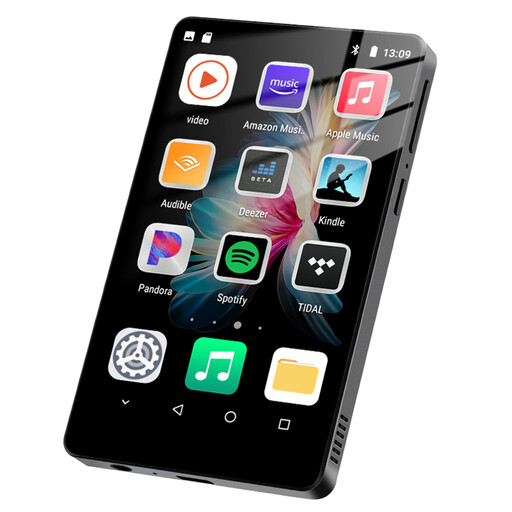
The option below is a Wi-Fi MP3 player with streaming apps and Bluetooth audio. Consider whether the app you want and the Bluetooth connection are suitable for your music library and speaker setup.
 No image available
According to the product description, you can use streaming apps and send Bluetooth audio to speakers.
The model has a 4-inch touchscreen and runs Android 11.
It has 16 GB of storage, expandable to 256 GB; the device also has 2 GB RAM, FM radio and a built-in speaker.
Not through the line or digital outputs of the standalone players described here; you’ll need a compatible amplifier. If you want to connect passive speakers directly, compare streaming amplifiers with speaker outputs and check that one is suitable for your speakers.
Check whether your TV has a suitable ARC or eARC connection and whether the exact model has the corresponding input. WiiM lists HDMI ARC for the Ultra and Bluesound lists HDMI eARC for the NODE; a TV connection is optional if you only want to stream music online.
No. For Dirac Live calibration on the compatible NODE N132, Bluesound lists a licence and a compatible measurement microphone as requirements.
For eligible online purchases from a business, you generally have a 14-day cooling-off period, according to the Dutch government. The seller must also provide a solution if a product is faulty; according to the Dutch government, the Netherlands does not have a fixed statutory warranty period for all products.