
Listener with an existing stereo system
Wants to play blues through their current amplifier or active speakers. WiiM and Sonos describe models that can connect to existing audio equipment; check which input your system has.


Choose a network music player that matches the input on your existing amplifier or active speakers, as well as the source of your blues recordings. Also check that the exact model offers the controls you want and, if needed, a headphone socket. A standalone streamer does not replace an amplifier for passive speakers.
Wants to play blues through their current amplifier or active speakers. WiiM and Sonos describe models that can connect to existing audio equipment; check which input your system has.
Has recordings stored on USB storage or a network source. Cambridge Audio lists USB and NAS playback for the MXN10; Bluesound describes the NODE NANO as compatible with BluOS and network sources.
Wants to listen directly through the player. Bluesound lists a headphone output for the NODE; check the exact model, as you should not assume that this connection is available on the NODE NANO.
Start by checking how the player connects to your existing system. Then consider your music source and the controls you want to use. If you plan to listen through headphones, check the connection on the exact model too.
| What to consider | What should you check? | Who is this important for? |
|---|---|---|
| Connection to your system | Check whether you have an RCA, optical or coaxial input, and whether your speakers are active. | If I want to keep using my current amplifier or active speakers, the player’s output needs to match. Around 33% of consumers prioritise compatibility with their existing audio equipment. |
| Streaming controls | Check whether the exact model supports your preferred streaming service and playback method. | I want to start playing blues from the app I already use, without having to switch between control systems unnecessarily. For around 27% of consumers, control through a familiar app is the top priority. |
| Your own music collection | Check the storage source, file formats and how the accompanying app gives you access to your collection. | If my blues albums are stored on USB storage or a network source, I want to know whether the player and app can access them. Around 20% of consumers prioritise access to their own files. |
| Headphone socket | Check whether the exact model has a headphone output and whether it’s compatible with your headphone plug. | I want to listen through headphones directly in my home office. This is the top consideration for around 20% of consumers when choosing a player. |
A streamer’s audio output won’t power passive speakers on its own. Check whether your speakers are active and which input your amplifier has.
Connect passive speakers to a suitable amplifier.
Bluesound lists a headphone output for the NODE; the listed connections for the NODE NANO do not confirm that this model has one too.
Check the full model name and look for an explicitly listed headphone output.
You may need additional equipment to listen directly through headphones if your chosen model doesn’t have a suitable output.
A stated maximum resolution doesn’t tell you the resolution of your blues recording.
Choose your player based on your music source, connections and preferred controls first, then check the resolution specifications in line with the manufacturer’s conditions.
The Pro Plus is designed as a standalone streamer for an existing amplifier or active speakers, with analogue and digital outputs.
The compact MXN10 is designed for streaming to an existing hi-fi or desktop setup, as well as playing music from USB and NAS.
The NODE NANO combines BluOS collection management with analogue and digital outputs.
The Port is designed to add an existing stereo or receiver to a Sonos setup with multi-room playback.
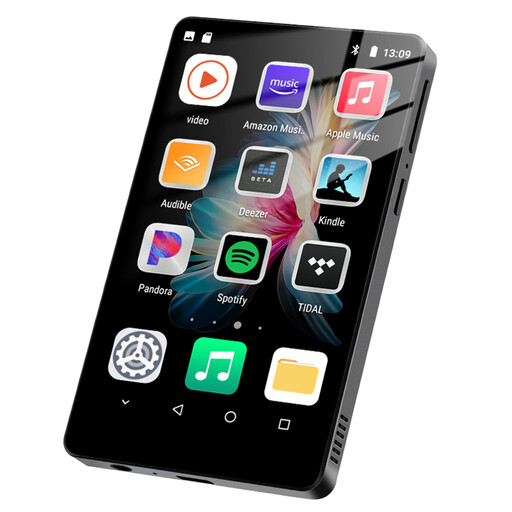
This product selection features a Wi-Fi MP3 player with Bluetooth and a built-in speaker, for anyone who also wants to listen through headphones in their home office. The product name describes it as an MP3 player, so check whether its features suit the way you want to listen to blues.
 No image available
The product name lists Wi-Fi, Bluetooth and a 3.5mm headphone socket. Check whether this MP3 player suits your preferred playback source and headphones.
The product name lists a 4-inch touchscreen, 2 GB RAM and 16 GB of storage, expandable to 256 GB.
An FM radio and built-in speaker are also listed.
No, not to the standalone streamers discussed here as a substitute for an amplifier. Use a suitable amplifier or active speakers. Sonos explicitly states that the Port needs an external amplifier for passive speakers.
First, choose an output that matches your amplifier’s input. For the Port, Sonos recommends a fixed line-out level if you want to control the volume using the amplifier alone. Sonos says that you then won’t be able to adjust the volume or equaliser through the Sonos app.
According to Cambridge Audio, the MXN10 supports playback from USB and NAS. Check that the specific model supports your storage source, files and preferred controls.
Report the fault to the retailer. According to the Dutch government, there is no fixed statutory guarantee period in the Netherlands; the product’s expected lifespan and the cause of the fault are relevant.
Radio equipment covered by European regulations must meet the applicable requirements and carry a CE mark. The Dutch Authority for Digital Infrastructure states that the products concerned may only be sold with CE marking; check the marking on the version actually being offered.