
Anyone who often transfers videos
You regularly copy large video files and want to avoid confusing drive specifications with the speed of your NAS or network. NETGEAR Support explains how a gigabit connection can limit faster network components.


Start by working out how much capacity your video library needs and how much usable space your NAS configuration will provide. Then compare the full model number and the drive’s workload rating. For frequent transfers, your entire network connection matters too: NETGEAR Support points out that a single gigabit port can limit faster network components. RAID is also no substitute for a separate backup; Synology Knowledge Center warns that data loss can still occur with RAID.
You regularly copy large video files and want to avoid confusing drive specifications with the speed of your NAS or network. NETGEAR Support explains how a gigabit connection can limit faster network components.
You want enough usable storage for your current library, with room for future additions. Synology’s RAID Calculator shows that usable capacity depends, among other things, on the NAS model and RAID type.
You want to be able to restore files after an error or failure, so you don’t rely on RAID as your only backup. Synology Knowledge Center recommends having an additional backup destination.
First decide which need matters most to you. Then check that the exact drive model is suitable for your NAS and the way you transfer files.
| What to consider | What should you check? | Who is this important for? |
|---|---|---|
| Frequent transfers | Check the workload rating of the exact drive variant, as well as the ports on your computer, NAS and networking equipment. NETGEAR Support explains how a single gigabit port can limit faster network connections. | If I often copy large video files, I want the drive and connection to suit that kind of use. Around 33% of consumers prioritise smooth, repeated transfers when making this choice. |
| Usable storage space | Calculate the available space for your exact NAS model, number of drives and RAID type. Synology notes that maximum capacity can vary by model and configuration. | I want enough room for my existing videos, with space left for future growth. Around 27% of consumers prioritise having enough usable space. |
| Being able to restore files | Alongside your NAS, plan to keep a copy in another location and test that you can restore it. Synology Knowledge Center warns that RAID issues or drive failures can also result in data loss. | If something goes wrong, I want to be able to restore my video files from a separate copy. For around 27% of consumers, recoverability is the top priority. |
| Noise and running costs | Check the noise and power consumption figures for the exact variant, and consider where you’ll keep your NAS. | I want to be able to position my NAS appropriately and take power consumption into account. Around 13% of consumers prioritise comfort at home and running costs. |
Even with local data protection, a RAID issue or drive failure can result in data loss, as Synology Knowledge Center explains.
Keep a copy in another location too, and test that you can restore your files.
An additional copy requires a separate storage destination alongside your primary NAS.
A drive’s stated capacity is not automatically the same as the usable capacity of your storage pool. The calculation depends, among other things, on your NAS model and the RAID type you choose.
Calculate the usable space for your NAS configuration before choosing a capacity. Synology’s RAID Calculator shows that supported capacity can vary by model.
If the calculated space isn’t enough, you may need a larger NAS configuration or an additional drive.
Drives in the same product range can have different capacities and model numbers; the series name alone doesn’t mean they’re identical.
Before buying, compare the full model number and the variant’s specifications with your NAS requirements and compatibility information.
WD Red Plus is a range of 3.5-inch NAS HDDs for uses including home setups and RAID-optimised NAS systems with up to eight drive bays.
IronWolf is the standard NAS HDD range; IronWolf Pro is a separate range to consider for more demanding setups with multiple users.
The N300 range is designed for internal NAS and multimedia storage; Toshiba Electronics Europe documents, among other options, a 22 TB variant.
These product options are internal NAS drives for video files, including choices for standard NAS storage and higher capacity.
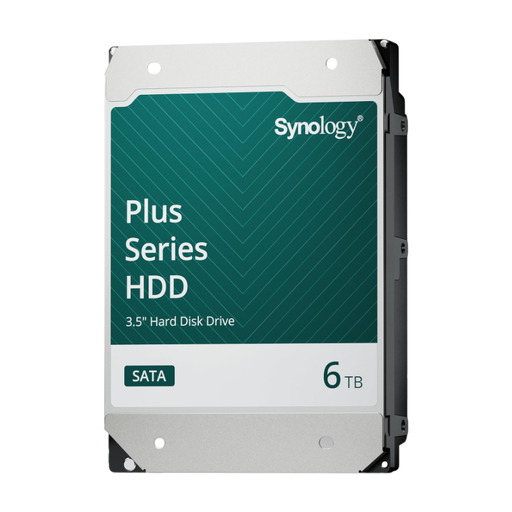 No image available
A 6 TB internal SATA drive for anyone looking for NAS storage for video files.
Capacity: 6 TB. Interface: SATA.
 No image available
A higher-capacity option for anyone looking to store a growing video library on a NAS.
Capacity: 16 TB. Rotational speed: 7,200 rpm.
 No image available
A 6 TB model from the WD Red Plus range for anyone looking for a NAS drive for video files.
Capacity: 6 TB. Cache: 256 MB.
 No image available
An 8 TB NAS drive for anyone looking for more space for a growing video library.
Capacity: 8 TB. CMR. SATA 6 Gb/s. 256 MB cache. 5640 RPM.
Start with the size of your existing video library and how much you expect it to grow. Then calculate how much space your planned NAS configuration will actually make available. This depends, among other things, on the RAID type, and may differ from the combined stated capacities of the drives.
No, not if another component is limiting the transfer. NETGEAR Support explains that a single gigabit port can limit what faster networking equipment can achieve. So check the connection from your computer to your NAS.
Check the full drive model against the compatibility information for your NAS. Synology, for example, recommends checking the compatibility list for each NAS model; its policy on drives not on the list varies by product range and software version.
No. Synology Knowledge Center warns that a RAID issue or drive failure can also result in data loss. Keep a backup in another location too, and test that you can restore it.
According to the Dutch government, there is no fixed statutory guarantee period in the Netherlands; you’re entitled to a product that meets what you can reasonably expect. A manufacturer’s warranty is additional. If a product is faulty, contact the seller to find a solution.