
Artist with a growing body of work
Wants to keep source files and completed work easy to find, while planning for space for new projects.


First, choose a drive that fits your NAS enclosure and the expected growth of your archive. Then consider shared access and your recovery plan. A larger or more highly specified drive isn’t automatically the better choice: the enclosure and network also affect shared access, and you’ll still need a separate backup to recover from data loss.
Wants to keep source files and completed work easy to find, while planning for space for new projects.
Wants to make files available to several people through shared storage, while also considering the NAS enclosure and access controls.
Prioritises recovery after an error, deletion or drive failure, and plans for a separate backup as a result.
Start by checking the full model code and compatibility with your NAS. Then work out how much usable space you need and how you can recover important files from somewhere other than your primary storage.
| What to consider | What to look for when buying | Who this matters to |
|---|---|---|
| Archive capacity and growth | Take stock of your current files and expected growth; compare the capacity of the exact drive with the usable space in your NAS configuration. | I want to keep original files and versions without having to find more space again too soon; around 33% of consumers prioritise archive capacity and growth. |
| Access for shared use | Consider the expected number of simultaneous users, and check the NAS enclosure, network connection and access controls too. | If several people will open or save files, I want the whole NAS and network setup to be suitable; around 27% of consumers prioritise shared access. |
| NAS compatibility | Check the full drive and NAS model codes against the NAS manufacturer’s compatibility information. | I want to know whether the exact drive variant will work in my existing NAS; around 20% of consumers prioritise compatibility. |
| Archive recoverability | In addition to your NAS, plan a backup to a separate destination and check that you can restore your files from it. | For irreplaceable work, I want to be able to restore files after deletion or a failure; around 20% of consumers prioritise recoverability. |
Usable space also depends on your storage configuration. And a single NAS isn’t a complete recovery plan for a damaged or deleted file.
Work out how much your archive is likely to grow and how much usable space you need before choosing a specific drive variant.
A complete solution may also require a NAS enclosure, extra drives and storage for a separate backup.
Western Digital distinguishes between WD Red models with SMR and WD Red Plus and WD Red Pro models with CMR. The company identifies sustained random writes during ZFS recovery as a relevant use case to consider.
Check the full model code and recording technology against your file system and the NAS manufacturer’s recommendations.
With shared access, the connection also runs through your NAS and network. A drive specification on its own doesn’t describe the performance of your entire workstation.
Consider the NAS enclosure, network connection and expected simultaneous workloads alongside the drive.
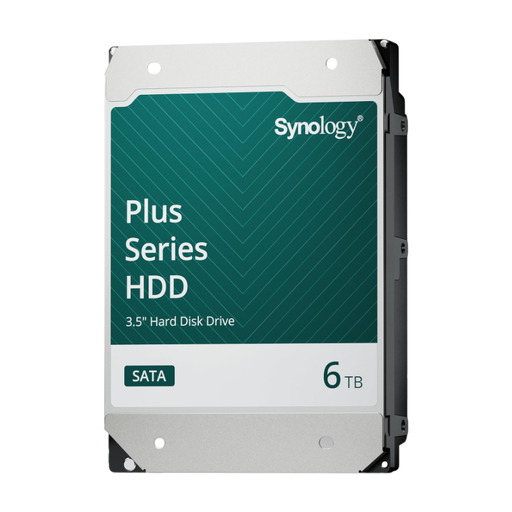
Plus Series drives are worth considering when the NAS enclosure and management through DSM are important factors in your choice.
The N300 range is worth considering for NAS storage when capacity and choosing the right variant are key.
IronWolf Pro is designed for the intensive, multi-user NAS applications that Seagate describes for this range.
WD Red Plus is worth considering if you’re comparing a CMR drive for NAS use with other variants in the WD Red family.
This selection focuses on internal NAS drives for a growing digital art archive, including drives described as suitable for shared NAS use.
 No image available
An option to compare for NAS storage in a shared working environment.
6 TB; 3.5-inch SATA; CMR; rated workload of 180 TB per year.
Check that the exact variant is compatible with your NAS.
 No image available
An option to compare if you’re looking for NAS storage for shared use.
6 TB; SATA III; 5400 rpm; rated workload of 180 TB per year.
The product description mentions NAS systems with up to 8 drive bays; check compatibility with your exact enclosure.
 No image available
An option to compare if you’re looking for NAS storage with room for your archive to grow.
8 TB; 3.5-inch SATA 6 Gb/s; CMR; rated workload of up to 180 TB per year.
The product description mentions NAS systems with up to 8 drive bays, RAID use and 24/7 operation; check that your exact NAS supports it.
No. The drive is installed in a suitable NAS enclosure, which makes files available over the network. Check your existing enclosure and network connection separately.
No. For important art files, plan a backup to a separate destination too. Synology warns that a RAID problem or drive failure can cause serious data loss, even when local measures are in place.
No, the connection alone doesn’t confirm compatibility. Synology provides compatibility information for each model. For 2025 DiskStation Plus models running DSM 7.3, the company states that there’s more flexibility to use third-party drives; check the compatibility information for your NAS too.
If an organisation processes personal data, it must protect it appropriately, according to the Dutch Data Protection Authority. The measures needed depend on the risks of the processing; the description ‘digital art archive’ doesn’t mean that every file contains personal data.
For consumer purchases, statutory rights apply alongside any manufacturer’s warranty. If a product used normally breaks down sooner than you could reasonably expect, the seller is responsible for an appropriate solution, according to ACM ConsuWijzer. For business purchases, check the contract terms separately.