
People managing irreplaceable recordings
You store meeting recordings and source files that you’ll want to recover after a failure. The National Cyber Security Centre emphasises that centralised storage alone is not a backup.


For an archive of meeting recordings and local source files, choose a NAS drive based on your combined storage needs and whether the complete drive model is compatible with your NAS. A NAS or RAID setup is not a separate backup, which is why the National Cyber Security Centre and Seagate recommend keeping a separate copy. If your recordings contain personal data, you’ll also need to set an appropriate retention policy and access controls: the drive won’t do that for you.
You store meeting recordings and source files that you’ll want to recover after a failure. The National Cyber Security Centre emphasises that centralised storage alone is not a backup.
You want to store recordings and related local files on an existing NAS. Assess capacity and drive type alongside compatibility with the exact model: specifications vary between drives from Western Digital, Synology, Seagate and Toshiba.
You manage recordings that identify participants and need to decide who can access them and how long the files are needed. The Information Commissioner's Office (Autoriteit Persoonsgegevens) outlines the considerations around the lawful basis, retention and security of personal data.
First, work out the size and growth of both your recordings and source files. Then check the exact drive model for your NAS and decide how you’ll manage a separate backup and access controls.
| Consideration | What to look for when buying | Who should consider this? |
|---|---|---|
| Recovering your entire archive | Check where your separate backup will be stored and how you’ll test recovery. | If I can’t recreate recordings and source files, I want to know how to restore them. Around 33% of consumers say recoverability is their top priority. |
| Space for recordings and source files | Add up your current files and expected additions, then check the usable capacity of your NAS configuration. | I want to store local files and allow for future growth too, not just keep the final recordings. Around 27% of consumers prioritise having enough archive space. |
| Access and retention periods for personal data | Check user permissions and backup settings; set the purpose and retention period separately. | For recordings that identify participants, I want to restrict access and set out how long they need to be kept. Around 20% of consumers say managing access and retention is their top priority. |
| Compatibility and recording technology | Compare the full model number with the NAS compatibility list and check whether the drive uses CMR or SMR. | I want to be sure that the specific drive will work with my existing NAS and suit how I use it. Around 20% of consumers prioritise compatibility between the model and their NAS. |
Redundancy can help keep a NAS available when certain drives fail, but it doesn’t protect against every cause of data loss.
Before buying, decide where you’ll keep a separate copy of both your recordings and source files.
A separate backup requires extra storage and management, including testing that you can actually restore your files.
A product family may include different versions. For example, Western Digital offers both CMR and SMR drives under the WD Red name. Compatibility also depends on the exact model and your NAS.
Check the full model number, recording technology and compatibility information for your NAS.
If you leave local source files out of your calculations, the capacity you choose may not be enough for your entire archive.
Make an inventory of both file types together, then work out how much usable space your chosen NAS setup provides.
When planning your storage, allow for source files, future growth and a separate backup too.
WD Red Plus is a CMR range for NAS systems. Western Digital lists the 4 TB WD40EFPX as one option for NAS systems with up to eight drive bays.
IronWolf is a NAS HDD range for centralised storage in multi-drive systems.
N300 is Toshiba’s NAS HDD range. Toshiba identifies the CMR MN11ACA22TS as a 22 TB model.
The Synology Plus Series HAT3300-4T is a 4 TB, 3.5-inch SATA drive for Synology storage systems.
This selection includes internal NAS drives for archiving. Compare capacities and, before buying, check that your NAS supports the full model.
 No image available
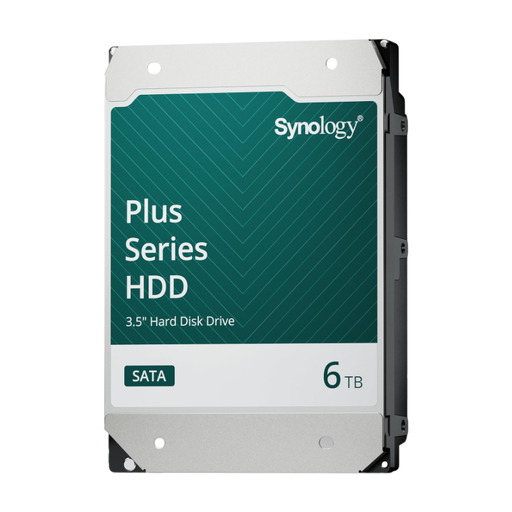
An option for a Synology NAS archive if 6 TB meets your calculated needs. Check compatibility with your NAS model.
Synology specifies CMR, a 3.5-inch SATA connection, 24/7 use and firmware updates through DSM.
 No image available
This capacity may suit a larger Synology NAS archive if it meets your calculated needs and your NAS supports the model.
Synology specifies 16 TB, CMR, 3.5-inch SATA, 7,200 rpm, 24/7 use and firmware management through DSM.
 No image available
An option for a NAS archive if the capacity is right and your NAS supports this specific version.
Western Digital describes WD Red Plus as CMR. The product description lists 6 TB, 3.5-inch SATA, 5,400 rpm and 256 MB cache, for NAS systems with up to eight drive bays.
For this product description, Western Digital specifies 24/7 use and a rated workload of up to 180 TB per year. This is no guarantee against data loss.
 No image available
This capacity may suit a growing NAS archive if your calculations support it and your NAS accepts this specific version.
The product title specifies CMR, SATA 6 Gb/s and 256 MB cache. The description lists a 3.5-inch model and support for NAS systems with up to eight drive bays.
For this product description, Western Digital specifies 24/7 use and a rated workload of up to 180 TB per year. Check the applicable specifications for the full model.
No. Redundancy can keep a NAS available when certain drives fail, but it doesn’t replace a separate backup. Keep backup copies separately and test that you can restore them; the National Cyber Security Centre and Seagate make this distinction too.
Compare the full drive model with the compatibility information for your NAS and software version. After installation, also check access permissions and backup settings: the National Cyber Security Centre recommends reviewing management settings during setup.
The Information Commissioner's Office (Autoriteit Persoonsgegevens) does not specify a general GDPR retention period in years for personal data. The organisation must set a period that is appropriate for the purpose of processing; other applicable laws may prescribe specific periods.
Consent is not the only possible lawful basis for processing personal data. The Information Commissioner's Office (Autoriteit Persoonsgegevens) explains that an organisation must decide on an appropriate GDPR lawful basis in advance and tell people what will happen to their data and why. Whether recording a particular meeting is permitted depends on the circumstances.