
Keepers of irreplaceable video recordings
You look after original recordings that cannot be recreated. The Digital Preservation Coalition highlights the importance of separate copies and checks for file changes in community archives.


Start by choosing a NAS that suits your current collection, expected growth and the number of people who will use it. Then compare the number of drive bays, usable capacity and network connections. A NAS with RAID is no substitute for separate copies, integrity checks and recovery tests. If your archive includes identifiable people or material by other creators, you should also set appropriate access permissions and check usage rights.
You look after original recordings that cannot be recreated. The Digital Preservation Coalition highlights the importance of separate copies and checks for file changes in community archives.
You take on projects regularly and want to plan your storage without confusing total drive capacity with the space available after your chosen configuration.
Several people need to find or share material, while access to original files and footage featuring identifiable people must remain manageable. The Dutch Data Protection Authority stresses the importance of setting appropriate access permissions.
A NAS is just one part of looking after an archive. The Digital Preservation Coalition highlights the need for separate copies and integrity checks, while the National Cyber Security Centre warns that central storage is not a backup in itself.
| What to consider | What should you check? | Who is this most relevant to? |
|---|---|---|
| Recovery and file integrity | What separate copies and recovery tests can your team manage, and how will it check files for changes? | If you store irreplaceable originals, you’ll want to know whether you can recover them and whether changes will be detected. Around 29% of consumers prioritise recovery and integrity. |
| Usable space and room to grow | Measure your collection and expected intake, then calculate the usable space with your chosen drives and storage configuration. | If projects keep coming in, you’ll want to avoid your setup filling up too quickly. Around 24% of consumers prioritise usable capacity and room to grow. |
| Collaboration and file transfers | Map out users, file sizes and network ports. Also decide whether files will be edited directly from the NAS. | If volunteers deliver or share large projects, it’s important that the entire network connection is set up to handle them. Around 18% of consumers prioritise collaboration and large transfers. |
| Access to sensitive material | Decide who can edit originals, who can view them only, and which copies can be shared. | If footage features identifiable people, you’ll want to match access to each person’s role and the purpose of use. Around 18% of consumers start with privacy and controlled access. |
| Complete setup | Include suitable drives, a separate destination for copies and only the network upgrades you need in your plan. | If you want to understand the whole setup and how it will be managed in advance, it helps to assess all the components together. Around 11% of consumers start with the complete setup and how it will be managed. |
A NAS with multiple drives is not automatically a backup. The Digital Preservation Coalition identifies separate copies, including one stored at another location, as part of preservation.
Set out your copying and recovery process before choosing your drives and capacity, and plan recovery tests.
Usable capacity depends on your chosen drives and storage configuration. Manufacturers may quote raw capacity, which is not the same as the space left for your files.
Calculate capacity for your intended configuration and leave room for new projects.
Drives are sold separately for the QNAP TS-464 reviewed here; 10GbE is an optional module for the Synology DS1525+.
Compare complete configurations, including the drives, separate copies and any network upgrades. You’ll still need to choose drives and include them in your setup.
Unnecessarily broad permissions can let users view or change files when they don’t need to. The Dutch Data Protection Authority considers appropriate access management important when handling personal data.
Keep the management of original files separate from viewing and sharing, and review permissions before making material public.
The DiskStation DS1525+ reviewed here has five drive bays and, according to Synology, can be fitted with a separate module to add a 10GbE port. This may be useful if you want to plan for additional capacity as your archive grows.
The TS-464 reviewed here is a four-bay model. QNAP lists built-in 2.5GbE ports and the option of a separate 10GbE card.
According to UGREEN, the NASync DXP4800 Plus reviewed here combines four drive bays with a 10GbE and a 2.5GbE connection.
For the AS5404T reviewed here, the manufacturer lists four M.2 slots and two 2.5GbE connections.
According to TerraMaster, the F4-424 reviewed here is a four-bay model that supports Btrfs and EXT4.
This Joybuy selection includes NAS systems for a growing video archive, along with separate Synology drives. First decide how much usable capacity you need, then check that your chosen drives are compatible with the NAS.
 No image available
A NAS option to consider if your collection is growing and you need shared file management.
 No image available
Worth a look if you want to plan for extra space as your archive grows.
Five drive bays; according to Synology, a 10GbE module is available separately. Hard drives are not included.
 No image available
This option may suit an archive that wants to build its storage setup gradually. Check which drives are right for your configuration first.
Supplied without hard drives.
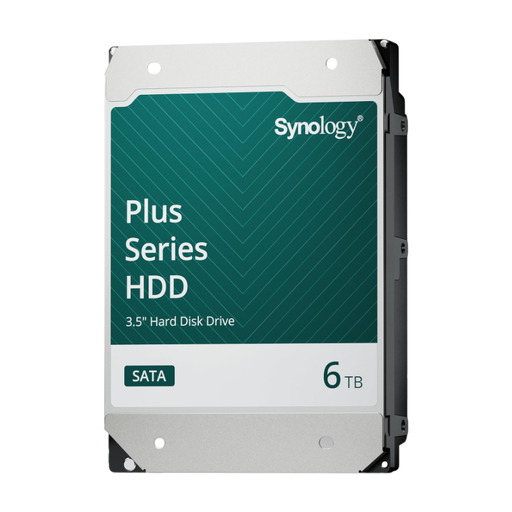 No image available
A standalone hard drive to consider as part of a suitable Synology NAS configuration.
Capacity: 6 TB.
 No image available
A standalone hard drive to consider for a growing collection in a suitable Synology NAS configuration.
Capacity: 16 TB. Rotational speed: 7,200 rpm.
No, RAID is not a backup in itself. The National Cyber Security Centre warns that central storage is no substitute for a backup; the Digital Preservation Coalition recommends separate copies, including at least one stored at another location. You should also check file integrity and test that recovery works.
Give each user only the permissions they need for their role, and make it clear who can change files. The National Cyber Security Centre highlights user permissions and logging; the Dutch Data Protection Authority stresses the importance of appropriate access management for personal data.
Keep documentation about your projects, check files and copies for changes, and plan recovery tests. The Digital Preservation Coalition explains that long-term preservation involves more than storage hardware alone.
Not without assessing the rules that apply to the purpose and collection. According to the Dutch Data Protection Authority, footage of identifiable people is personal data. Processing it requires a valid legal basis under the GDPR, and personal data must not be kept for longer than necessary. Assess the legal basis and retention period for each purpose; storing footage on a NAS does not in itself give you the right to publish it.
Not automatically. The Dutch Government states that you need the creator’s permission to use films protected by copyright. Check the rights before sharing other people’s material; choosing a NAS does not determine what permission has been granted for a project.