
Living alone with a small kitchen
You want to wash your dinner plates in a dishwasher, but you’re short on space. Measure the area where you plan to put it, then check that your crockery fits in the racks.


A narrow dishwasher measuring around 45 cm could suit one person’s washing-up, but check that your dinner plates and other items fit in the racks: the number of place settings won’t tell you that on its own. Choose a freestanding model if you have the space and connections for one, or an integrated model if your kitchen unit and door panel are suitable. If you don’t generate much washing-up, weigh the convenience against running a partly empty machine, and compare the consumption figures on the energy label. Consumentenbond and Milieu Centraal offer practical guidance to help you decide.
You want to wash your dinner plates in a dishwasher, but you’re short on space. Measure the area where you plan to put it, then check that your crockery fits in the racks.
As well as dinner plates, you regularly wash pans, bowls and cutlery. In this case, the layout and when you can load the machine matter just as much as the number of place settings.
You already have a space for an integrated model. Check that the cabinet dimensions, door panel and connections are suitable for the new machine, following the instructions for your chosen model.
Consumentenbond points out that the number of place settings doesn’t tell you whether your crockery will fit. Milieu Centraal also takes loading the machine and using the eco programme into account when advising on how to use it.
| What to consider | What should you check? | Which consumers does this matter to? |
|---|---|---|
| Space and dinner plates | Measure the space where you plan to put it and your largest plate. Check the external dimensions, clearance for the door and maximum plate diameter. | I want my everyday dinner plates to fit without the machine blocking my kitchen. For around 31% of consumers, making sure it fits their kitchen and plates comes first. |
| Washing-up routine and loading space | Compare your usual mix of plates, bowls, glasses, pans and cutlery with the rack layout; check whether you can get the machine reasonably full. | If I regularly wash pans and bowls, it matters how much fits in the machine at once and when I can run a cycle. Around 25% of consumers prioritise their washing-up routine and usable capacity. |
| Positioning and connections | For an integrated model, check the cabinet space and door panel against the model-specific instructions. For a freestanding model, also check the available space, water supply and drainage. | If I have an existing cabinet space, I want to know whether the machine, door panel and connections will all work together. For around 25% of consumers, installation is their main buying concern. |
| Energy use and noise | Compare kWh per 100 eco cycles, litres per eco cycle, programme duration and the noise rating; take into account how many cycles you run. | Noise and energy use can influence your choice if you have an open-plan kitchen or are keeping an eye on running costs. Around 19% of consumers put these factors first. |
A place setting is the crockery and cutlery for one person at one meal. It doesn’t guarantee that your large dinner plates and pans will fit at the same time.
Measure your largest plate and compare its diameter with the specifications for the exact model. Also check the position of the upper rack.
A freestanding machine and a fully integrated model need different setups. For an integrated model, you also need to check the cabinet height and door panel.
Before buying, check the measurements, connections and installation instructions for your chosen model. If the cabinet space isn’t suitable, the door panel is missing or the connections don’t match, you may need extra work or a different model.
Energy use also depends on how often you wash and which programme you use. Milieu Centraal suggests a 45cm machine as an alternative when you can’t fill a larger one properly; the organisation advises against mini dishwashers because of their energy and water use.
Compare the energy label figures and think about how much washing-up you actually collect for each cycle. Don’t assume that a half-load option proves a half load uses less energy.
Bosch has narrow freestanding models worth considering if you want to compare specifications such as energy use and rack layout.
Inventum is worth considering if you’re looking for a fully integrated narrow dishwasher. The IVW4508A is a model with a stated capacity of 10 place settings.
The ETNA VWV147SWIT is a narrow freestanding model with a stated capacity of nine place settings.
The Whirlpool WSFC 3M27 X is a narrow freestanding dishwasher you can compare with other models.
The BDFS26046XQ is a narrow freestanding dishwasher worth comparing if you’re weighing up a cutlery tray against a cutlery basket.
These Joybuy products are narrow freestanding dishwashers for anyone keeping an eye on the available kitchen width. Check that your crockery and the space you have in mind are suitable for each model.
 Image unavailable
The 45 cm freestanding design suits a narrower kitchen; check that your plates and other items fit in the racks.
The product name lists a capacity of 13 place settings. Bosch Netherlands lists energy class B and water consumption of 8,7 l per eco programme for this model. The number of place settings won’t tell you on its own whether your dinner plates will fit.
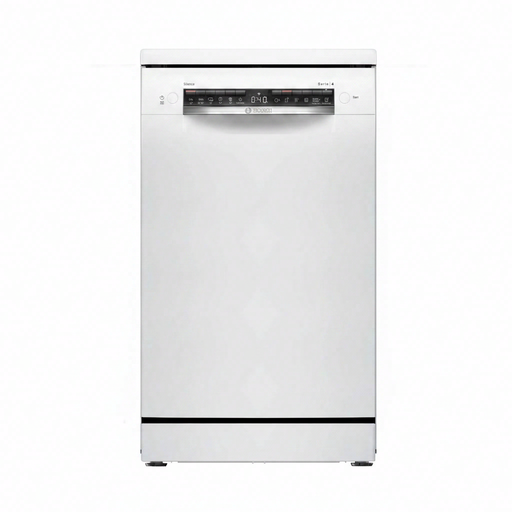 Image unavailable
The product name lists a 45 cm freestanding model; compare the space you have available and the rack layout with your own crockery.
Measure the diameter of your largest plate and compare it with the maximum plate diameter for the exact model. Also check the position of the upper rack and whether there’s still room for glasses or pans. The number of place settings doesn’t give you these measurements.
Choose a freestanding model if you have a suitable space and the right connections. Choose an integrated model only if the cabinet space, fittings and door panel are compatible. Measure the available space and follow the installation instructions for your chosen dishwasher.
A half-load button doesn’t prove that a half load uses less energy. Milieu Centraal advises filling the machine and using the eco programme where possible; compare energy-use figures for the same programme.
The EU label includes information such as energy use per 100 eco cycles, water use per eco cycle, capacity, programme duration and noise. How often you use the machine also affects your running costs; the label figures don’t measure your own washing-up habits.
Report the fault to the retailer. The Dutch government says the retailer must offer a solution if a product isn’t working properly, and can’t simply send you to the manufacturer. The appropriate solution depends on the fault and the circumstances.