
Vandaag of morgen in huis

Kwaliteit gegarandeerd

Welkomstaanbiedingen ontgrendelen: GRATIS bezorging | Tot 80% korting | Gratis 30 dagen JoyPlus-proefperiode
Download de app
Musical toys for babies and toddlers engage several senses at once. Pressing a key, tapping a baby drum or switching on a light produces an immediate response. This makes them appealing to children from around 6 months to 3 years old. However, not every toy with lights and sounds is a practical purchase for the home.
Many parents and gift buyers face the same challenges:
Do not just look at the age recommendation on the packaging; also consider how your child plays. A baby aged 6 to 12 months will often play lying down or sitting on the floor. A child who can stand independently may get more use from a musical activity table with sturdy legs.
A model with removable legs can remain useful for longer. Check that the table remains stable, that the parts are securely attached and that its size suits the available play space. For travelling or visiting family, a compact activity cube is often more practical than a large table.
For toys with lights and sounds, volume control and a silent mode are practical features. They will not eliminate every sound, but they give parents more control during nap time, in the car or in a shared household.
Also check the type of power supply. The product information for several models states that batteries are not included. Before unpacking, check which battery type is required. Keep batteries out of children’s reach and have an adult open the battery compartment.
For baby and toddler toys, rounded edges, a sturdy construction and securely closed battery compartments are important points to check. According to their product descriptions, the models mentioned are made from ABS and BPA-free materials. This is a product specification, not a substitute for supervision or checking the item when it arrives.
Check the toy after delivery for:
The product descriptions refer to CE and EN71 standards. Always check the marking and documentation on the product yourself. A CE mark does not mean that a toy is suitable for every play situation without supervision.
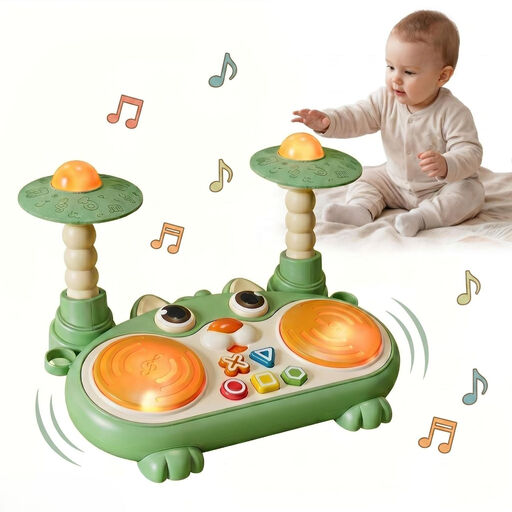
Why it suits this profile: This compact baby drum combines tapping, lights, animal sounds and shape sorting. This gives young babies several ways to play in one relatively simple product.
The product description lists four play modes and a non-slip base. When it arrives, check that all the shapes are securely attached and supervise young children during play.
Suitable from 6 months according to the product information; illuminated drum pads, shape buttons and animal sounds; batteries not included.
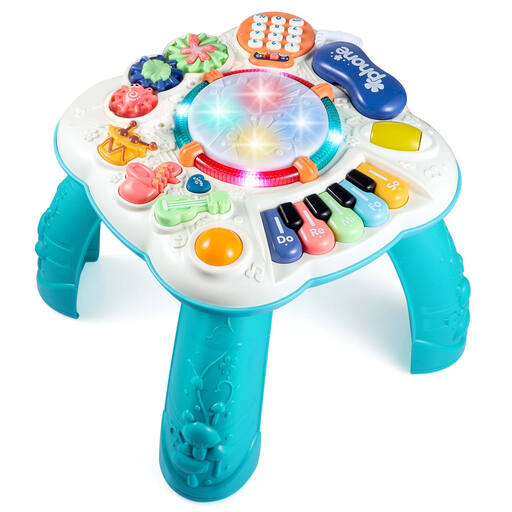
Why it suits this profile: Parents looking for variety and a longer usable life get a table with a piano, drum, telephone, gears and instrument buttons.
According to the product information, the table has volume control and a silent mode. The legs are removable, allowing younger children to play on the tabletop.
Age recommendation 6-36 months; six play zones; ABS and BPA-free according to the product description; batteries not included.
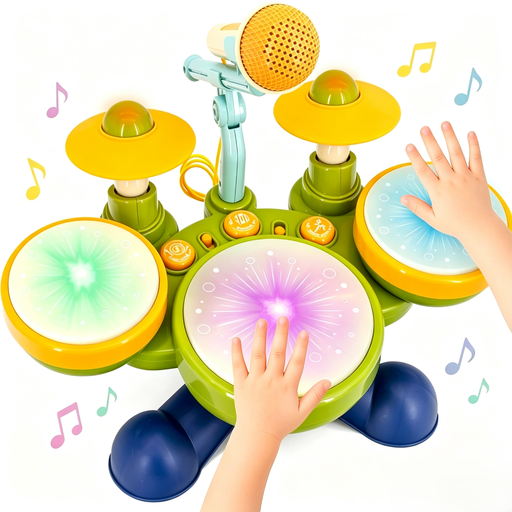
Why it suits this profile: This model is ideal for toddlers who enjoy active tapping, singing and movement. The microphone and three illuminated drum pads make it suitable for playing together.
The volume is adjustable according to the product information. The detachable stand and non-slip base offer extra flexibility, but check that it is stable on your floor.
Suitable for 1-3 years; microphone included; adjustable drumsticks; batteries not included.
We have put together a complete, up-to-date list of products that fully meet these strict selection criteria and the applicable European safety regulations.
A baby piano is suitable for children who enjoy pressing keys and hearing an immediate sound in response. A baby drum is better suited to rhythmic, physical play. A table or cube offers more variety, while sensory toys with lights, sounds and shapes are particularly suitable for short discovery activities.
Consider your home environment. In a flat, volume control and a mute function are more important than a large number of melodies. A portable activity cube can be practical for grandparents. As a gift for a baby or toddler, an age range of 6-36 months is useful, but always check whether the child can already sit or stand independently.
You can describe a toy as Montessori-inspired when the product description does so, but do not treat this as a quality guarantee. The specific features matter more: can the child operate a button independently, are the parts large enough and is there room for repetition and imagination?
It can be, depending on the child’s playing position and the age recommendation. Choose large, fixed parts and use the toy on the floor if your baby is not yet standing. Stay nearby and regularly check for loose parts.
Their lifespan depends on the materials, usage and battery maintenance. Remove the batteries when the toy will not be used for an extended period and clean plastic surfaces according to the instructions. A product with several play modes or an adjustable configuration may remain interesting for longer, but this varies from child to child.
The purchase price is not the only cost to consider. For models without included batteries, you will also need to buy replacement or rechargeable batteries. Also check whether the toy switches off automatically and use a lower volume setting whenever possible.
