
Accompanist with limited storage space
You put the instrument away after rehearsals. So compare its width and depth, and make sure you also have enough room to play.


A touch-sensitive 61-key instrument can save space if the notes in your musical theatre parts fit within its range. Choose an instrument with more keys if your parts need a wider range and you have enough room. If you’re rehearsing with a singer, also check how they’ll hear the accompaniment and whether your chosen model offers the connections and transposition you need. Before buying, check the applicable safety information and CE marking for the specific instrument and any adapter.
You put the instrument away after rehearsals. So compare its width and depth, and make sure you also have enough room to play.
Check the lowest and highest notes in your parts. A compact keyboard is only suitable if those notes fit within its range.
You want the singer to be able to hear the accompaniment. So check the listening setup and whether the exact model offers transposition.
Start by checking the highest and lowest notes in the parts you actually practise, and how much space you can make available. Then consider how the singer will hear the accompaniment and which connections you’ll need.
| Concern | What to look for when buying | Who this matters to |
|---|---|---|
| Space to set up and store the instrument | Measure the available width and depth and compare them with the exact model. Leave room for a chair and music stand, too. | If I have to put the instrument away after every rehearsal, I want to know how much space the whole setup will take up. Around 36% of consumers give setting up and storage the highest priority. |
| Range of the parts | Compare the lowest and highest notes in representative parts with the model’s range. Assess touch sensitivity separately. | I want to be able to play the written parts without any notes falling outside the keyboard’s range. For around 29% of consumers, the range of their own parts is their main concern. |
| Making sure the singer can hear the accompaniment | Check the built-in speakers or the external audio setup you’ll need, and see whether transposition is available. | When rehearsing with a singer, I want them to be able to follow the accompaniment and sing in a suitable key. Around 21% of consumers prioritise practical vocal accompaniment. |
| Private practice and connections | Check the headphone socket and plug size. Also check which accessories are included with the specific version. | If I practise in a shared space, I want to be able to listen through suitable headphones. Around 14% of consumers give private practice the highest priority. |
A keyboard’s dimensions don’t automatically tell you how much room you’ll need to play or set out your sheet music.
Mark out the full setup on the floor, including a chair and music stand, before choosing a model.
Headphones let the keyboard player listen, but they don’t automatically let the singer hear the accompaniment.
Decide in advance who needs to hear the sound, then check the connections on the exact model and the audio setup you want to use.
Touch sensitivity and the type of key action are different features; one doesn’t prove that the other is present.
If key feel is an important factor in your choice, check exactly what type of keyboard action the model has.
The NP-15 is a piano-focused point of comparison, while the PSR-E383 also offers automatic accompaniment styles.
The CT-S1BK is worth considering if you want to compare a range of sounds.
The Liano offers a touch-sensitive 88-key keyboard when your parts need a wider range.
These Joybuy products have 61 keys and suit rehearsals where the parts fit within the range of a keyboard with this number of keys. Compare the highest and lowest notes first, and check the applicable safety information and CE marking for the specific product and any adapter.
 Image unavailable
Worth considering if the notes in your parts fit within the range of 61 keys.
The product name lists a weighted keyboard, 300 sounds, 300 rhythms, USB-MIDI, speakers and a headphone socket.
 Image unavailable
An option to compare if your parts fit within the range of 61 keys.
The product name lists MIDI, a recording function, speakers, a metronome and a music stand.
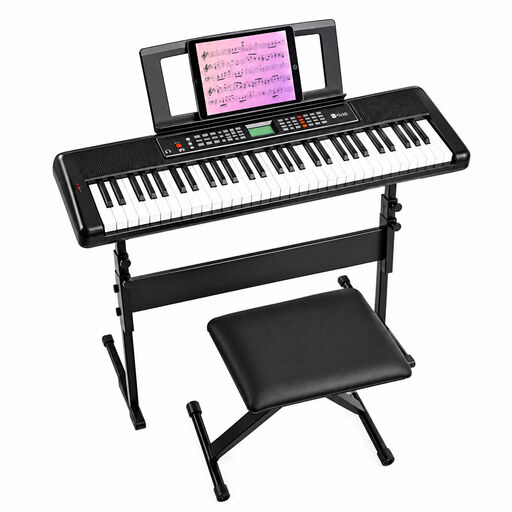 Image unavailable
Worth comparing if your parts fit within the range of 61 keys and you’re looking for a set with accessories.
The product name lists 300 tones, 300 rhythms, a three-level learning function, LCD, USB-MIDI, a stand, stool and music stand.
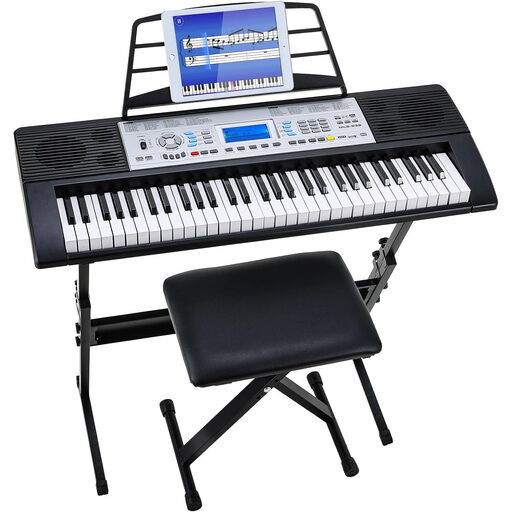 Image unavailable
An option to compare if your parts fit within 61 keys and you want to include built-in speakers in your choice.
The product name lists two speakers, a three-level learning function, an LCD screen, a stand and a stool.
It depends on the notes in your parts. Before buying, compare the lowest and highest notes with the model’s range: the Yamaha NP-15 has 61 keys, while the Korg Liano has 88 keys, from A0 to C8.
Headphones let the keyboard player listen, but they won’t automatically let the singer hear the accompaniment. For playing together, check the speakers or a suitable external audio setup, along with the connections on your chosen model.
Compare the dimensions with your playing space and leave room for a chair and music stand, too. Check which adapter and accessories come with the specific version; Yamaha notes that an adapter may not be included with the NP-15, depending on the region.
According to the Dutch government, if a product is faulty, the seller must provide a solution; there is no single statutory guarantee period that applies to all products. For a standard online purchase, you’ll usually have a statutory cooling-off period. ACM ConsuWijzer states that it ends 14 days after delivery, with some exceptions.
The NVWA explains that CE marking is required when the applicable European rules specify it for the product. Check the information for the specific instrument and any adapter; the rules depend on the product version.