
Player with limited storage space
You want to practise a musical theatre song, but need to put the instrument away after use. Compare its dimensions with those of a stand and music stand, and check that your part fits on a shorter keyboard.


Start with the sheet music: a shorter stage keyboard is an option if the entire part fits within its range and you want to store the instrument away easily. A portable piano with 88 keys may be more suitable if you also want to practise fuller piano accompaniments and piano technique, provided the complete setup fits in your room. Also compare the key action, listening options and which accessories are included with the model.
You want to practise a musical theatre song, but need to put the instrument away after use. Compare its dimensions with those of a stand and music stand, and check that your part fits on a shorter keyboard.
You want to accompany yourself and learn the piano part too. In that case, key range, touch response and a usable sustain pedal may matter more than the number of sounds alone.
You share a living space or practise near other people. Compare the headphone socket and built-in speakers separately; a piano without speakers requires a different listening setup.
First check that your arrangement’s range and the complete playing setup will fit; then consider key feel, how you’ll listen and which sounds you want.
| What to consider | What to check before buying | Who is this important for? |
|---|---|---|
| Space and storage | Measure the space needed, including the stand, sheet music and room to sit. Also check the weight and whether the part fits within the keyboard’s range. | If I need to put the instrument away after practising, I want to know whether everything will fit in my room without leaving out any notes from my part. Around 36% of consumers give space requirements and storage top priority. |
| Piano playing and range | Compare the arrangement with the keyboard’s range and check the exact type of key action. Also check which pedal is included. | If I want to learn a piano accompaniment as well as the melody, I look at range, touch response and pedal use. Around 29% of consumers prioritise piano playing and key range. |
| Quiet practice | Check whether the model has a headphone socket and built-in speakers; also consider how other people can listen along. | If I practise at home while others are nearby, I want to be able to use suitable headphones and know whether speakers are included. Around 21% of consumers give their listening setup top priority. |
| Choice of sounds and rehearsals | Decide whether you only need a piano sound or want other sounds too. Check which connections and controls the model has. | If I want to switch between different sounds during rehearsals, I look for controls and connections to suit. Around 14% of consumers prioritise choice of sounds and rehearsal use. |
The space needed for the Korg D1 changes when the music stand is in place. Korg specifies a depth of 263 mm without the music stand and 375 mm with it.
Measure the complete setup, including sheet music, space to sit and room for your hands.
You may need to find a different spot in the room or use another stand.
According to Korg, the D1 has no built-in speakers, while the Liano does. So the way you listen will depend on the model.
Decide in advance how you want to practise on your own and how others might listen along.
If you don’t already have suitable headphones or external audio equipment, you may need to add these to your listening setup.
According to Korg, the Liano has a touch-sensitive LS keyboard; Casio specifies a hammer action for the CDP-S110.
Compare the types of key action and, if possible, try the instrument out if piano technique is an important goal.
The CK61 is a shorter stage keyboard with a range of sounds, while the P-145 is a portable digital piano with 88 weighted GHC keys. They offer different approaches to sound variety and piano-focused practice.
The FP-10 is a portable 88-key digital piano for piano-focused practice at home.
The CDP-S110 is a slim, portable digital piano with 88 keys and hammer action.
The lightweight Liano and the D1, which has no speakers, suit different needs: easier portability versus an RH3 hammer-action keyboard and stage connections.
This selection includes digital pianos and 61-key keyboards for practising on a shorter keyboard. Before buying, check that the lowest and highest notes in your arrangement fall within the range.
 Image unavailable
An option to consider if your part fits within 61 keys and you want to use a range of sounds.
The product title lists a weighted keyboard, 300 sounds, 300 rhythms, an LCD screen, USB-MIDI, speakers, a headphone socket and a music stand.
 Image unavailable
An option with a shorter keyboard if the notes in your arrangement fit within its range.
The product title lists speakers, a metronome, a recording function, a headphone socket and a music stand.
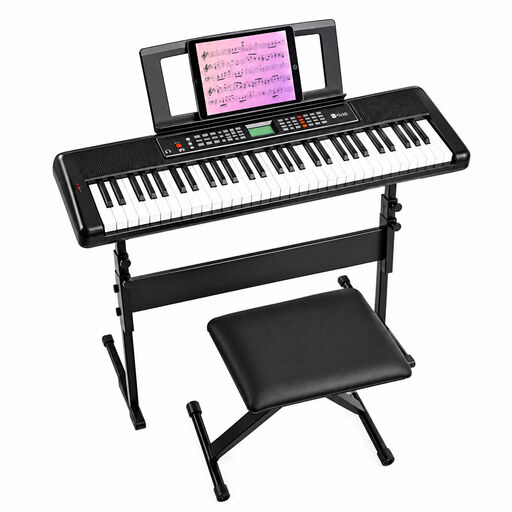 Image unavailable
A set with a shorter keyboard to consider if your arrangement fits within 61 keys.
The product title lists a stand, stool, music stand, 300 sounds, 300 rhythms, a three-step learning mode, an LCD screen and USB-MIDI.
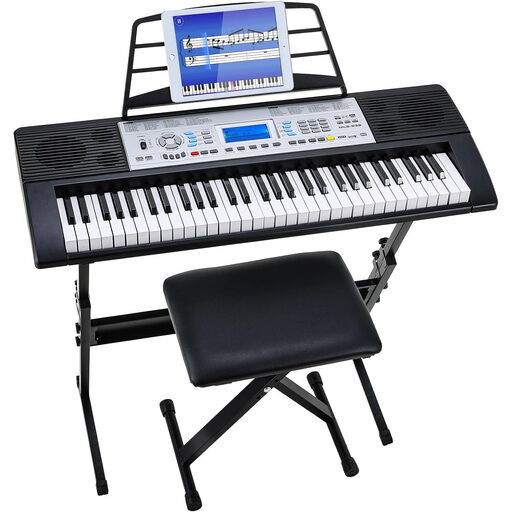 Image unavailable
An option with a shorter keyboard if the complete part fits within the range of 61 keys.
The product title lists a stand, stool, 500 sounds, a three-step learning mode, dual speakers and an LCD screen.
That depends on your arrangement. Compare the lowest and highest notes in both the melody and any accompaniment with the instrument’s range. Yamaha lists 61 keys for the CK61; the portable pianos from Yamaha, Casio and Roland discussed here have 88 keys.
For the Korg D1, you’ll need headphones or external audio equipment, as Korg does not specify built-in speakers. Also measure the piano with the music stand in place: Korg gives a depth of 263 mm without the stand and 375 mm with it.
In the Netherlands, you’re entitled to a product that works properly; if it’s faulty, the seller must provide a solution. The Dutch government states that there is no fixed statutory guarantee period that applies to every product. Also follow the instructions in the manual for your exact model when using and maintaining it.
For many standard online purchases from a business, a 14-day cooling-off period applies. The Dutch government lists exceptions and distinguishes these purchases from online purchases from a private seller; check the terms that apply to the actual sale.
According to the Dutch government, electronic devices placed on the EU market must carry a CE mark. Business.gov.nl clarifies that the CE mark is not a quality mark; check the product information and the version supplied.