
Vandaag of morgen in huis

Kwaliteit gegarandeerd

Welkomstaanbiedingen ontgrendelen: GRATIS bezorging | Tot 80% korting | Gratis 30 dagen JoyPlus-proefperiode
Download de app
A musical activity table for toddlers often combines keys, spinning wheels, lights and sounds in one toy. This makes it appealing to children aged around 6 months to 3 years, but not every model suits every age or home. Parents therefore look not only at the number of features, but also at volume control, stability, cleaning and small parts.
A product with a piano, telephone, drum, cogs and melodies may seem versatile. However, a 6-month-old baby can still do very little with a standing table. Check whether the legs can be removed or whether the toy can also be used as a play board on the floor. For a toddler, a sturdy table design is usually more practical.
Electronic toys can quickly become loud in a small living room. A volume control or silent mode is therefore an important practical feature. Also look for an automatic shut-off. This not only prevents unnecessary battery drain, but also makes the toy easier to use.
Terms such as “safe material” do not say much on their own. Look at the material information, rounded edges, loose parts and recommended age. Product information may, for example, mention BPA-free ABS, but still check that battery covers close securely and that no parts are loose. According to the product descriptions of the selected models, CE and EN71 standards are mentioned; always check the markings, instructions and warnings when the product arrives.
A model for 6 to 36 months may be suitable for different stages of development, but the way children play changes. Younger babies mainly use individual buttons and keys while lying down or sitting. Toddlers who are standing get more from a stable activity table. Do not use a standing model as a walker unless the manufacturer expressly states that it is suitable for this purpose.
Where possible, choose:
Batteries are not included with several models. Check this before buying, especially if the toy is being given as a birthday present.
Measure the space where the toy will be placed. An activity table measuring around 30 × 30 cm takes up little floor space, but it does need a flat surface. Check that the base is wide enough and that the product will not tip over easily when a child leans on it. Removable legs, a handle or a foldable design can be useful for storage and transport.
For everyday use, smooth ABS plastic is easy to wipe clean. A fabric play mat requires more care when dealing with spills and crumbs. Always follow the cleaning instructions and do not use water near electronic components.
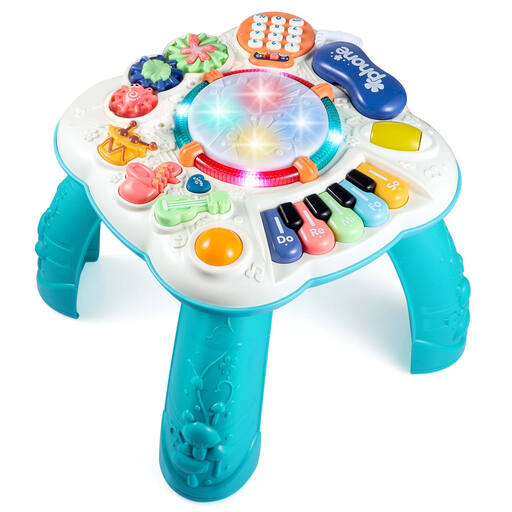
Why this suits the profile: This compact model combines six play zones, including a piano keyboard, light-up drum and spinning cogs. The removable legs allow it to be used on the floor or on a table.
The product description mentions volume control and a silent mode. This means the sound can be adjusted to suit a flat or a quieter moment.
ABS, BPA-free according to the product information, rounded edges, dimensions of approximately 30 × 30 × 31 cm and suitable for 6-36 months.
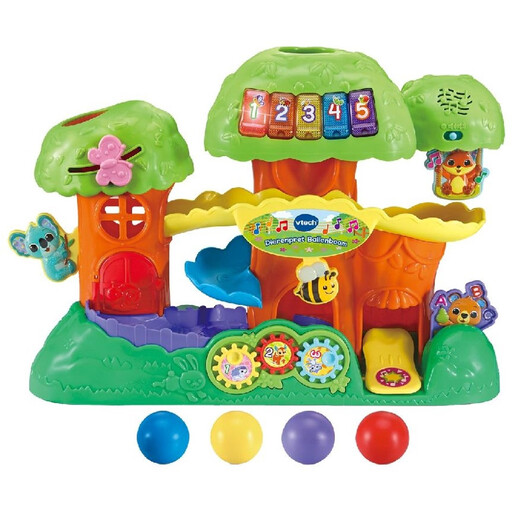
Why this suits the profile: This activity centre is aimed at children from 12 months and uses balls, light-up buttons and melodies to provide engaging, repeatable play.
The minimum age of 12 months and the warning about small parts make it clear that this is not a toy for young babies.
Five light-up buttons, four balls, 15 melodies, eight nursery rhymes, volume control and automatic shut-off.
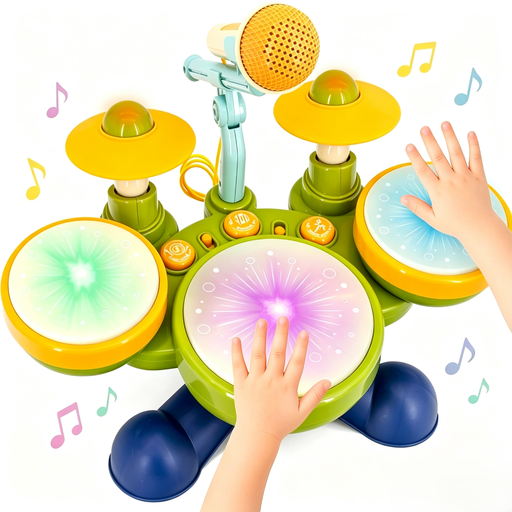
Why this suits the profile: For children who mainly want to drum and sing, this musical toy offers a clearer focus for play than a general activity table.
The adjustable volume control helps limit loud sounds. The removable stand also allows the product to be used as a flat play board.
Three illuminated drum pads, two cymbals, working microphone, removable stand and a base with four support points according to the product description.
We have put together a complete, up-to-date list of products that fully meet these strict selection criteria and the applicable European safety requirements.
That depends on the design. According to the product information, a model with removable legs or a flat play area can be used from 6 months. A standing table or activity centre with small balls is generally intended for older children. Always follow the manufacturer’s age recommendation and warnings, and stay nearby while your child is playing.
Its lifespan depends on the material, battery care and how intensively the toy is used. A model with several ways to play may remain interesting for longer as your child discovers new features. Check regularly for cracks, loose parts, damaged cables or a battery compartment that does not close properly. Stop using the toy as soon as you notice any damage.
Most models run on batteries, and these are not included with several products. Costs depend on playtime, battery type and automatic shut-off. A silent mode does not always save power, as the toy may still be switched on. Therefore, switch it off completely after use and remove the batteries if it will not be used for an extended period.
