
Vandaag of morgen in huis

Kwaliteit gegarandeerd

Welkomstaanbiedingen ontgrendelen: GRATIS bezorging | Tot 80% korting | Gratis 30 dagen JoyPlus-proefperiode
Download de app
A musical activity table for toddlers combines sound, light and movable parts in one play station. That sounds appealing, but not every table suits a child of 6, 12 or 24 months. Making the wrong choice can lead to a toy that is quickly abandoned, too loud for the living room, or not well matched to your child’s motor skills.
So don’t just focus on the number of buttons. Instead, look at age, stability, volume control and how you’ll actually use the toy day to day.
A product with a piano, telephone, gears, drum and lights might seem versatile. In practice, features can be of little value if buttons are hard to reach or if your child can’t work out what’s making the sound. It’s better to choose parts that your child can press, turn or tap independently.
A table labelled “6 to 36 months” may suit different developmental stages, but the way it’s played with changes. A baby will mainly use a detachable play panel lying on the floor. A toddler who can stand steadily needs a sturdy table at the right height. So check whether the legs are removable and whether the base is likely to slide.
Musical baby toys can quickly feel loud in a small living room. A volume control or silent mode is therefore not a minor detail. Also check whether batteries are needed, whether they are included, and whether the toy is still usable without sound.
Look at the official age recommendation and the dimensions. A compact activity table is handy in a flat, but it must remain stable when a toddler leans on it. For younger babies, a flat play surface is practical. For children who are starting to stand, sturdy legs and a wide base matter more.
With Montessori toys for 1–3 year olds, focus on simple actions: pressing, turning, sliding and sorting. The term “Montessori” on a packet doesn’t mean much on its own; the actual play actions are what count.
According to the product descriptions of the models mentioned here, parts are made from ABS plastic, and some products mention rounded edges and BPA-free material. Always check this on the current product page. A CE mark indicates that the manufacturer declares the product meets relevant European regulations. The mark is not an independent quality rating.
EN71 is also a relevant European standard for toy safety. If a seller mentions this standard, check that the information relates to the specific product. Also look out for:
Always use sensory toys for babies and toddlers according to the age recommendation. Check them regularly for cracks or loose parts.
An adjustable volume helps you adapt the sound level to the room and the time of day. Treat this as a practical feature, not as medical protection. According to the product descriptions, some of the models below have a volume control or silent mode. Check before you buy which type of batteries are needed; with several products, batteries are not included.
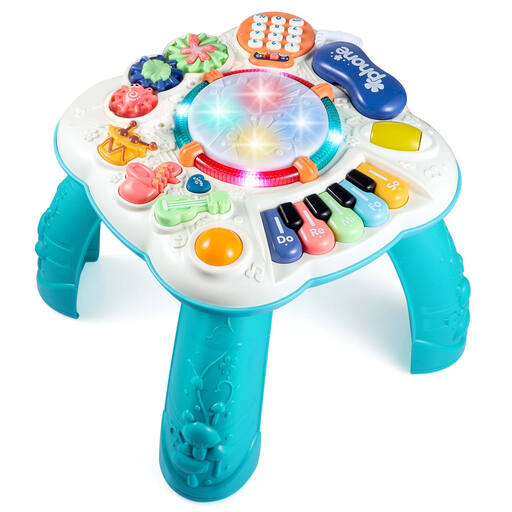
Why this fits the profile: This table is designed for 6 to 36 months and has removable legs. That means it can be used first as a flat play panel and later as a standing table.
The product description mentions a volume knob and silent mode. That makes it easier to adapt to nap times, neighbours or a shared living room.
Six play zones, including a piano keyboard, drum, telephone and spinning gears; ABS plastic and rounded edges are mentioned.
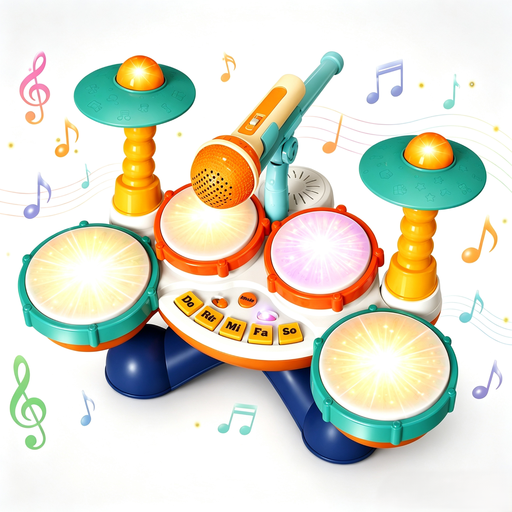
Why this fits the profile: Suitable for families who are mainly after musical interaction and value multiple play modes in one product.
The product description mentions a volume control and a wide base. Still check on arrival that the table stands steadily and that the microphone is used appropriately.
Four illuminated drum pads, two cymbals, a microphone and multiple sound modes; suitable according to the product information for 1 to 4 years.
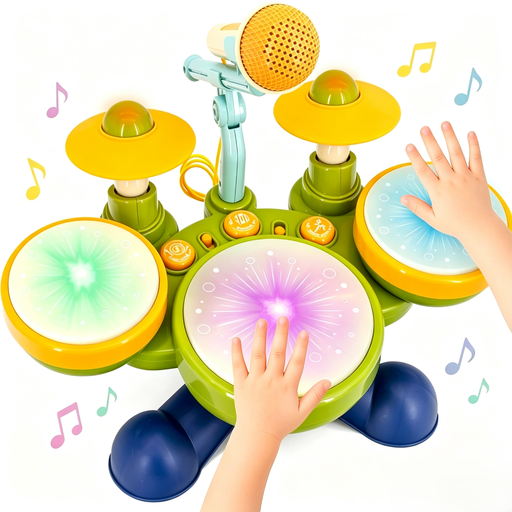
Why this fits the profile: This model suits toddlers who love actively tapping, singing and making rhythms, and parents who want an adjustable setup.
The product information mentions an adjustable drumstick construction, a detachable stand and a volume knob. That means you can adapt the setup to the play area.
Three illuminated drum pads, two cymbals, a working microphone and a four-point base; batteries are not included.
Place an interactive learning table on a flat surface, away from stairs and radiators. Before each use, check that legs, buttons and battery covers are securely fastened. Clean plastic with a slightly damp cloth if the manual allows it, and remove the batteries when the toy won’t be used for a while.
For a toddler birthday gift, it’s wise to compare the age on the packaging with the age of the recipient. A musical baby toy for 6 to 18 months isn’t automatically suitable for a three-year-old, and conversely, small parts from older toys can be unsuitable for younger children.
If you’re mainly looking for fine motor skills toys, you could also consider an activity cube, shape sorter or simple educational toys for toddlers. That way, you avoid paying just for lights and sound.
We’ve put together a full, up-to-date list of products that fully meet these strict selection criteria and current European safety regulations.
That depends on the design. A model with removable legs and a flat play panel can be used from 6 months according to the product information. Use the table on the floor during that stage and supervise. Once your child starts standing, check the stability again.
The lifespan depends on the material, construction and how it’s played with. A table with multiple play positions can stay interesting for longer, but features can wear out and batteries need replacing. Check regularly for damage and stop using the product if parts come loose.
The main ongoing cost is batteries. With the products mentioned, batteries are not included. A volume control doesn’t automatically change battery consumption; the exact usage depends on how long it’s used and the type of batteries. So check the battery requirements on the product page before you order.
