
Vandaag of morgen in huis

Kwaliteit gegarandeerd

Welkomstaanbiedingen ontgrendelen: GRATIS bezorging | Tot 80% korting | Gratis 30 dagen JoyPlus-proefperiode
Download de app
A musical activity table for babies can offer plenty of variety: from piano keys and cogs to lights and sounds. However, not every model is equally practical for a British living room. A table that is too loud, tips over easily, or is mostly just buttons with little obvious play value can quickly end up unused.
So don’t just focus on bright colours and long product descriptions. Instead, pay close attention to age suitability, stability, materials, power source, and how your child actually plays with it.
A product labelled 6-36 months isn’t automatically suitable for every baby from six months old. Younger babies usually play lying down or sitting on the floor. A model with legs is only practical once your child can sit or stand steadily. A detachable base or play board can therefore offer more value than a fixed table.
Music, animal noises and light effects grab attention, but in a flat or during quiet times, a high volume can quickly become annoying. So check whether there is a volume control, on/off switch or silent mode. Also pay attention to the type of batteries required and the fact that batteries are often not included.
A volume knob doesn’t guarantee a specific sound level. Use a low setting and supervise, especially during longer play sessions.
Terms like Montessori, sensory and educational often describe the play setup, but they don’t guarantee a measurable developmental outcome. A spinning cog can engage fine motor skills; your child decides how intensively and in what way they play. So see a table as a supplement to free play and parent-child interaction, not as a replacement for guidance.
Compare the age recommendation with the actual construction:
A compact table around 30 cm high can be suitable for floor use, but the right playing position depends on your child’s height and motor skills.
The product descriptions of various models mention ABS plastic. Some products also state BPA-free material. According to the manufacturer’s product information, the models in question have rounded edges and no loose parts. Always check on delivery that the item matches the description.
The markings CE and EN71 are mentioned in the product information as European safety details. A CE mark is the manufacturer’s declaration of conformity with applicable European regulations; it is not a quality ranking. Keep the packaging and instructions, and check warnings about batteries, small parts and supervision.
A versatile interactive learning table can include piano keys, a drum, spinning cogs, a telephone and instrument buttons. This makes it possible to alternate between:
More features aren’t automatically better. Choose a setup that matches your child’s interests and that you can clean easily.
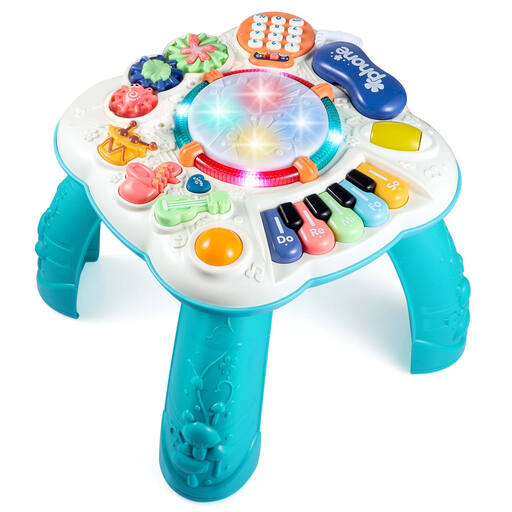
Why this fits the profile: This model combines six play zones in one compact table. Thanks to the detachable base, it can also be used as a flat play board, according to the product description.
The product information mentions a volume control and silent mode. This means you can adjust the sound to suit a living room, flat or quiet time.
According to the product description: ABS, BPA-free, rounded edges, six play zones and suitable for 6-36 months. Batteries are not included.
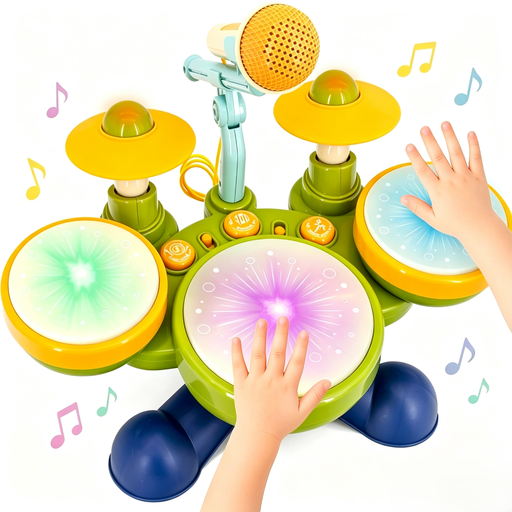
Why this fits the profile: For families looking specifically for musical toys for 1-3 year olds, this drum set offers a clearer music activity with drum pads, cymbals and a microphone.
The product information mentions an adjustable volume knob and a detachable base. This helps with sound management and allows floor use.
According to the product description: ABS, BPA-free, rounded corners, adjustable drumsticks and a base with four support points. Batteries and supervision are points to note.
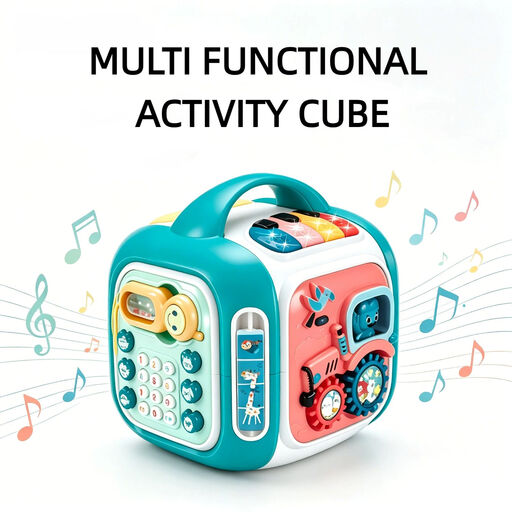
Why this fits the profile: The cube is compact and has a handle. That suits families who want to take sensory toys for their baby or toddler to another room, a restaurant or when visiting.
Thanks to its compact shape, it takes up less floor space than a table. The product description mentions eight play modes, but check before buying which features are relevant for your child.
According to the product description: 23 × 23 × 24 cm, ABS, BPA-free, rounded edges, piano, guitar, telephone and cog functions. Batteries are not included.
We’ve put together a full, up-to-date list of products that fully meet these strict selection criteria and current European safety regulations.
An activity table will generally last longer if you don’t leave it permanently in a busy walkway. Wipe plastic with a slightly damp cloth and avoid getting liquid near buttons, speakers or the battery compartment. Check the base and any screws regularly.
With battery-operated toys, keep these points in mind:
The practical lifespan depends on how intensively it’s played with, the materials and how well it’s maintained. A table with several types of controls can stay interesting when you introduce new ways of playing together, but no product can stop a child from eventually moving on to something else.
That depends on the model and playing position. A flat play board is usually more useful for a younger baby than a tall table. Only use a product from six months according to the instructions provided, and always supervise.
Most models run on disposable batteries; in the product information for the tables mentioned, batteries are not included. The running costs depend on volume, playtime and the number of batteries. A silent mode can help you use the toy only during active times.
Yes, as long as the age recommendation, dimensions and play interests match. For a child who loves making rhythms, a drum table is a good fit; for a toddler who switches between buttons, imaginative play and turning, an interactive learning table can offer more variety. Always check the safety warnings and small parts.
