
Vandaag of morgen in huis

Kwaliteit gegarandeerd

Welkomstaanbiedingen ontgrendelen: GRATIS bezorging | Tot 80% korting | Gratis 30 dagen JoyPlus-proefperiode
Download de app
A musical activity table for babies can provide hours of fun, but not every table suits every stage of development. Some models have lots of buttons but little space for independent discovery. Others are attractively priced but prove difficult to clean, unstable on the floor or reliant on batteries that are not included.
Parents and carers should therefore watch out for these common pitfalls:
An activity table for 6–36 months should grow with your child. For younger babies, a flat play surface is often more convenient during tummy time or seated play. Once a child can pull themselves up and stand steadily, a table with legs becomes more useful.
When looking at the age guidance, pay attention to the difference between:
An age recommendation is not a substitute for supervision. Always check that your child can sit or stand independently and reach the play elements without leaning dangerously.
According to the product description, the musical activity table is made from ABS plastic, BPA-free material is specified and the model has rounded edges. The manufacturer also states that there are no loose parts. Even so, check on arrival that the buttons, flaps and leg attachments are securely fastened.
The product description also mentions CE and EN71 compliance. This is information from the manufacturer or seller and is not a guarantee that every part will remain problem-free in every situation. Keep the instructions, inspect the table regularly and stop using the toy if cracks or loose parts appear.
For everyday use, smooth surfaces without deep seams are practical. Wipe the table clean according to the care instructions and avoid prolonged contact with water or harsh cleaning products.
A musical table is only enjoyable to use when the sounds can be kept under control. According to the product information, this model has volume control and a silent mode. This makes it easier to adjust the sound level to the room, your child’s sleep routine and the tolerance of other household members. The description does not present this as medical protection; use a low volume and stay nearby while your child is playing.
The dimensions are approximately 30 × 30 × 31 cm. Measure the space where you plan to place the table and leave room around the legs. According to the product information, batteries are not included. Check which battery type is required before giving the toy as a gift.
A table with several zones is most useful when each element encourages a different action. This model includes the following zones, among others:
This combination makes it suitable as sensory baby toys, as children can explore sound, colour, movement and touch at the same time. It can also be used as an educational baby toy, as long as “educational” is understood as independent discovery and practising simple cause-and-effect actions. The toy is not a replacement for interaction with a parent or carer.
For a toy for a 1-year-old, large buttons and rotating parts are often easy to understand. A toy for a 2-year-old may also offer engaging imaginative play with the telephone and rhythmic tapping. With a toy for a 3-year-old, interest depends more on the child’s preferred style of play: some children will continue making music, while others may be ready for more complex construction, drawing or sorting toys.
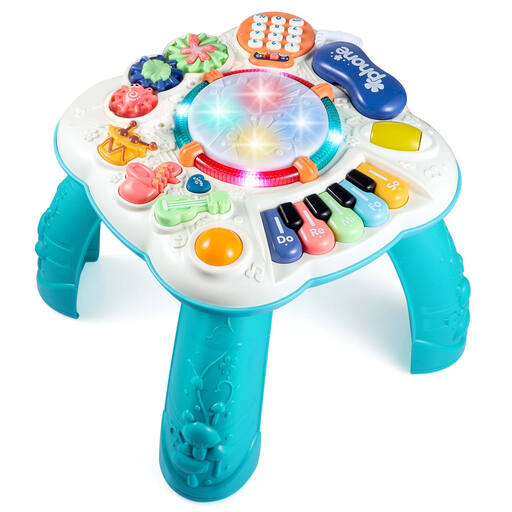
Why it suits this profile: The combination of a play board and removable legs makes this a practical starting choice for families looking for one product that works in several play positions.
The product description lists six play zones and volume control. This means you do not have to rely solely on a long list of features.
Removable legs, six play zones, ABS material according to the description, and batteries not included.
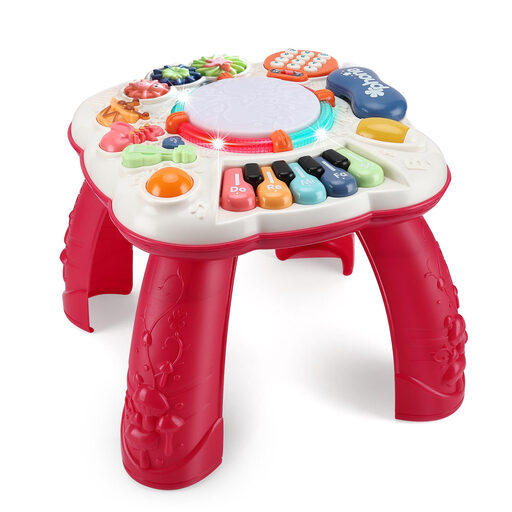
Why it suits this profile: This versatile model is designed for parents who want to combine different types of play in one compact piece of furniture.
The six separate play zones are clearly described: piano, drum, telephone, gears and sound buttons. This keeps development claims linked to observable actions.
Floor and table use, adjustable volume, rounded edges according to the product information, and stated suitability for 6–36 months.

Why it suits this profile: An addition for families who use the musical activity table in a playroom or nursery and also want soft, basic lighting there.
It is not a replacement for the activity table, but it stops you choosing a multifunctional toy for a problem that would be better solved with lighting.
Two lights, automatic light sensor, dimming range of 10–100% and low stated power consumption of 0,3 W per lamp.
We have put together a complete, up-to-date list of products that fully meet these strict selection criteria and the applicable European safety regulations.
Yes, if you know the child’s age and have enough space for play. For a birthday, this type of table may be a good choice for a child who enjoys pressing buttons, making music or moving objects around. As a birthday gift for a toddler, it is particularly practical when the model is not too large and several children can take turns playing.
For a baby aged 6 to 12 months, use the table only in the form and position permitted by the instructions. Once the legs are attached, check that the surface is level and that the table cannot easily slide around. Do not let a child pull themselves up on the table if they are still unsteady on their feet.
Its lifespan depends on the material, how intensively it is used and how well it is maintained. A model with an age recommendation of 6–36 months can support several stages of development, but parts such as buttons, battery covers and legs should be checked regularly. Stop using it if you find cracks, sharp edges or loose parts.
This varies by model and how often your child plays with it. The table discussed here runs on batteries, but according to the product information, these are not included. Use the volume control or silent mode when full sound effects are not needed. This keeps the toy suitable for quieter moments.
No. “Montessori” refers to an educational approach, whereas activity tables are commercial toys. According to the product description, this model is described as Montessori-inspired. Focus instead on the concrete features: can your child turn, tap, press and listen independently? This says more about the toy’s practical play value than the label itself.
