
Workshop host serving individual portions
You heat sauce for participants and want to be able to stir and check each portion as you go.


A freestanding solo microwave is suitable for individual portions of mushroom sauce, as long as your dish fits and you can set the power and cooking time. A larger capacity, flat base or oven function is only relevant if your dish or workshop calls for it. Whichever microwave you choose, stir the sauce part-way through and check it is piping hot throughout.
You heat sauce for participants and want to be able to stir and check each portion as you go.
Different people use the same appliance. You want settings they can easily find and an interior you can clean after spills.
You’d rather use one wide dish than several small portions, so you need to know whether your dish will fit in the microwave.
Start by checking that your bowl fits and that you have enough worktop space. Then compare the controls and settings. Extra oven functions only matter if you need them for other dishes at your workshop.
| What to consider | What should you look for? | Who is this important for? |
|---|---|---|
| Heating evenly and safely | Check that you can set the power and cooking time, and that you can easily take the dish out to stir the sauce part-way through. | I want to stir and check every portion before serving it. Around 36% of consumers prioritise even, safe heating. |
| Speed when heating portions one after another | Compare the controls and stated power, bearing in mind that portion size and stirring part-way through also affect heating. | When participants need sauce one after another, I want to be able to set the time and power easily. Around 29% of consumers prioritise speed when heating successive portions. |
| Fit for your bowl and workspace | Measure your bowl, including the handles, and compare it with the turntable or usable interior space. Measure the space where you plan to put the microwave too. | I want to use my own bowl without it touching the sides or failing to fit on the turntable. Around 21% of consumers focus on whether their bowl and workspace are a good fit. |
| Controls and cleaning | Take a look at the control panel and read the cleaning instructions for the exact model. | When the microwave is shared, I want participants to recognise the settings and to be able to clean up any spilled sauce. Around 14% of consumers make controls and cleaning their top priority. |
According to the Netherlands Nutrition Centre, parts of food can remain cold when heated in a microwave, even if the appliance has a turntable.
Choose a dish that’s easy to take out, stir the sauce part-way through and check the whole portion before serving.
The capacity in litres alone won’t tell you whether your bowl will fit or turn freely on the turntable.
Measure your dish and compare its dimensions with the turntable or usable interior space. Check the appliance’s external dimensions too.
If your bowl doesn’t fit, you may need a different dish or have to heat the sauce in extra batches.
A solo microwave heats food, while a combi microwave adds functions such as baking and grilling. These extra features aren’t necessary if you’re only using the appliance for sauce.
Choose a combi model if you also want to bake or grill during the workshop, and bear in mind how much worktop space you have available.
These models illustrate different options for controls, interior space and placement. The features listed apply to the models shown, not to every product from each brand.
The freestanding solo SMV720 is an example of a model with dial controls and a turntable for simple heating tasks.
The solo MN207S is a freestanding model with a digital timer.
The solo MW 7761 has a flat base instead of a turntable.
The solo MS23K3513AS/EN is an example of a model with a stated capacity of 23 litres, according to Samsung.
This product selection focuses on a freestanding solo microwave with adjustable power levels for heating individual portions of sauce at a workshop.
 No image available
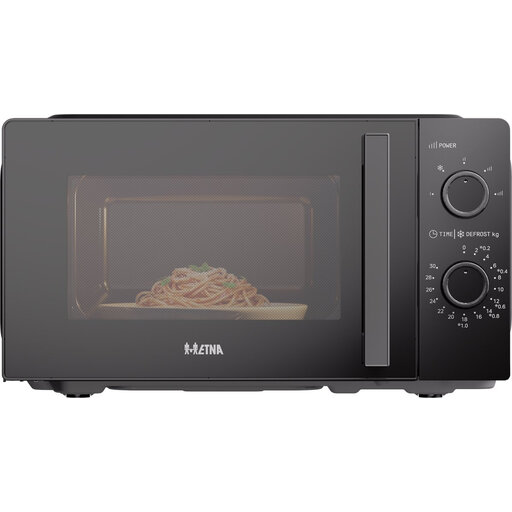
The adjustable power levels are handy for heating individual portions. Stir the sauce part-way through and check it’s piping hot throughout. ETNA lists dial controls and a 24.5 cm glass turntable. Measure your bowl to check that it will fit.
Stir the sauce while heating it and check that the whole portion is piping hot before serving. According to the Netherlands Nutrition Centre, stirring is important even when using a microwave with a turntable.
Check that the dish and any cover are suitable for microwave use. The Netherlands Nutrition Centre lists glass, glazed earthenware and porcelain as suitable materials, and explains that a microwave-safe symbol on tableware indicates that it’s suitable. Also compare the dish’s dimensions with the usable space inside the appliance.
If you prepare or sell food as a business, the NVWA says you must follow a HACCP food safety plan or an applicable approved hygiene code. For reheating food in a business setting, the NVWA specifies a temperature of 60 °C or higher. Whether this applies to your workshop depends on how it’s organised and what activities you carry out.
For a consumer purchase in the Netherlands, you’re entitled to a product that works properly, according to the Government of the Netherlands. There’s no fixed statutory warranty period, and the retailer is your point of contact if there’s a problem. Also check the terms of any manufacturer’s warranty and whether it covers business use during a workshop.
Measure the space where you plan to put the appliance and check that the socket is within reach of the cable. Follow the model’s instructions when cleaning it. For the MW 7761 specifically, Severin describes a flat base that can be wiped clean with a cloth.