
Vandaag of morgen in huis

Kwaliteit gegarandeerd

Welkomstaanbiedingen ontgrendelen: GRATIS bezorging | Tot 80% korting | Gratis 30 dagen JoyPlus-proefperiode
Download de app
A multistyler for hair can dry, straighten, curl and add volume with a single device. That sounds convenient, but not every hair styler with attachments suits every hair type or routine. Some models are designed primarily for damp hair, while others may only be used on completely dry hair. Marketing claims about ions, automatic curling and “protection” can also present an incomplete picture.
As a Joybuy Product Recommendation Officer, I filter the most important product specifications so you can compare more effectively and avoid paying for features you are unlikely to use.
A set with five or seven accessories may seem appealing. However, a diffuser, volumising brush or automatic curling attachment is of little use if you mainly want to dry and straighten your hair. So do not focus solely on the number of attachments. Consider what each one is designed to do:
An airwrap hair styler is generally most worthwhile if you want to create multiple looks. For one specific styling task, a dedicated straightener, curling brush or straightening comb may be more practical.
An ionic hair styler may, according to the product description, help reduce static electricity and frizz during styling. However, this does not mean the device cannot cause damage. Heat, taking sections that are too small and holding the device in one place for too long can still put stress on the hair.
Claims about smoother, shinier or frizz-free hair should be viewed as product claims. According to a brand’s own research or the manufacturer’s description, ions may contribute to a particular styling experience; the result varies depending on hair structure, temperature and technique.
A high setting can be useful for thick hair, but for fine, bleached or dry hair, a lower temperature is often the more sensible starting point. Check the following:
An automatic curling iron that uses airflow works differently from a traditional curling iron with a hot metal surface. So compare not only the product name, but also how the hair is shaped.
Not every multistyler is a hair dryer. For example, the Wavytalk Thermal Brush states that it is not intended to function as a blow-dry brush and should only be used on dry hair. According to the included instructions, the Philips AirStyler 5000 Series is suitable for towel-dried or dry hair. The Dyson HS02 Airwrap Origin is designed for damp hair, according to the product information.
This distinction determines how much time you need and whether you will still require a separate hair dryer.
A ceramic hair styler may distribute heat more evenly across a surface, depending on its construction and how it is used. Check the material and temperature settings in the product specifications. The Philips BHA530/00 has three heat settings, a cool-air setting and a dedicated Care setting. The Wavytalk Thermal Brush has five settings ranging from 150 to 215°C.
Always use the lowest setting that delivers the result you want. Allow your hair to dry completely when the instructions require it, and use a heat-protective product if it suits your hair-care routine.
A heavy device can become awkward to handle when styling long hair or creating more elaborate looks. Also pay attention to a 360° swivel cord, the cord length and how the filters are cleaned. On models that use airflow, a blocked air intake can affect both performance and safety.
Also check:
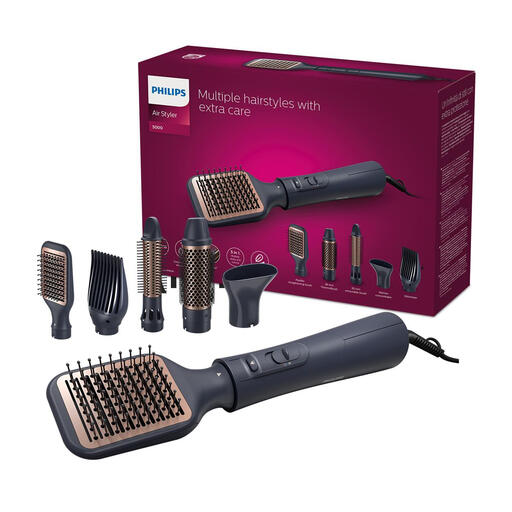
Why it suits this profile: A practical choice for anyone who wants to dry, smooth and add volume at home without needing several separate devices.
The functions are clearly specified: five attachments, three heat settings, a Care setting and a cool-air setting. This makes it easier to check whether the set matches your routine.
1000 W of power, a ceramic coating, a 2-metre swivel cord and attachments for straight hair, volume and waves.
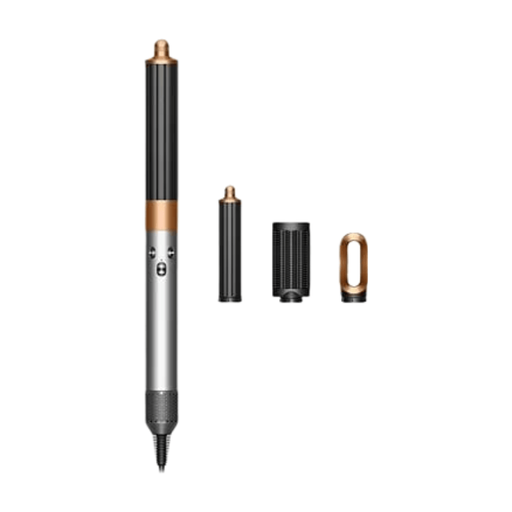
Why it suits this profile: For users who primarily want to dry and curl their hair using airflow and value a lightweight, compact device.
The set offers three heat settings, three speed settings and a cold shot. The product specification also lists a maximum temperature of 150°C; always check the usage instructions.
1300 W, 0.58 kg, a 40 mm curling attachment, styling brush and drying attachment. According to the manufacturer, the model uses Coanda airflow.

Why it suits this profile: Suitable for households where different users want to dry, straighten, curl or add volume to their hair.
The product specification lists nine combinations of temperature and power. This provides more flexibility than a model with only one or two settings.
The set combines a hair dryer, straightening brush, curling iron, volumiser and styling nozzle. The manufacturer also lists a 360° swivel cord and overheating protection.
Start with detangled hair and divide it into small sections. When using a blow-dry brush, work steadily from the roots towards the ends. For added volume, hold the brush briefly at the roots; do not keep the device in the same spot for an extended period.
Use an automatic curling iron according to the instructions and avoid taking sections that are too thick. Allow a formed curl to cool before brushing it out. A straightener or straightening comb should generally be used on completely dry hair. Before buying, check whether the selected temperature is suitable for your hair type.
Also browse the full selection of hair care, styling and hair polishers if you want to compare different devices and accessories side by side.
We have put together an up-to-date selection of products that meet these practical selection criteria and the applicable EU safety information.
That depends on the model, the temperature and the condition of your hair. Choose a device with multiple heat settings and use the lowest effective setting. Always follow the instructions and avoid holding the device in one place on a single section of hair.
Not always. A model with a drying attachment, such as some airwrap hair stylers, can partially or fully dry damp hair. A thermal curling brush, on the other hand, is not a hair dryer and only works on dry hair. Check this before buying.
Energy consumption depends on the wattage and how long the device is used. A 1,000 W device running for ten minutes theoretically uses around 0.167 kWh. In practice, warm-up time, settings and the actual operating time also play a role. A lower wattage does not automatically mean lower overall costs if you need to spend longer styling.
